Taiwan's Drone Integration Signals a Shift in Regional Capability
The recent joint missile live-fire drills, featuring uncrewed aerial systems, indicate an evolving defense posture with implications for Asia-Pacific stability.
SINGAPORE
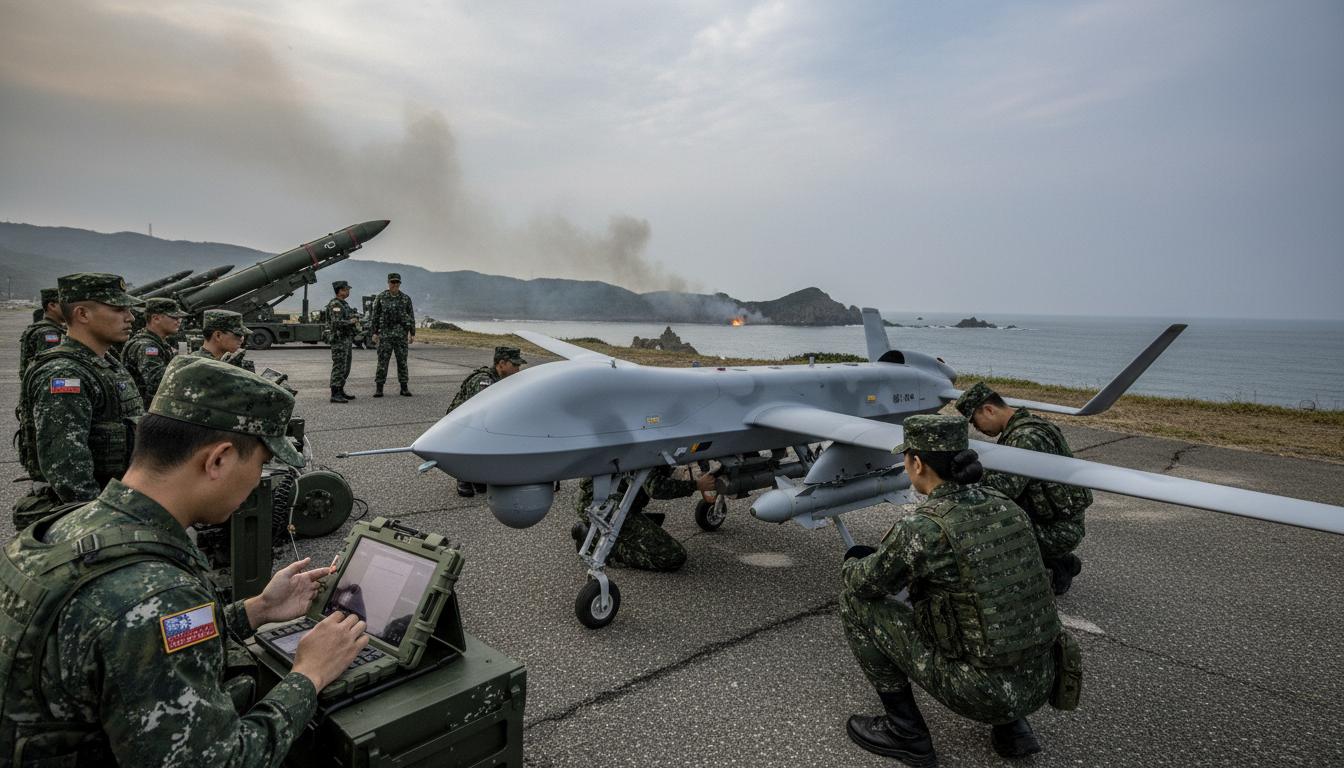
The inspection of joint precision missile live-fire drills by President William Lai at the Jioupeng Base in Pingtung County, with their inclusion of multiple types of attack drones for the first time, marks a tangible shift in military capability within the Asia-Pacific. The three-day drills, which concluded, incorporated indigenous Hsiung Feng III anti-ship missile systems, Tien Kung III surface-to-air missile systems, and US M142 High Mobility Artillery Rocket Systems.
Historically, Taiwan's defense strategy has relied on a combination of asymmetric capabilities and advanced weaponry, often procured from external partners. The coordinated use of uncrewed vehicles, as highlighted by President Lai, represents a new phase. This integration reflects a doctrinal evolution, moving beyond traditional platforms to embrace networked, unmanned systems for combat exercises. The significance lies not merely in the presence of drones, but in their joint combat application alongside conventional missile systems. This development suggests an emphasis on enhancing situational awareness, targeting precision, and potentially, force multiplication in a contested environment.
The broader regional context frequently sees military exercises as demonstrations of resolve or as responses to perceived threats. Examples include North Korea's missile firings in March 2026, coinciding with US and South Korea military drills, and combined drills conducted by S. Korean and U.S. Army troops in California in March 2026. The Talisman Sabre joint military drills in August 2025 also featured various 'firsts'. While these events highlight the ongoing tempo of military readiness across the region, Taiwan's specific integration of drones into joint missile drills signals a strategic adaptation rather than a mere escalation of existing practices.
An alternative interpretation might suggest that these drills are primarily a political statement, aimed at bolstering domestic confidence or signaling intent to external actors without fundamentally altering the strategic balance. Indeed, the footage released by the Presidential Office could be seen as an intentional projection. However, the technical details reported – the specific mention of ‘multiple types of attack drones’ and their ‘joint combat exercises’ – point to an operational enhancement. The integration of uncrewed systems into complex live-fire scenarios requires significant investment in training, command-and-control infrastructure, and interoperability protocols. This is a material change in defensive architecture, not solely a declarative one.
The enduring challenge for Taiwan remains the scale and sophistication of potential adversaries. While the new capabilities enhance defense, they operate within a geopolitical environment characterized by persistent military modernization by major powers. The integration of drones offers an immediate tactical advantage by expanding reconnaissance and strike options. Yet, the long-term effectiveness of such advancements will hinge on continuous development, integration, and the ability to counter evolving countermeasures. The shift is discernible, but the strategic landscape retains its inherent complexities.
Sources
Newsletter
Pacific Daily
A curated briefing from Thailand, Asia-Pacific and the world.