The Standard Behind the Chair
At Bobby Barber, the perfect haircut begins not with clippers, but with observation — of the face, the profession, the lifestyle and the person who must live with the result.
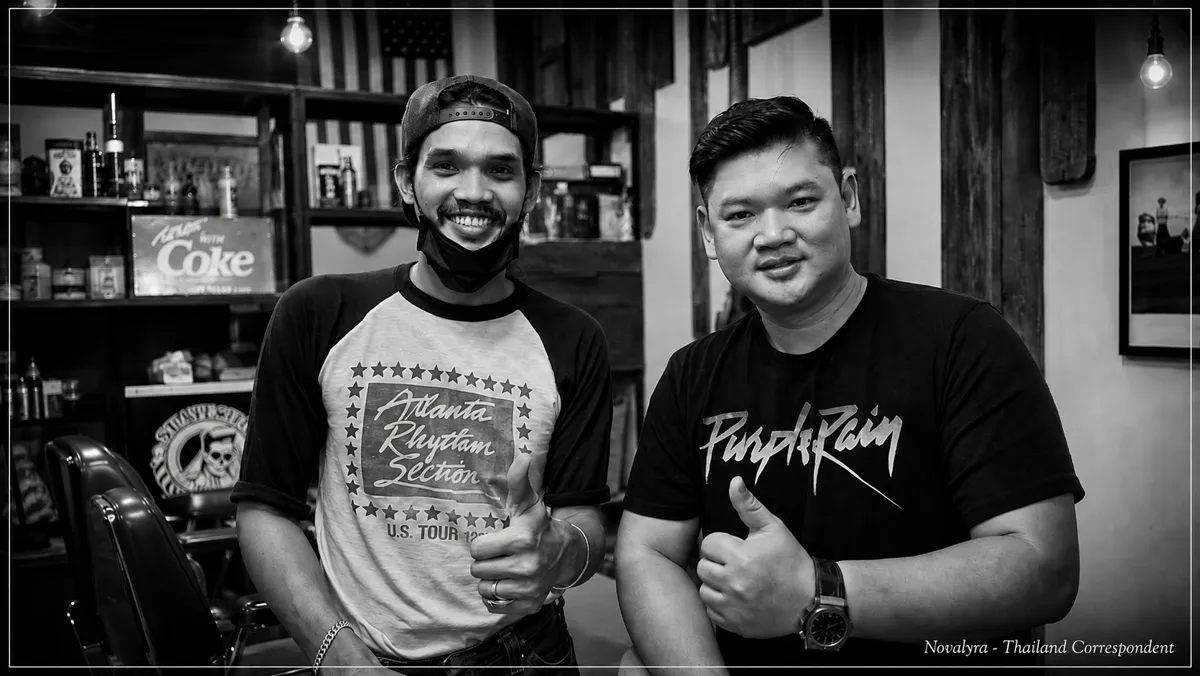
BANGKOK
At Bobby Barber, a haircut begins long before the first cut — with observation, discipline and the quiet art of understanding the person in the chair.
There is a moment in every good barbershop when the work stops being about hair.
The mirror is still there. The scissors are still moving. The clippers still hum against the quiet rhythm of the room. But somewhere between the first consultation and the final line of the cut, something more complicated is taking place: a negotiation between how a person looks, how they live and how they want to be seen.
At Bobby Barber, that distinction sits at the heart of the craft.
For Bobby, barbering is not the mechanical act of shortening hair into a fashionable shape. It is an exercise in reading people — their profession, their habits, their personal style, the architecture of their face, the behaviour of their hair and, perhaps most importantly, the image they want to carry back into the world when they leave the chair.
That philosophy may sound simple. In practice, it demands discipline. And discipline, Bobby believes, is where professionalism begins.
A Career Built by Returning Home
Bobby did not arrive at barbering through a perfectly mapped-out career path.
Part of his life was spent in Malaysia. Eventually, the instinct to return home became stronger than the attraction of remaining elsewhere. Coming back meant beginning again — reconsidering where life was headed and choosing a profession that could be built patiently over time. Barbering became that direction.
What could easily have remained a practical career decision gradually became a craft.
Barbering itself is a profession of small decisions that accumulate into a whole: a millimetre here, a line softened there, weight removed from one area and deliberately preserved in another. Rarely does one dramatic movement determine the final result. Quality emerges from a succession of disciplined choices.
A career can be much the same. Bobby’s return home was not merely a geographical move. It became the point at which direction turned into commitment.
Barbering is an industry where technical talent can be immediately visible. A clean fade photographs well. Sharp lines perform beautifully on social media. A dramatic transformation can generate attention within seconds.
But Bobby makes a more demanding distinction between performing well once and being dependable repeatedly. Skill matters; consistency matters more.
“Improving your skills is important, but the real challenge is maintaining your standard every day.”
That idea — maintaining the standard — runs through almost every part of his professional philosophy.
For Bobby, discipline means arriving prepared and respecting time. It means continuing to notice details even after the movements of the job have become familiar, and refusing to let yesterday’s good work become an excuse for today’s carelessness.
A customer rarely experiences a business through its best-ever day. They experience it through the day they happen to walk through the door. That is why consistency becomes reputation.
Before deciding what should be cut, Bobby studies what is already there: the face, the shape of the head, hair density, texture, growth pattern and the natural movement of the hair.
But the technical analysis is only the beginning. He also watches the person.
How do they dress? What kind of work do they do? How formal is their environment? How much time are they realistically willing to spend styling their hair in the morning?
The logic is precise: a haircut does not live in the barber’s chair. It lives at work on Monday morning and after the first shower. It lives in humidity, under a helmet, during a long day, at dinner, in a meeting, in a photograph and in all the unremarkable hours during which nobody is standing beside the client with a brush and styling product.
A haircut that looks exceptional for ten minutes but becomes impractical the next morning is not, by Bobby’s definition, an exceptional haircut. That is where observation turns technique into judgement.
Modern beauty culture creates an endless library of references. A client can enter a barbershop carrying screenshots from Instagram, TikTok, celebrities, athletes and fashion campaigns.
But photographs can be deceptive. A haircut belongs not only to a style, but to a skull shape, a hairline, a density, a texture and a personality.
Bobby therefore resists the logic of copying. Instead, he customizes.
He considers facial proportions and head shape; the type and natural growth of the hair; the client’s occupation, routine and maintenance preferences; and the personal image that individual wants to communicate.
A corporate professional may need precision without theatricality. Someone in a creative industry may want more movement or experimentation. Another client may value a haircut that still looks controlled even with almost no styling at all.
The technique may be similar. The reasoning cannot be. That is the difference between reproducing a haircut and designing one for a person.
There is another discipline Bobby treats with equal seriousness: listening. A barber can possess excellent visual judgement and still misunderstand the customer.
Some clients know exactly what they want. Others arrive speaking indirectly: “I want to look cleaner.” “More professional.” “Not too short.” “Something different.” “I want to look younger.”
These are not technical instructions. They are intentions. The responsibility of the barber is to understand the intention before reaching for the tools.
Bobby’s approach is therefore collaborative rather than authoritarian. Professional expertise matters, but it should not erase the client’s voice. The best result emerges when the barber’s judgement and the customer’s expectations meet somewhere intelligent in the middle.
In service businesses, expertise should guide. It should not dominate.
The Real Product Is Confidence
Hair is superficial only if we misunderstand what appearance does.
People enter rooms differently when they feel well presented. They speak and stand differently. Sometimes the transformation is subtle enough that nobody else can identify precisely what changed — yet the person wearing it can.
Bobby sees that psychological shift as part of the reward of his profession. A successful haircut can alter the way someone carries themselves because the external image suddenly feels more aligned with the internal one.
That is why the best barbering rarely tries to turn someone into another person. It makes the existing person look more resolved, more deliberate and more themselves.
There is a measurable difference between attracting a customer and keeping one. The first can be achieved through promotion. The second requires trust.
When clients return repeatedly to the same barber, the relationship becomes increasingly precise. Preferences no longer need to be explained from zero. The barber begins to understand how much experimentation the client accepts, what works in their profession, where previous cuts succeeded and how the hair behaves several weeks after leaving the shop.
Technique creates the first result. Memory, listening and consistency build the relationship.
For Bobby, that is why craftsmanship and service cannot truly be separated. A loyal client is not simply returning to a pair of scissors. They are returning to the expectation of being understood.
Ask Bobby what the next generation of barbers should learn and the answer does not revolve around celebrity, virality or shortcuts. His advice is to practice, observe, listen, be patient, learn from mistakes and respect the customer. And once people begin to trust the quality of your work, protect that trust.
“Keep learning, keep improving, and never stop maintaining your standard.”
It may be the least fashionable advice in an industry increasingly shaped by trends. It may also be the most durable.
Trends generate visibility. Talent generates opportunity. But reputation is produced differently. Reputation is repetition: the difficult discipline of being good again tomorrow, and the day after that.
At Bobby Barber, the cut is only the visible part. Behind it is observation; behind observation is listening; behind listening is judgement. And behind all of them is a standard that has to be rebuilt every day.
That may be the clearest explanation of Bobby Barber’s philosophy: the customer is not a canvas for the barber’s ego. The haircut must belong to the person who will actually wear it.
The technical work ends when the cape comes off. The real test begins when the client walks outside.
Bobby’s philosophy can be reduced to one line that extends beyond barbering itself:
STANDARD IS NOT A MOMENT. IT IS A HABIT.
Bobby Barber — Sponsored Feature / Paid Partnership
Written by Novalyra — Thailand Correspondent, Pacific Press Asia
Find Bobby Barber on Google Maps → https://maps.app.goo.gl/gkWRDgi8DK8c4SJ46
Newsletter
Pacific Daily
A curated briefing from Thailand, Asia-Pacific and the world.