The Canine-AI Partnership: A Diagnostic Frontier or a Symptom of Deeper Needs?
While new technologies promise early cancer detection, fundamental questions about access and application persist.
SINGAPORE
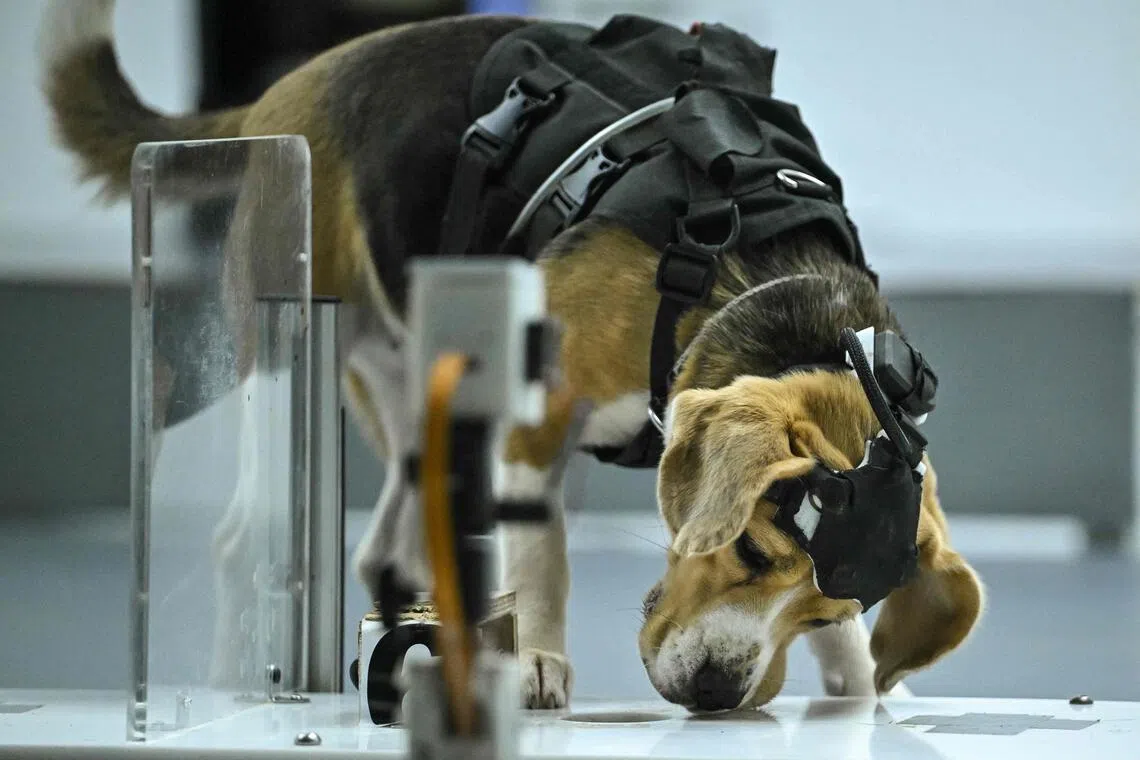
The intersection of biological intuition and artificial intelligence presents a curious tension. Recent reports highlight ventures like Dognosis in Bengaluru, employing specially trained dogs equipped with sensor-packed helmets to detect cancer from human breath. This fusion of ancient instinct and modern computation aims for over 90 percent accuracy in early screening by 2027, with a stated goal of affordability. Simultaneously, other AI models, such as one open-sourced by Alibaba, claim the ability to detect cancer and nearly 150 other conditions, while Chinese scientists have developed handheld detection devices. These developments suggest a future where early disease detection might become more widespread and less invasive.
Yet, the very innovation that excites also reveals underlying disparities. While a company in India pursues a high-tech solution to cancer detection, India itself faces a high cancer risk, a fact that underscores the urgency for early detection methods. The enthusiasm for sophisticated diagnostic tools, whether canine-assisted AI or advanced algorithms, sidesteps a more fundamental question: what happens after detection? For a significant portion of the population in the Asia-Pacific, even if a diagnosis becomes accessible and affordable, the subsequent steps—treatment, long-term care, and financial burden—remain formidable barriers. The promise of detection is hollow without the infrastructure to act upon it effectively and equitably.
The historical context of medical innovation often shows a trajectory from exclusive to accessible, yet this process is rarely linear or guaranteed. The current focus on diagnostic accuracy, while scientifically compelling, can inadvertently overshadow the broader societal challenges of public health. Consider the anecdotal accounts of dogs detecting their owners' cancers, which, while deeply personal, do not scale to a public health framework. The scientific community, as noted in assessments of Dognosis, calls for larger trials, a standard scientific caution that tempers enthusiasm with the necessity of rigorous validation. This is not merely about proving efficacy, but about understanding how such technologies integrate into existing healthcare systems, particularly in regions with diverse economic and healthcare landscapes.
The drive for early detection is undeniably vital. However, the narrative often implies that the solution lies solely in improved diagnostic capability. The actual impact of such advancements depends not just on precision, but on a more comprehensive societal commitment to health equity. The ability to identify disease earlier, without a corresponding ability to treat it effectively for all who need it, risks creating a new form of disparity: the knowledge of illness without the means to address it. The tension, then, is not between dogs and AI, but between technological potential and societal readiness.
Sources
Newsletter
Pacific Daily
A curated briefing from Thailand, Asia-Pacific and the world.