Beyond the Canvas: How Tokyo’s teamLab Borderless Is Redefining the Museum Experience
TOKYO
With four million visitors, an international audience and an ambitious new exploration of light and perception, Tokyo's teamLab Borderless is challenging the boundaries between art, technology and human experience. But as immersive exhibitions become a global cultural phenomenon, a larger question emerges: when the viewer becomes part of the artwork, where does artistic value truly reside?
TOKYO, JAPAN — October 9, 2026
For centuries, the relationship between art and its audience has been built around a relatively simple arrangement: the artwork occupies a defined space, and the viewer approaches it.
Paintings hang on walls. Sculptures stand on pedestals. Museum visitors move from one object to another, observing works that generally remain unchanged by their presence.
At teamLab Borderless in Tokyo, that arrangement no longer applies.
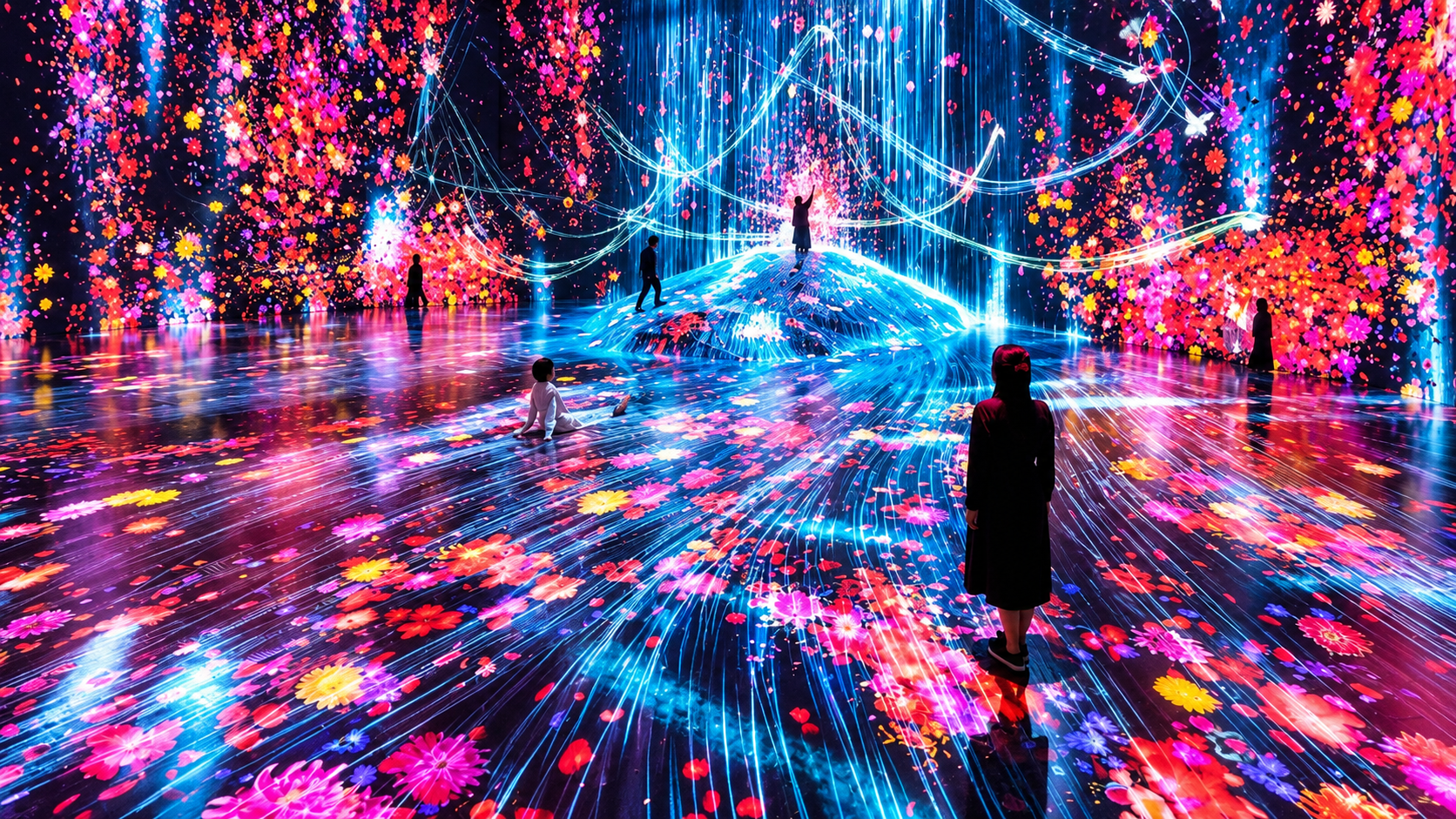
Light travels across walls and floors. Digital landscapes transform as visitors move through them. Images migrate between spaces, while the distinction between an artwork and its surroundings becomes increasingly difficult to identify.
The result is neither a conventional gallery nor simply a technological attraction. It is an attempt to reconsider how art can exist when physical boundaries, fixed viewpoints and passive observation are no longer treated as essential.
For Japan's contemporary cultural landscape, the implications extend far beyond the popularity of a single museum.
A Museum That Refuses to Stand Still
Located at Azabudai Hills in central Tokyo, teamLab Borderless reopened at its current permanent location in February 2024.
Developed by the Japanese interdisciplinary art collective teamLab in collaboration with Mori Building, the museum is organised around an unusual proposition: artworks need not remain confined to individual rooms.
Instead, digital installations interact with their environments, overlap with other works and sometimes respond to the behaviour of visitors.
The museum deliberately avoids providing conventional exhibition maps. Rather than following a prescribed route, visitors explore a changing environment in which discovery becomes part of the artistic experience.
This approach alters the fundamental relationship between the visitor and the exhibition.
A traditional museum generally asks viewers to interpret works that already exist in front of them. At Borderless, their movement and presence can influence what appears next.
The distinction is important because it moves the audience from the margins of the artistic experience towards its centre.
Yet participation does not necessarily make visitors artists. The environments are still governed by concepts, software and interaction rules designed by their creators.
What changes is the extent to which the final experience depends on the relationship between those systems and the people moving through them.
Four Million Visitors and the International Appeal of Immersive Art
The scale of teamLab Borderless's success became particularly apparent in August 2026.
According to figures announced by Mori Building, the museum surpassed four million visitors on July 31, approximately two and a half years after reopening at Azabudai Hills.
Around 70% of visitors were international travellers, representing more than 185 countries and regions.
These figures demonstrate the museum's extraordinary ability to attract a global audience.
They also raise an important question about contemporary cultural tourism.
Why are visitors increasingly willing to travel considerable distances for experiences that cannot be understood through photographs alone?
Part of the answer lies in the distinction between viewing an image and occupying an environment.
A photograph can reproduce the appearance of an installation, but it cannot fully communicate scale, bodily movement or the sensation of being surrounded by constantly changing light.
Immersive art therefore offers something particularly valuable within a digitally saturated culture: an experience that remains meaningfully different from its reproduction.
At the same time, visitor numbers should not be confused with a definitive measure of artistic achievement.
Commercial popularity establishes cultural reach. It does not, by itself, resolve questions about artistic depth, originality or long-term significance.
Borderless deserves attention not simply because millions have visited it, but because its popularity reflects a wider transformation in what audiences increasingly expect from museums.
The 2026 Exhibition That Questioned Reality Itself
That transformation gained a new dimension in July 2026 when teamLab reopened its *Light Sculpture – Flow* space and introduced the special exhibition *On the Asymmetry of the Universe*.
Presented from July 8 to October 8, the exhibition featured two new artistic series, *Asymmetric Existence* and *Chromatic Existence*.
The first challenged a familiar assumption about mirrors.
Ordinarily, a reflection corresponds to an object occupying physical space. In teamLab's conceptual framework, however, a light sculpture could appear in the physical environment without appearing in the mirror, while another could exist only within the reflected image.
The relationship between an object and its apparent reflection was deliberately disrupted.
The second series approached the problem through colour.
In *Chromatic Existence*, flowing colour and light produce the perception of sculptural form without requiring a conventional solid object or material boundary.
These investigations raise questions about how human beings identify form, substance and spatial relationships.
A sculpture has traditionally been understood as something occupying physical volume. But if the human eye perceives an organised arrangement of light as a distinct presence, is material solidity necessary for sculpture to exist?
The exhibition's central contribution was not merely the technological manipulation of light.
It was the suggestion that perception itself may provide the conditions under which an artwork acquires form.
With the special exhibition's scheduled run concluding on October 8, its conceptual questions remain central to understanding Borderless's artistic ambition.
When the Audience Becomes Part of the Artwork
One of the most consequential ideas behind immersive digital art is that visitors can influence an artwork without controlling it completely.
At teamLab Borderless, installations such as *Infinite Crystal World* explore changing relationships between light, space and audience participation.
The museum's dedicated application also allows visitors to interact with selected works, adding another layer to the relationship between human action and programmed environments.
Such experiences challenge the assumption that an artwork must have one stable appearance.
Instead, artistic expression can become a sequence of possibilities generated within a system.
The underlying concept is familiar in contemporary art, where participation, performance and installation have long questioned the separation between artist and audience.
Digital technology, however, expands the range and complexity of those interactions.
Software can translate movement, timing and proximity into changes that occur across an entire environment.
This makes the spectator's presence relevant to the work itself.
Nevertheless, an important distinction remains.
The visitor may influence the experience, but the artist determines the framework within which those influences operate.
Audience participation should therefore be understood as a form of interaction rather than unrestricted creative authorship.
Recognising that difference is essential to evaluating immersive art critically.
Art in the Age of Smartphones
There is an apparent contradiction at the centre of the contemporary immersive museum.
Its appeal often depends on providing experiences that cannot be adequately reproduced on a screen.
Yet social media has become one of the most effective ways of communicating that appeal.
Illuminated rooms, endless reflections and dramatic digital environments lend themselves naturally to photography and short-form video.
Borderless permits personal photography and social media sharing, subject to restrictions intended to protect visitors and the installations.
This creates a relationship between artistic experience and digital circulation.
Images shared online can introduce new audiences to the museum, while the expectation of producing memorable photographs may influence how some visitors engage with the work.
Neither outcome is inherently negative.
Photography can encourage curiosity and extend access to audiences who might otherwise never encounter an exhibition.
The difficulty emerges when the production of images begins to compete with the experience they are supposed to document.
A visitor concentrating on capturing the perfect photograph may pay less attention to an installation's development over time, its conceptual structure or the relationships between its different elements.
This tension is not unique to teamLab. It reflects a broader challenge facing museums, galleries and cultural institutions.
The question is whether visual spectacle can serve as an entry point to deeper artistic engagement rather than becoming the entire purpose of the visit.
The Commercial Value of Wonder
Borderless also occupies a revealing position within Tokyo's urban economy.
Its permanent home is part of Azabudai Hills, a major mixed-use development that brings together commercial facilities, residences, offices and cultural attractions.
Within such developments, museums can perform functions extending beyond the presentation of art.
They attract visitors, strengthen the identity of a district and contribute to the wider appeal of surrounding businesses.
This relationship between culture and urban development is not new. Major museums have long influenced tourism, property values and the reputations of cities.
What distinguishes contemporary immersive attractions is their capacity to combine artistic programming with the commercial characteristics of destination experiences.
Tickets, international tourism, digital visibility and repeat visitation all contribute to the operating environment in which the institution exists.
The challenge is to ensure that commercial success does not become the primary standard by which artistic decisions are evaluated.
Popular exhibitions can be intellectually ambitious. Equally, technically sophisticated experiences can lack conceptual substance.
The two possibilities are not mutually exclusive.
Borderless is most interesting when approached through this tension rather than being classified either as a technological masterpiece or an elaborate tourist attraction.
Its commercial reach is significant, but its lasting cultural value will depend on the ideas and experiences that remain meaningful beyond the immediate excitement of the spectacle.
What Traditional Museums Still Offer
The emergence of immersive digital art does not make conventional museums obsolete.
Historical collections, original paintings, archaeological objects and material artworks provide forms of knowledge that cannot be replaced by projected environments.
Their physical characteristics, provenance and relationships to historical circumstances remain essential to their interpretation.
A centuries-old painting carries evidence of its creation, preservation and passage through time.
A digital installation operates according to a different set of artistic and technological conditions.
Both can produce meaningful encounters, but they should not be expected to fulfil identical purposes.
The more productive question is therefore not whether immersive art will replace traditional museums.
It is how different institutions might expand the possibilities of cultural engagement without reducing the diversity of artistic practice.
Borderless suggests that museums can encourage exploration rather than prescribe it, and that the experience of art can involve the entire body rather than vision alone.
Traditional museums, meanwhile, continue to demonstrate the importance of historical context, material authenticity and sustained interpretation.
The future of museum culture may be stronger for accommodating both approaches.
The Future of Art Is Not Simply More Technology
As immersive exhibitions gain international recognition, technological sophistication is likely to become increasingly accessible.
Projection systems, interactive software and responsive environments may eventually be familiar features of cultural institutions around the world.
When that happens, technology alone will no longer provide sufficient distinction.
The value of an exhibition will depend more heavily on the strength of its artistic ideas, the originality of its interpretation and the quality of the experience it creates.
This is where teamLab Borderless faces its most consequential challenge.
Its ability to astonish audiences is already evident from its international reach. Whether its approach continues to generate new artistic questions will determine its longer-term importance.
The 2026 investigation into symmetry, perception and immaterial sculpture offers a compelling example of how technological media can serve conceptual inquiry.
For museums considering similar approaches, the lesson should not be to reproduce an environment filled with light.
It should be to identify what those environments allow audiences to understand, question or experience differently.
Beyond the Canvas
Perhaps the most significant achievement of teamLab Borderless is not that it has eliminated the conventional boundaries of the museum.
It is that it has made those boundaries visible as choices rather than necessities.
A work of art does not always have to remain still. An audience does not always have to remain passive. A museum does not always need to organise experience around objects that can be separated from their surroundings.
Yet the fundamental purpose of art remains open to debate.
Technology can reshape the conditions of perception, but spectacle alone cannot guarantee insight.
The enduring question is not how convincingly an exhibition can surround its visitors with an alternative world.
It is whether they leave that world seeing their own differently.
---
Visiting teamLab Borderless in Tokyo
Museum: teamLab Borderless: MORI Building DIGITAL ART MUSEUM
Location: Azabudai Hills Garden Plaza B, Basement 1, 5-9 Toranomon, Minato-ku, Tokyo, Japan
Opening hours: Generally 8:30 a.m.–9:00 p.m., with selected extended hours and closures. Last entry is one hour before closing.
Admission: Advance booking is recommended. Adult admission starts at ¥3,400, with dynamic pricing applying to selected ticket categories.
Transport: Approximately two minutes on foot from Kamiyacho Station, Exit 5, or six minutes from Roppongi-Itchome Station, Exit 4.
Official website: https://www.teamlab.art/e/tokyo/
Google Maps: https://shorturl.at/n9FAr
Newsletter
Pacific Daily
A curated briefing from Thailand, Asia-Pacific and the world.