The Spectacle of Disagreement: A Journalist's Encounter on Capitol Hill
An incident on Capitol Hill, though satirical, illuminates the expectations placed upon those who arrive seeking dialogue in an increasingly fractured political landscape.
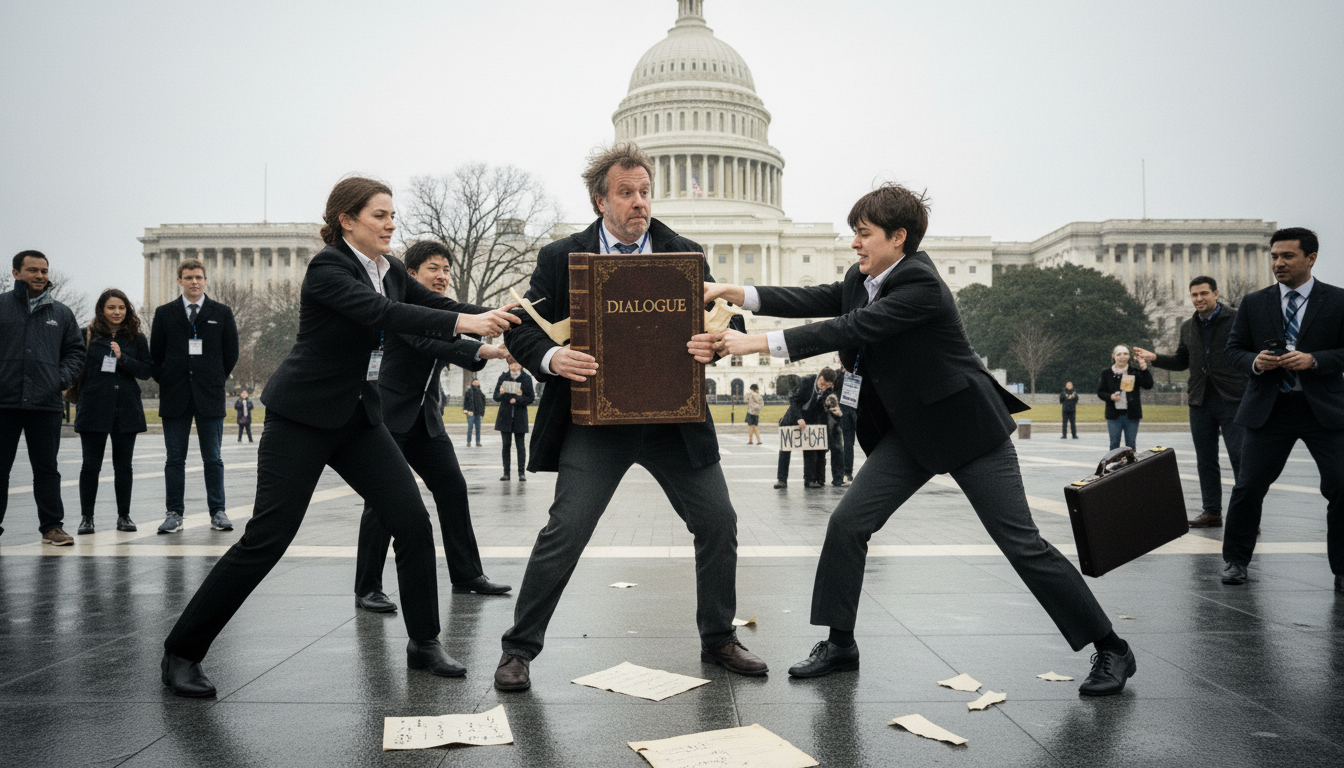
On Capitol Hill, a campaign event for the upcoming midterm elections reportedly became a scene of hostile shouting. A journalist, daring to ask if candidates might adopt a milder tone, was met with sharp rebuke. This encounter, detailed in the satirical publication El Jalapeño, suggests a particular challenge for those who venture into political spaces to observe or question.
The reporter's query concerned the portrayal of political rivals, specifically the use of terms like “communist saboteurs plotting to steal your groundwater” in television advertisements. The underlying premise of the question was whether such language hinders civil discourse. The response, as relayed by Mexico News Daily on October 9, 2026, indicated an unwillingness to engage with the premise, escalating into a "vicious harangue" and a politician's assertion of "absolute, unyielding commitment to respect." This exchange, while fictional, highlights a tension.
Journalism often seeks clarity and precision, especially when documenting political processes. When a journalist questions the civility of political discourse, they are, in essence, asking for a recognition of a shared public space where ideas are debated rather than opponents demonized. The satirical nature of the report from El Jalapeño, as clarified by Mexico News Daily, does not diminish the observation itself. It serves as a narrative device to spotlight an apparent trend in contemporary political rhetoric: the perceived decline of civility.
In the District of Columbia, a locale frequently associated with policy and debate, such an incident, even if imagined, speaks to a broader cultural context. It raises the question of what is asked of individuals who enter environments where the lines between political contest and personal attack blur. The journalist’s act of questioning, intended to foster a more moderate dialogue, instead triggered a defensive and aggressive reaction, according to the report. This suggests that in certain political arenas, the very act of seeking common ground can be interpreted as a challenge.
The implications for regions like the Pacific-Rim extend beyond American politics. The style of political engagement observed in one influential nation can influence and normalize similar approaches globally. When prominent political figures, even in satirical portrayals, are depicted as resistant to calls for civility, it signals a potential shift in what constitutes acceptable public discourse. For those observing from afar, this offers a lesson on the challenging conditions journalists and the public might face when engaging with polarized political environments. The willingness to ask difficult questions, even in the face of hostility, remains essential for understanding the underlying currents of political life.
Sources
Newsletter
Pacific Daily
A curated briefing from Thailand, Asia-Pacific and the world.