The Overlooked Liability of Pet Ownership in Asia-Pacific Urban Centers
Beyond the headlines of pet fines, a deeper issue of spatial economics and responsibility for dangerous breeds surfaces, impacting property values and public safety.
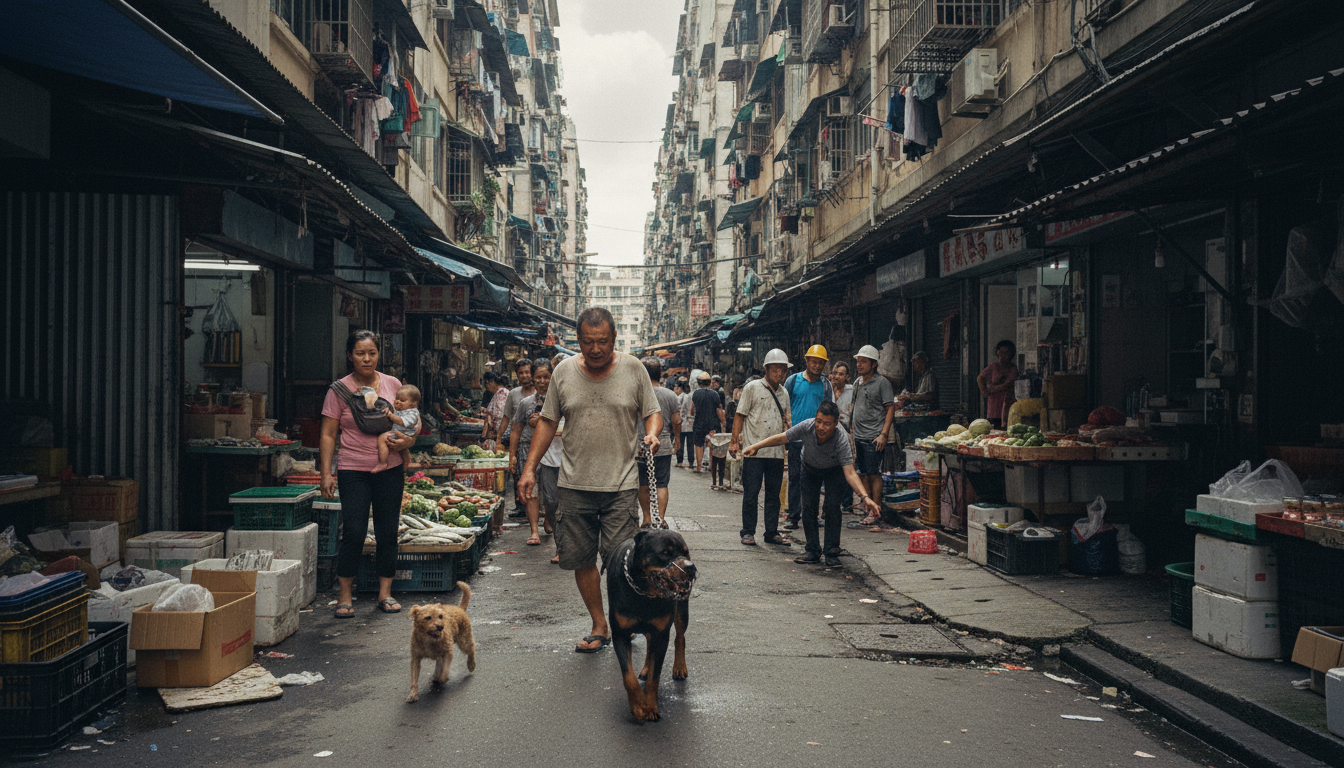
SINGAPORE
A Singaporean couple, Merissa Leow Hwee Li and Lionel Tay Wei Yuan, faced a fine in 2026 after their four dogs — two Rottweilers and two Cane Corsos — escaped their property. The incident resulted in a Labrador retriever suffering a deep, open wound, 9cm long and 7cm deep, during an encounter with the escaped dogs. This event, reported by CNA Lifestyle, highlights a confluence of issues often unaddressed in discussions of urban living and pet ownership across the Asia-Pacific region.
The immediate consequence was a financial penalty for the dog owners. However, the underlying dynamics point to more significant economic and social factors at play. The presence of powerful dog breeds, such as Rottweilers and Cane Corsos, in densely populated urban environments creates latent liabilities. While owners may perceive these animals as protected companions within their property lines, the risk of escape, as demonstrated in this case, generates tangible hazards for the broader community.
The core issue is one of berth economics, applied not to yachts but to living spaces and public thoroughfares. In urban centers where private land is at a premium, the spatial requirements for large, potentially dangerous animals are often insufficient. The incident in Singapore underscores this: four large dogs, confined to a property from which they eventually escaped, illustrate a mismatch between animal scale and urban density. This is not an isolated phenomenon; similar pressures exist in Bangkok, Kuala Lumpur, and other fast-growing cities where residential developments often prioritize density over dedicated animal space.
The financial implications extend beyond the fine levied. Property values in neighborhoods with documented histories of uncontrolled or aggressive animals can suffer. Insurers may reassess premiums in areas where pet-related incidents are frequent, and legal costs stemming from injuries or property damage can be substantial. The costs are not merely borne by the directly affected parties but can diffuse across a community through increased public safety measures or a general decrease in desirability for affected zones.
The challenge for regulators is to balance private pet ownership rights with public safety imperatives. Current frameworks often rely on reactive measures, such as fines and court orders, after an incident has occurred. A proactive approach would involve a more rigorous evaluation of appropriate breeds for urban environments, potentially linked to property size or specific enclosure standards. The incident does not indicate a failure of legislation itself, but rather a point where existing measures proved insufficient to prevent harm.
The counterargument posits that responsible ownership is the primary determinant, not breed or urban density. Owners, it is argued, bear full responsibility for containment and training, irrespective of external factors. This perspective holds merit, as the immediate cause of the injury was indeed the dogs' escape. However, it overlooks the systemic pressures that urban density places on even well-intentioned owners. A small lapse in security, which might be inconsequential for smaller, less powerful pets, becomes a significant public hazard with breeds capable of inflicting a 9cm x 7cm wound.
The outlook depends on whether municipal authorities in the Asia-Pacific region move beyond incident-specific penalties to address the broader implications of pet ownership in high-density areas. This would entail re-evaluating zoning laws, breed restrictions, and enclosure requirements, not as punitive measures, but as integral components of urban planning that acknowledge the spatial and safety demands of powerful animals. The incident in Singapore serves as a factual signal that the current equilibrium between private pet ownership and public safety is subject to significant economic and social strain in the region’s expanding urban landscapes. The outcome will now depend on whether this signal prompts a re-evaluation of how such liabilities are managed and contained within increasingly crowded confines.
Sources
Newsletter
Pacific Daily
A curated briefing from Thailand, Asia-Pacific and the world.