The Deliberate Pace of Digital Pigeons in Asia
A new app slows communication, reflecting a long-standing tension between speed and experience.
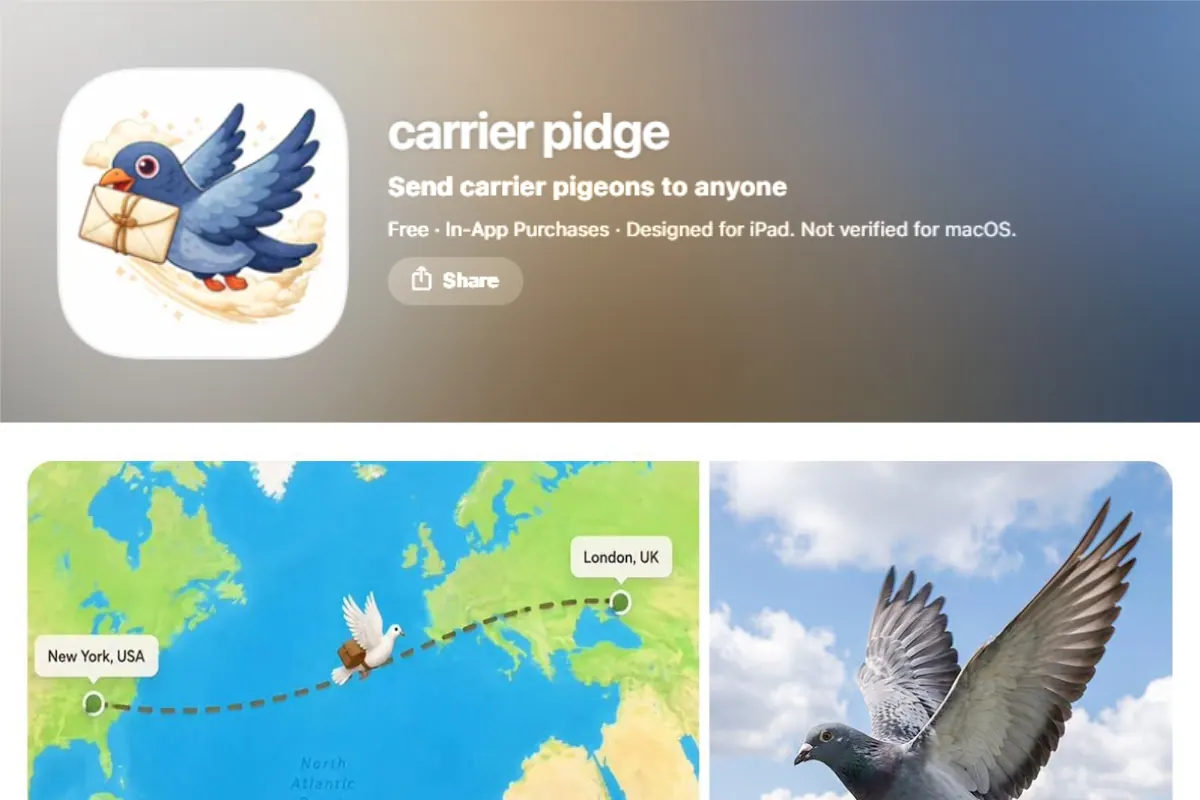
BANGKOK
A digital carrier pigeon, Winging its way across a simulated landscape, carries a message from Bangkok to Chiang Mai. The new iOS application, Carrier Pidge, does not boast rapid delivery. Instead, it intentionally engineers a delay in digital communication, using simulated homing pigeons to deliver messages based on the actual physical distance between users. What does this design choice suggest about how people might seek to engage with digital interactions in a region often characterized by rapid technological adoption?
The application posits an interesting counter-narrative to the prevailing expectation of instantaneity. Its core mechanic is to slow down, to introduce a temporal gap where none existed. This is not merely a novelty; it is a conceptual challenge to the very premise of modern communication platforms, which are universally optimized for speed and efficiency. The company behind Carrier Pidge indicates that demand is rising for this kind of experience. The inherent slowness of the app transforms the act of sending and receiving into something more akin to anticipation, mirroring the tangible wait for a physical letter or, indeed, a message carried by a living bird. This design reintroduces a form of patience into digital exchange, compelling users to acknowledge the space and time that separate them.
This deliberate pacing finds a subtle resonance in places where the rhythm of life, even amid modern advancements, sometimes resists pure acceleration. The bustling markets of Bangkok, for instance, operate with an underlying current of transaction that is swift, yet often punctuated by moments of negotiation, reflection, and social interplay that extend beyond mere utility. Similarly, the careful craft of traditional artisans throughout Southeast Asia, from silk weavers to wood carvers, inherently involves a measured, unhurried process. These are activities where the value is tied not just to the outcome, but to the journey of its creation. Carrier Pidge, by imposing a journey onto data packets, draws a parallel to these older, more embodied forms of communication and creation.
There is, however, an argument that such an application will remain a niche curiosity. In cities like Singapore or Kuala Lumpur, where digital infrastructures are highly sophisticated and the pace of commerce is relentless, the utility of a deliberately slow communication tool might be perceived as limited. Most users, it could be reasoned, rely on instant messaging for practical, immediate concerns—coordinating meetings, sharing urgent information, or maintaining a continuous stream of social interaction. For these purposes, slowness is a hindrance, not a feature. The market for digital tools that actively impede efficiency is, by definition, smaller than the market for those that enhance it. Some might even view it as an affectation, a romanticized rejection of progress rather than a meaningful alternative.
Yet, the very existence of Carrier Pidge, and the reported interest in it, suggests a latent desire for friction in an otherwise frictionless digital world. It asks users to consider what is gained when communication is not instant. Perhaps it is a greater appreciation for the message itself, a more considered response, or simply a moment of reprieve from the constant demand for immediate attention. In a region where connectivity is rapidly expanding, and digital saturation is an increasing reality, such an app might serve as a counterpoint, a digital reminder of physical distance and the value of waiting. The journey of a digital pigeon, from Bangkok to Chiang Mai, thus reflects more than just software design; it speaks to a deeper human inclination to experience, rather than merely transmit, information.
The app's design, which places a virtual bird's flight at its center, compelling users to wait, reframes the utility of distance itself. The digital pigeon’s slow, virtual flight across a simulated landscape compels users to acknowledge distance in a new way, suggesting that some messages are perhaps best delivered not at the speed of light, but at the pace of a wingbeat.
Sources
Newsletter
Pacific Daily
A curated briefing from Thailand, Asia-Pacific and the world.