The Cultural Capital of an iPhone Gift
An actress's gesture reveals more than generosity in a shifting Asia.
SINGAPORE
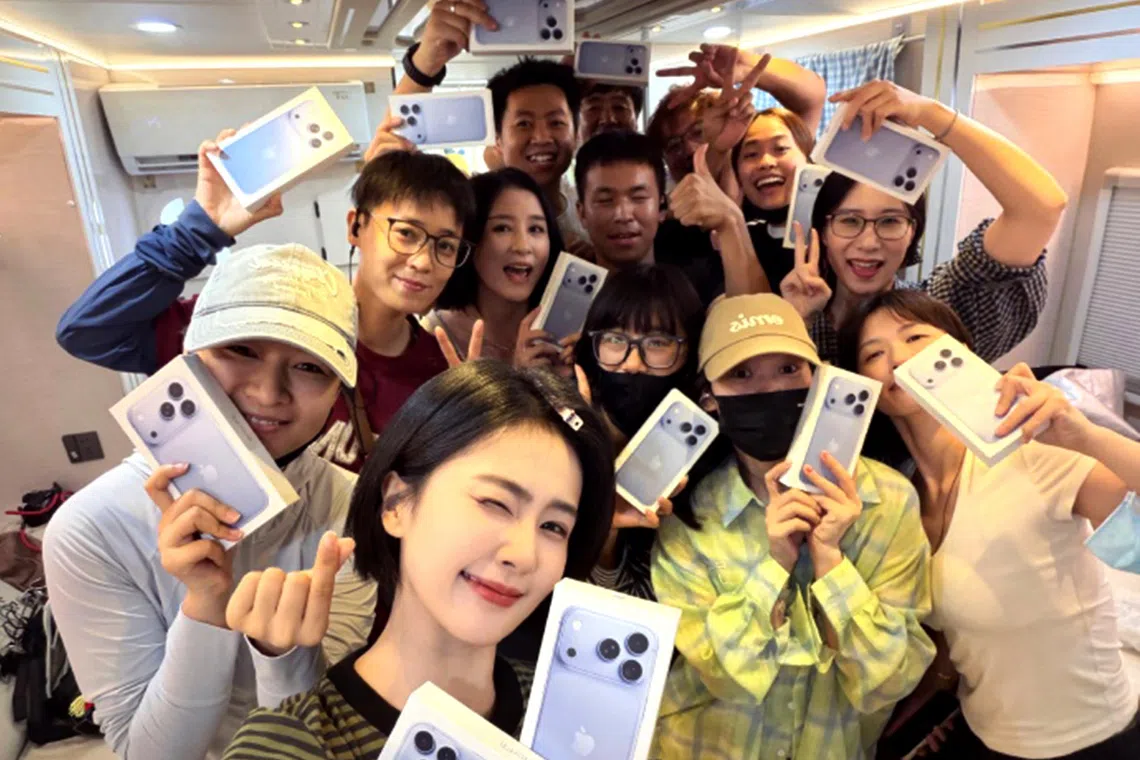
A specific moment captured on Chinese social media platform Weibo, on September 20, shows Chinese actress Bai Lu with 12 members of her team. Each individual holds an iPhone 18. This was a gift from Bai Lu to more than 10 staff members, a detail revealed by two of her staff. The Straits Times Life reported this event on September 21, framing it as an instance of generosity and strong team bonds.
Yet, this precise observation unfolds against a wider tapestry where cultural signals often carry weight beyond their surface meaning. Bai Lu is known for treating her team well, including giving hongbao during Chinese New Year, and she left Huanyu Entertainment after ten years to start her own agency, as reported by The Straits Times Life on September 21. Her staff have praised her energy and kindness, with her agency reportedly planning legal action against false rumors concerning her personal life. The iPhone 18, presented to her staff, was described as "newly launched" by The Straits Times Life.
In the Asia-Pacific, such public displays, particularly when involving high-value, status-affirming technology, can be read as strategic cultural capital. This gesture occurs at a time when China's standing in the region is complex. Pew Research Center released findings on China’s image in the Asia-Pacific region. The country's memory-chip platform, CXMT, announced mass production of a new platform on September 20, as reported by Reuters. Concurrently, The Japan Times reported Chinese pressure on Taiwan with new patrols off its Pacific coast, and a Chinese defense forum was set to open amid regional tensions.
The gift of a newly launched, expensive device like the iPhone 18, in a market where technology and national identity are increasingly intertwined, positions Bai Lu and, by extension, her team, within a particular narrative. It projects an image of success and stability, perhaps intended to counter rumors or reinforce her standing. The swift public sharing of this act by her staff on Weibo suggests an awareness of its communicative power, whether intended by the actress or not. It is a visual affirmation of loyalty and prosperity in a public sphere that scrutinizes celebrity, but also national, identity.
One might argue that this is simply a generous act, a demonstration of gratitude from a successful individual to her employees, no different from similar gestures in other industries or cultures. The reported staff praise for Bai Lu's kindness lends credence to this interpretation. However, the timing with a "newly launched" product and its immediate public circulation via social media elevate it beyond a private appreciation. The iPhone, while not a Chinese product, represents a global standard of technological aspiration. Its bestowal by a prominent Chinese figure, publicized by Chinese media, becomes part of a larger cultural conversation, reflecting the values and perceived strength of those who can command such resources.
This single image of Bai Lu and her team, each holding a new phone, provides a glimpse into how individual actions can mirror and refract broader regional dynamics. The gift is not just a phone; it is a visible signal of belonging, influence, and perhaps, resilience, in an Asia-Pacific navigating its own shifting currents.
Sources
Newsletter
Pacific Daily
A curated briefing from Thailand, Asia-Pacific and the world.