The Capitalist Spectacle of Temporary Culture
A modest fringe theatre in east London secures a costly permanent envelope, exposing how mega-event regeneration captures the very informality it was designed to replace.
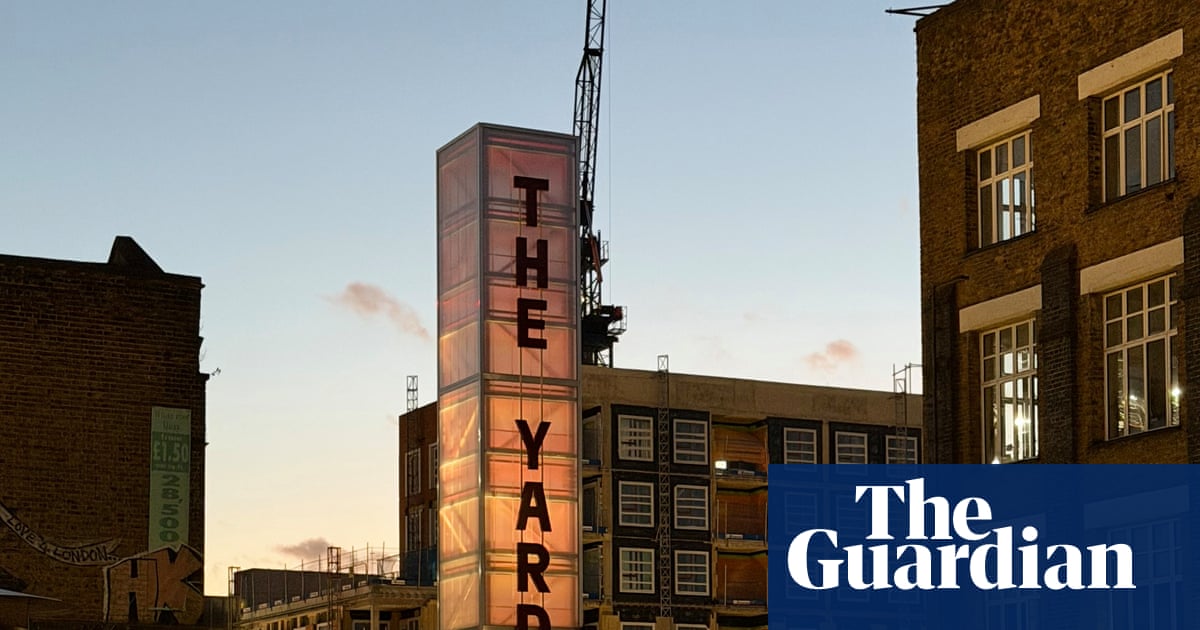
Olympic infrastructure operates on an unacknowledged tension between long-term property investment and provisional artistic license. When municipal planners assemble land for global games, marginal industrial acreage is frequently allocated to interim cultural occupancy while long-term commercial schemes mature. The original structures are explicitly intended to be temporary. Yet when those transitional spaces survive and professionalise, their durability rarely challenges the surrounding speculative property market. Instead, architectural institutionalisation often serves as its most persuasive aesthetic asset.
Consider the documented transformation across the canal in Hackney Wick. Following the 2012 London Olympics, the post-industrial perimeter saw sustained construction activity, with cranes hoisting prefabricated brick cladding panels to enclose speculative residential developments. Amid this intense redevelopment sat The Yard, a performance space initially built using basic planks and plasterboard. That low-budget building, never intended as a permanent fixture near the Olympic site, has completed a £4m revamp featuring a glowing polycarbonate ventilation shaft, heated seating, and design references drawn from Milan’s Villa Necchi. With actor Ian McKellen scheduled to perform, the informal enterprise has crossed into the category of a formal civic venue.
The Price of Formalisation
Public discussions routinely treat such reinventions as independent triumphs over commercial displacement. The prevailing narrative suggests that a frugal, community-rooted venue outlasted private redevelopment through institutional endurance. Yet this assessment tends to bypass the underlying economics of physical adaptation. A £4m capital injection effectively converts an ad hoc cultural site into a permanent anchor for rising land values. The commercial dynamics that displaced earlier light industry do not recede when an upgraded theatre appears; rather, the completed facility provides the surrounding master plan with cultural validation.
Urban planning frameworks frequently rely on this pattern during regeneration cycles. Informal arts venues provide neighbourhood character and social currency during the transitional years following athletic competitions, when commercial leases are still taking shape. Once dense residential complexes are established, unmanaged and impermanent structures present an administrative friction. The capital upgrade resolves this friction by replacing fragile planks and plasterboard with dedicated civic infrastructure, formalising the enterprise within the regulated municipal economy.
Durable Illusions of Edge Culture
There is, to be sure, a compelling practical defense of this trajectory. Independent performing arts organisations face structural economic precarity, and refusing capital investment or facility modernisation often ends in site closure or eviction. Expecting fringe venues to remain materially vulnerable purely to satisfy external notions of authenticity ignores the financial realities of venue operation. By securing £4m in structural upgrades and presenting established talent such as Ian McKellen, a working theatre gains operational continuity, year-round heating, and insulation against immediate clearance, outlasting the basic shed that housed its earliest productions.
A capital revamp transforms precarious cultural production into an anchor tenant for rising land values.
At the same time, this formalisation leaves a fundamental contradiction unresolved. While structural stability shields the physical stage, the transition from improvised materials to polished references from Milan’s Villa Necchi alters the social environment of the original Olympic edge. The venue gains architectural permanence and programming security, yet the surrounding residential market remains driven by the very commercial forces that initially designated the site as disposable. The venue has secured its walls, while the speculative framework outside them continues on its own terms.
Sources
Newsletter
Pacific Daily
A curated briefing from Thailand, Asia-Pacific and the world.