The Architecture of Deliberate Scarcity on Awaji Island
A planned fourteen-key footprint in Japan exposes how hospitality developments increasingly treat spatial withdrawal as a structural strategy.
SINGAPORE
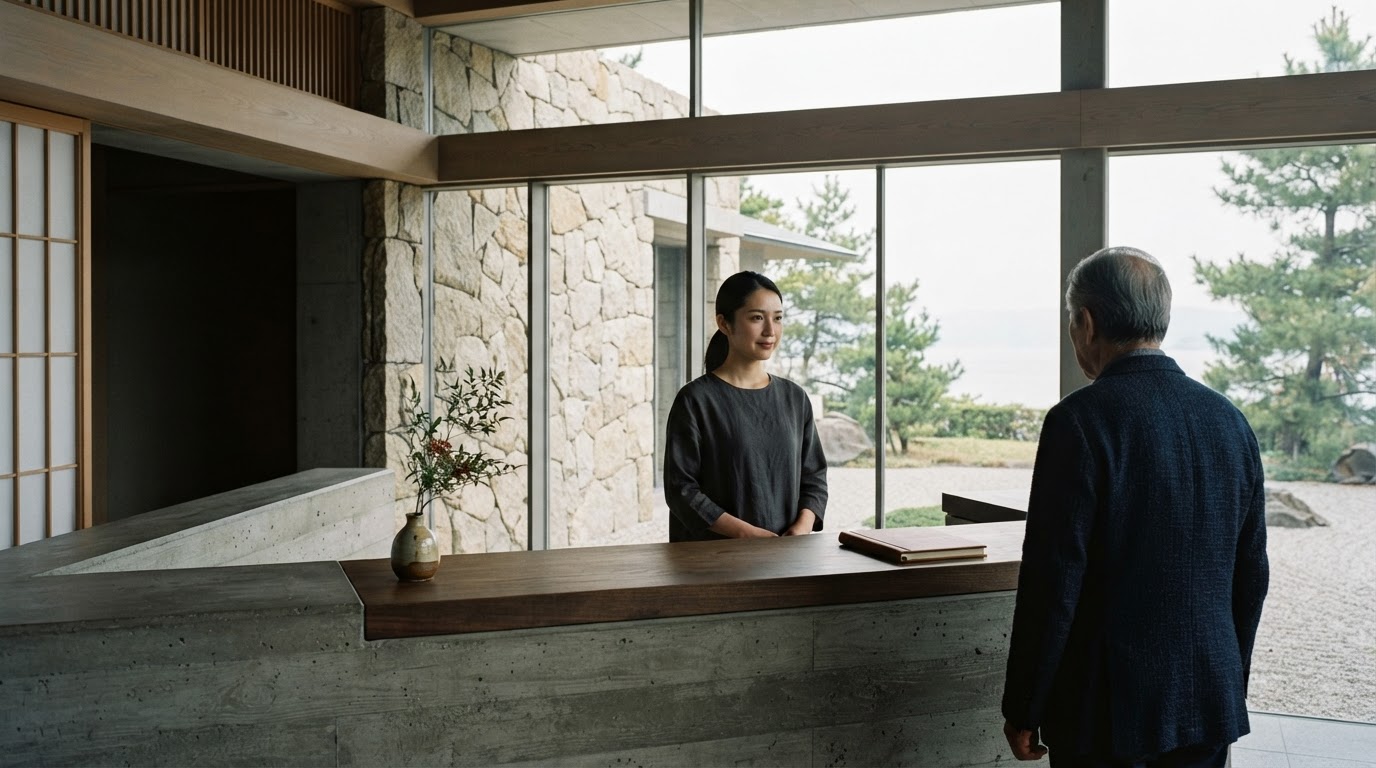
A fourteen-key hospitality program is fundamentally an exercise in what a structure refuses to accommodate. When a project limits its density to fourteen rooms, as Rus Tourism News reports for the upcoming BE WANDERLUST Hotel on Awaji Island, the primary architectural statement is not stylistic flourish. It is omission.
Traditional leisure developments across coastal Japan have historically balanced site footprint against commercial capacity, relying on volume to absorb infrastructure overheads. Committing to a room count that barely exceeds a private residence alters the relationship between the building envelope and its immediate terrain. Rather than acting as an engine of regional throughput, such an intervention converts land into an insulated spatial redoubt. The gesture asserts that spatial value derives directly from exclusion.
The Economics of Spatial Omission
Scale dictates architectural posture. Large floor plans require circulatory hierarchies, public foyers, and administrative spines designed to distribute footfall across shared amenities. By contrast, compressing programmatic density down to fourteen keys eliminates the collective commons. Service routes collapse, common lounges become acoustic liabilities, and the exterior threshold must bear the burden of total insulation.
This is architecture deployed as defensive retreat. The building refuses mass accommodation, functioning instead as a private compound that operates on the logic of minimal friction. For insular environments like Awaji Island, such spatial strategies present an unresolved operational dilemma. Low-density installations claim to touch their surroundings lightly, yet they simultaneously demand complete civic detachment to preserve the illusion of isolation.
Skeptics of rural tourism initiatives often note that hyper-restricted room counts risk becoming hermetic enclaves, divorced from the wider economic life of regional prefectures. Proponents counter that restrained physical capacity avoids the infrastructural degradation that accompanies standard mass tourism. Both assessments hold weight. The tension lies in whether an insular design can ever truly engage with its locality when its entire layout is configured to keep that locality at bay.
Limits of Regional Withdrawal
Regional planning frameworks often welcome low-volume developments as an orderly alternative to high-density tourism. That assumption misreads the architectural reality. A micro-scale establishment still imposes energy, transport, and servicing pressures on municipal conduits, but it redistributes none of its spatial volume back to the public realm. The envelope remains closed.
What remains unresolved on Awaji Island is the fundamental civic compromise at the heart of such planning. By shrinking interior capacity to fourteen rooms, BE WANDERLUST articulates a design philosophy where isolation becomes the final programmatic asset. The structure achieves quietude precisely by disengaging from the landscape it occupies.
Sources
Newsletter
Pacific Daily
A curated briefing from Thailand, Asia-Pacific and the world.