Anutin’s Calculation on Bangkok’s Street Dissent
By framing youth mobilization as routine civic expression, Thailand’s leadership seeks to deny street protests their historic disruptive leverage.
BANGKOK
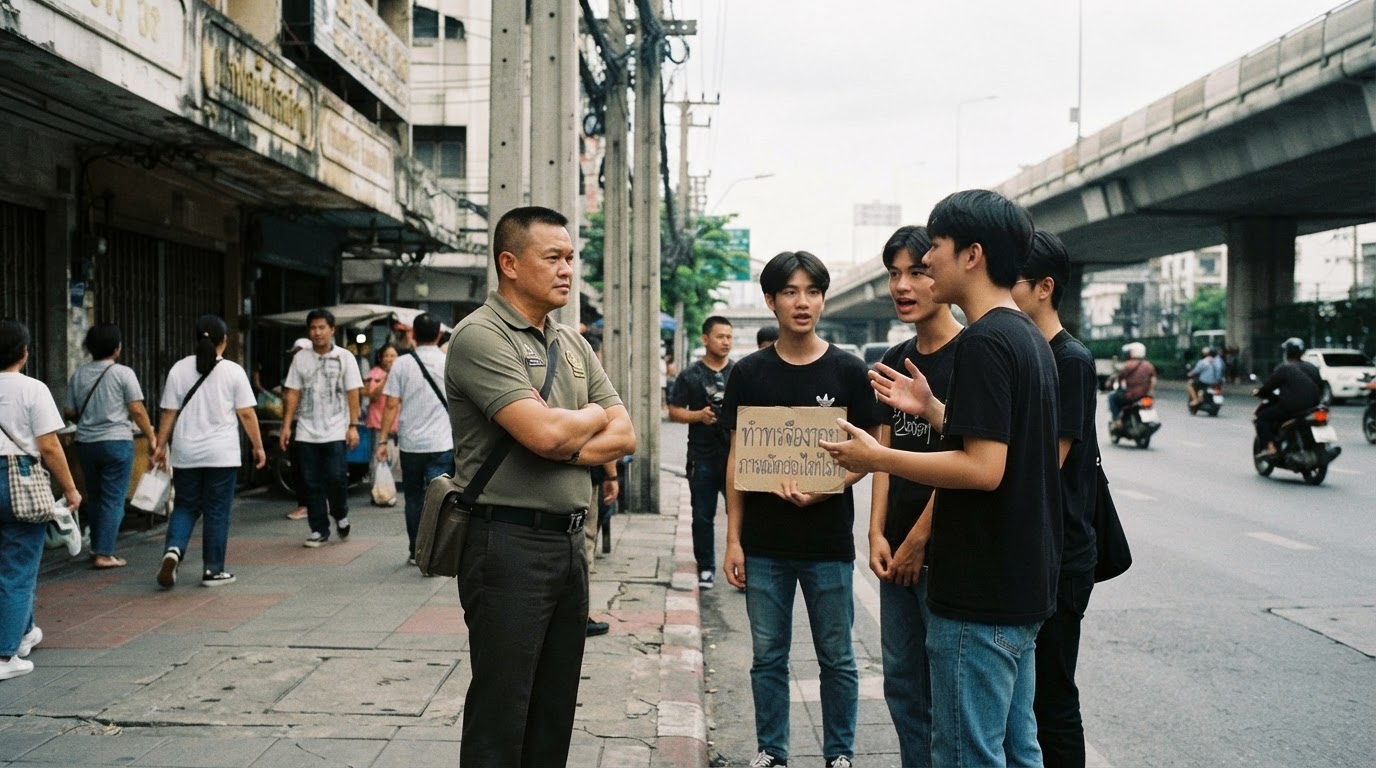
Thai political authority has historically measured its vulnerability by the physical density of Ratchadamnoen Klang Avenue. Prime Minister Anutin Charnvirakul, who concurrently holds the interior portfolio, stated on Saturday at Government House that monitoring of demonstrations led by youth networks showed no indications of escalation. His assessment followed a symbolic gathering staged by Gen Z protesters at the Democracy Monument in Bangkok on Nov 20. Rather than signalling immediate administrative alarm, Anutin affirmed that the administration had listened to demonstrator concerns, was pursuing remedies, and regarded lawful assemblies exercising constitutional rights as manageable civic activity.
That official equanimity marks a calculated operational posture. Previous cycles of Thai political friction turned on rapid state characterisation of youth assemblies as destabilising disruptions requiring exceptional security intervention. By categorising the Nov 20 gathering at Democracy Monument as compliant with legal frameworks, Anutin attempts to disarm the confrontation before it acquires institutional momentum. Acknowledging public grievances while simultaneously insisting that lawful public gatherings pose no direct threat to government functioning allows the administration to project administrative command without provoking wider street mobilisation.
The Strategic Utility of Restraint
Yet administrative tolerance in Bangkok is rarely an end in itself; it functions as a diagnostic tool. Conceding the constitutional right to assemble deprives protest organizers of an immediate state adversary against which to rally broader sympathetic demographics. When interior and executive authorities deliberately understate the disruptive scale of youth activism, they establish strict legal compliance as the sole boundary of state tolerance.
Assemblies conducted within the law do not pose an operational problem for the state, provided institutional authority retains the prerogative to define compliance.
This deliberate containment strategy reveals an acute awareness of regional precedent. Across Southeast Asia, heavy-handed municipal crackdowns on student and youth networks have historically catalyzed dispersed opposition movements into sustained national campaigns. Thai authorities have repeatedly confronted this institutional dilemma across decades of urban protest. Managing public dissent through regulatory accommodation preserves administrative equilibrium, while isolating activist demands within conventional bureaucratic channels.
The Boundaries of Permitted Grievance
Such posture nevertheless depends upon a fragile equilibrium. While Anutin maintained that the administration remains attentive to youth demands, procedural willingness to listen does not guarantee structural responsiveness. Youth movements organize around policy frustrations that seldom yield to superficial consultation or standard ministerial reassurances. If state machinery absorbs symbolic protests at the Democracy Monument without addressing underlying governance friction, the legal boundaries currently defining permitted dissent will face persistent strain.
The unresolved tension rests in the gap between public expression and policy execution. Maintaining that civic gatherings are harmless because they remain small risks misreading the durable grievances that drive youth networks into public avenues in the first place. For Anutin and the interior apparatus, containing protests through procedural calm avoids immediate confrontation on Ratchadamnoen Klang Avenue, yet leaves open the deeper question of how long bureaucratic management can substitute for substantive political resolution.
Sources
Newsletter
Pacific Daily
A curated briefing from Thailand, Asia-Pacific and the world.