Arsenal Face Defensive Fragility as Tactical Margin Collapses on Single Selection
An injury to David Raya at Newcastle exposes the narrow structural tolerance of Mikel Arteta’s tactical system.
SINGAPORE
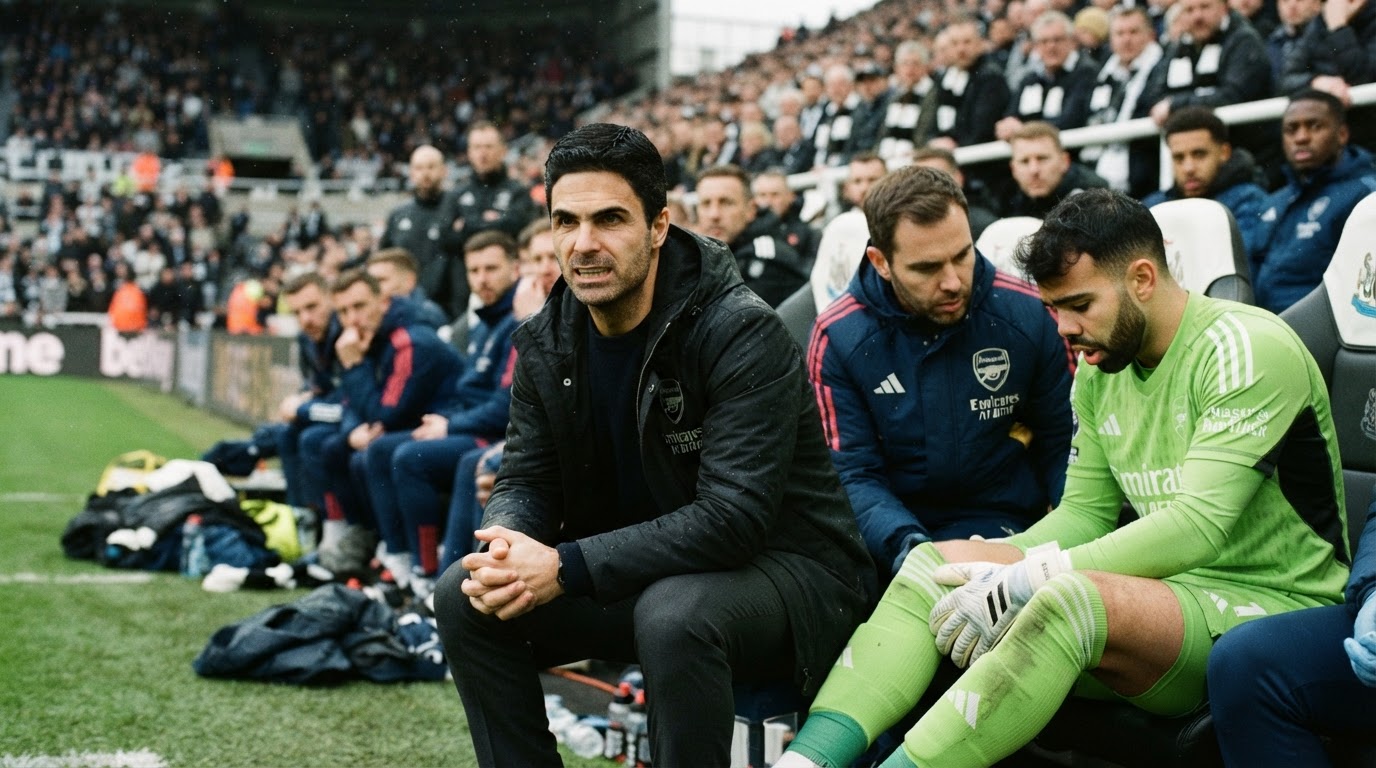
Elite tactical systems function on the assumption of structural interchangeability until an individual absence disproves it. During the Premier League fixture at St James' Park on November 21, 2026, Arsenal confronted that exact reality when David Raya walked off the pitch after sustaining an injury, leaving manager Mikel Arteta facing an immediate diagnostic scan and the residual frustration of missed attacking chances against Newcastle United.
The setback in Newcastle reveals the operational tension between intricate possession strategies and basic defensive resilience. In modern competition, a specialized goalkeeper does not merely prevent goals; the position dictates field geography, initiates attacking phases, and sustains high defensive lines. When such an asset limps off under the direct gaze of management, tactical continuity ceases to be an abstract philosophy and becomes a practical personnel crisis.
The Cost of Structural Specialization
Arteta built Arsenal's competitive model around rigorous positional discipline and controlled territorial possession. That framework demands an uncommon profile from its goalkeeper, requiring composure under pressure alongside standard shot-stopping responsibilities. Losing Raya alters the foundational distribution of the entire squad, forcing immediate adjustments across the back line.
At Newcastle, the consequences of this vulnerability compounded quickly. A manager ruing missed opportunities at one end of the pitch while monitoring a key defensive injury at the other highlights how narrow elite margins remain. When attacking efficiency falters, defensive errors or sudden personnel changes carry disproportionate weight. Dominance without clinical finishing leaves any system exposed to sudden counter-pressures.
When an intricate tactical architecture loses its primary distributor, structural discipline quickly yields to operational compromise.
Competing at the highest level of the Premier League requires navigating these sudden disruptions without compromising long-term objectives. Squad depth is frequently measured by numbers on a roster, yet true depth depends on whether replacement options can replicate specialized responsibilities without degrading collective output. An extended absence following Raya's medical evaluation would test whether Arsenal's tactical identity resides in the system itself or depends entirely on specific personnel.
Competitive Realities and Squad Governance
The immediate dilemma facing Arsenal illustrates an ongoing dilemma for managers operating within compressed schedules across the United Kingdom and continental tournaments. Balancing peak performance against physical attrition is an unrelenting calculation. An injury sustained mid-match disrupts not only the contest at hand but also subsequent preparation, forcing coaching staff to choose between tactical consistency and risk mitigation.
Sustained performance over a grueling domestic season rarely hinges on ideal tactical scenarios. Success belongs instead to organizations capable of absorbing severe personnel shocks without abandoning strategic coherence. As Arteta monitors the forthcoming scan results and evaluates the missed opportunities at St James' Park, the central question shifts from what went wrong in Newcastle to how resilient Arsenal’s operational architecture truly remains under direct stress.
Sources
Newsletter
Pacific Daily
A curated briefing from Thailand, Asia-Pacific and the world.