Suburban Storage and the Industrialised Botanical Trade
A five-tonne cannabis seizure in Bang Khen reveals how regional syndicates have outpaced domestic policy frameworks
SINGAPORE
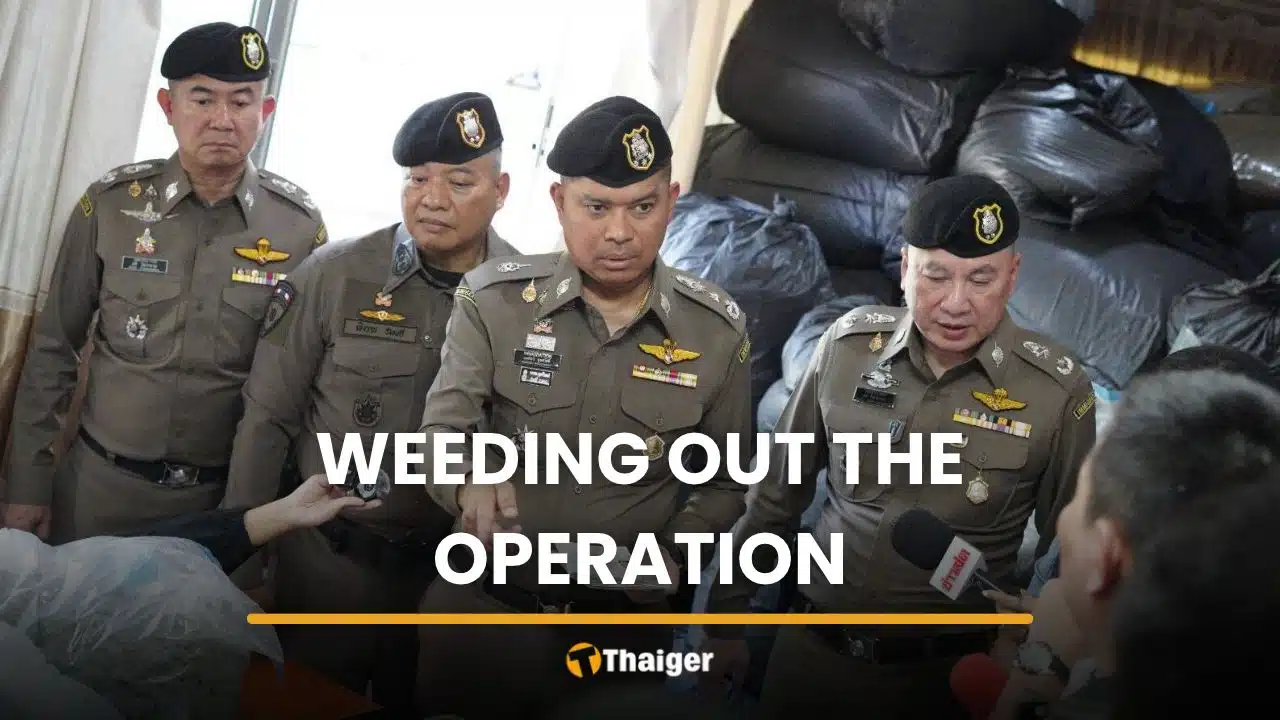
High perimeter walls in northern Bangkok suburbs were engineered to enforce privacy, dividing quiet residential enclaves from the surrounding commercial sprawl. Behind one such gate on Khu Bon 27 Road in Bang Khen district, that domestic seclusion sheltered an industrial transshipment depot. When Immigration police chief Pol Lt Gen Noppasilp Poonsawat led officers into the rented luxury house on Monday, the rooms contained no domestic furnishings or neighbourhood life. Officers uncovered five tonnes of cannabis buds stacked across the property, tended by four Myanmar workers under the direction of a Vietnamese supervisor.
The scene in Bang Khen illustrates how rapidly a crop once framed through rural heritage has evolved into an anonymised corporate logistics pipeline. For generations, traditional Thai herbalism positioned plant cultivation within local agrarian rhythms, an understanding codified under state frameworks overseen by institutions like the Department of Thai Traditional and Alternative Medicine. Smallholder farming was supposed to revive domestic soil, anchoring economic self-determination in village communities while safeguarding botanical knowledge. What appeared on Khu Bon 27 Road reflects the exact opposite trajectory, substituting rural herbal craft with cross-border commodity arbitrage managed from a quiet suburban villa.
Cross-Border Labour and Parallel Transit
This physical reorganisation of agricultural stock mirrors shifts across older regional transit lines. While investigators inspected the Bang Khen residence on Monday, a parallel interdiction intercepted five Thais travelling along a central plains highway with 284 kilogrammes of crystal meth. Transit routes spanning provincial arteries toward Nakhon Sawan and Nong Bua Lam Phu have long funnelled illicit contraband through the kingdom's geographic heart. Today, synthetic chemicals and botanical crops travel through an identical logistical architecture, reliant on rapid transit and discreet suburban holding hubs.
Defenders of rapid commercialisation maintain that concentrated warehousing simply reflects standard supply-chain maturation. Under this interpretation, five tonnes of dried flower gathered in a single suburban node indicates nothing more than logistical efficiency, bringing down transaction costs and organising fragmented farm yields for legitimate retail. That defense falters when confronted with the labour hierarchy within the house. Rather than local agricultural cooperators, the enterprise relied on four Myanmar labourers directed by a Vietnamese intermediary, replicating the precarious staffing structures common to regional grey-market syndicates.
The discovery of five tonnes of dried flower on Khu Bon 27 Road exposes how easily domestic botanical reform converts into an unregulated logistics trade.
The Hollowed Heritage
The transition from small-scale cultivation to bulk transshipment carries profound cultural consequences. State initiatives originally envisioned Thai botanical therapies as high-value domestic products, promising rural prosperity and certified therapeutic quality. Yet the scale of five tonnes housed in a residential garage demonstrates how completely industrial volume displaces artisanal cultivation. When bulk tonnage supersedes agricultural stewardship, the smallholder producer is sidelined by commercial syndicates capable of renting metropolitan luxury homes to store untracked inventory.
This shift empties the formal harvest of its social justification, turning what was promoted as agrarian revitalisation into an anonymous distribution trade. Low-wage migrant hands perform the physical labour of packing and sorting, while regional coordinators orchestrate delivery across borders without contributing to domestic public health or rural infrastructure. Law enforcement agencies find themselves inspecting residential subdivisions rather than regulating certified farms, chasing bulk shipments through northern Bangkok rather than monitoring community dispensaries.
The empty villa on Khu Bon 27 Road remains standing behind its concrete gate, shorn of its five tonnes of processed buds and returned to neighbourhood stillness. That quiet exterior masks an unresolved contradiction in domestic agricultural governance. By allowing industrial-scale aggregation to outstrip regulatory surveillance, policymakers have enabled a shadow logistics industry to supplant the promise of agrarian revival. Sacks of dried flower stacked ceiling-high in a suburban bedroom confirm that without disciplined oversight, local botanical culture is readily absorbed into the anonymous machinery of transnational freight.
Sources
Newsletter
Pacific Daily
A curated briefing from Thailand, Asia-Pacific and the world.