Rural Dispute Resolution Stumbles in Maha Sarakham
A lethal confrontation along a provincial village lane exposes how informal rural networks struggle when domestic frictions turn volatile.
SINGAPORE
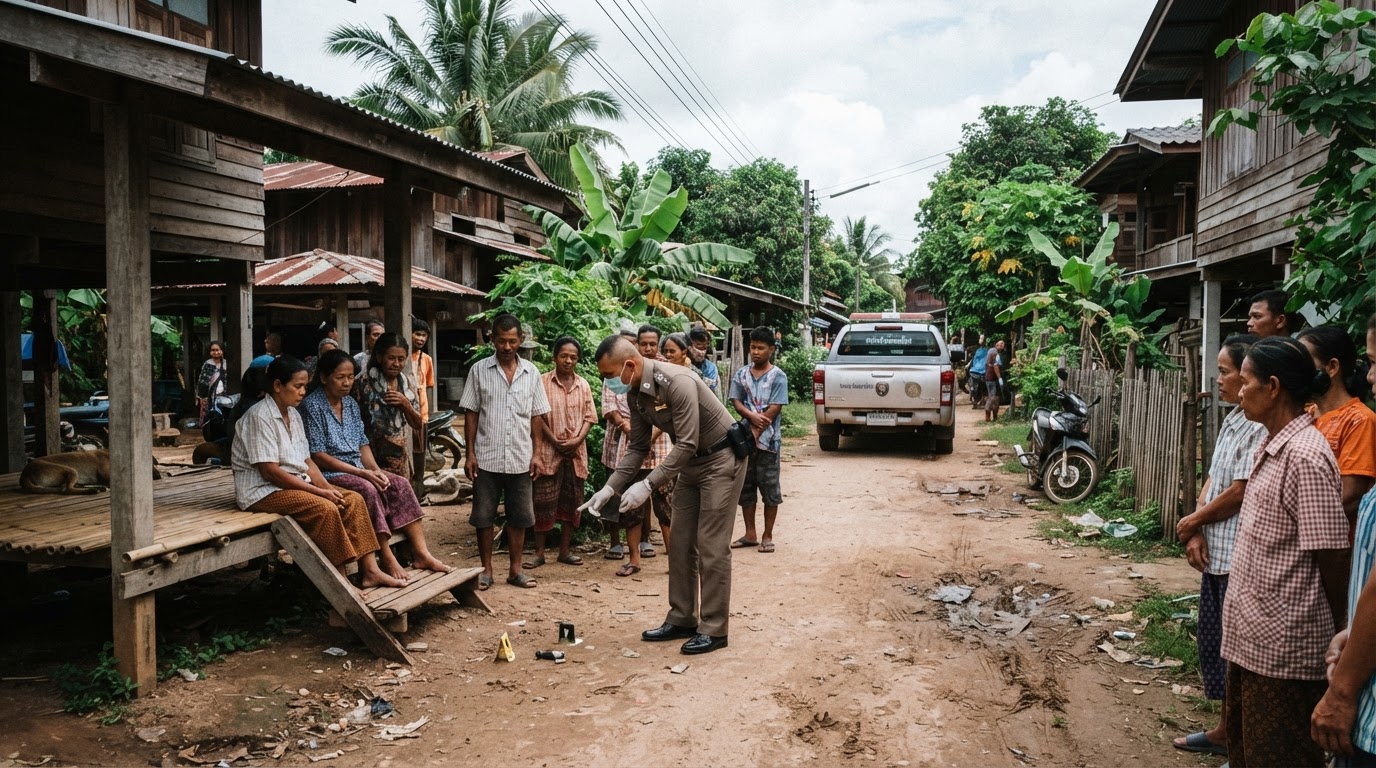
Emergency calls in agrarian districts rarely come with warning. Most violent encounters seem abrupt, but the resentments that provoke them usually simmer across months or years along the very paths neighbours share every morning. In Ban Khong Kut Wian, a farming settlement in the Kham Riang subdistrict of Kantharawichai district, that quiet balance broke down completely on a Friday night in October.
Officers from Kaowyai Police Station arrived to find three people gravely hurt beside an unpaved community road. Rescue workers moved quickly, taking fifty-two-year-old Jomsri, forty-eight-year-old Supaporn and forty-five-year-old Suraset to Maha Sarakham Hospital. All three died from their injuries. Residents told investigators that their neighbour, fifty-seven-year-old Khampong, assaulted the group using a knife and an axe following a long-running dispute over an alleged affair. The violence ended as quickly as it began, leaving a tight-knit residential lane facing the grim consequence of unmonitored personal grievance.
Pressures in the Settlement
Daily routine in rural Thailand depends on unbroken physical proximity. Families live alongside the same families for generations. They share boundary lines, irrigation ditches, unpaved cart tracks and cooperative farm labour, leaning on collective goodwill rather than formal statutes to resolve daily friction. When personal rancour begins to poison those daily interactions, the lack of institutional distance can turn dangerous.
Village structures typically absorb domestic arguments before they turn physical. Kinship mediation, respected elders and community leaders usually step into private quarrels to damp down tempers before pride turns lethal. Sometimes, however, mediation falters. An interpersonal grievance can outrun traditional social pressures when embarrassment or jealousy hardens quietly behind closed doors, hidden from public scrutiny until it is too late to halt. In Ban Khong Kut Wian, no informal safety valve intervened before bladed tools were drawn.
The breakdown of routine dispute resolution in rural hamlets reveals how fragile informal neighbourhood protections become under acute strain.
One might argue that no policing model or community mechanism can realistically anticipate an erratic assault by an armed neighbour. Domestic emotions flare without an administrative schedule. Interventions are notoriously difficult when parties keep animosities private until the final confrontation occurs. Yet dismissing such tragedies as unpredictable flukes overlooks how long-standing tension alters daily behaviour across close-quarters settlements, turning minor encounters into points of potential combustion.
Limits of Informal Arbitration
Provincial policing operates under tight geographic realities. Officers at Kaowyai Police Station oversee broad stretches of countryside populated by scattered, independent hamlets. Because patrol units are spread thin, statutory law enforcement acts as a reactive agency that records casualties rather than an early warning mechanism capable of catching domestic flashpoints.
Demographic transformation makes this institutional absence harder to bear. Working-age adults continuously leave northeastern villages to find factory or service employment in industrial zones, leaving older residents behind to manage village life and longstanding feuds without the buffer of larger, multigenerational households. Communal oversight erodes under these pressures. When long-running accusations over domestic conduct boil over in this thinned-out social environment, customary arbitration often proves insufficient to restrain someone determined to strike.
Neither statutory policing nor casual neighbourly diplomacy stopped the bloodshed in Maha Sarakham. What happens across these settlements now depends on whether provincial administrations build concrete channels for domestic mediation before quiet village lanes become crime scenes.
Sources
Newsletter
Pacific Daily
A curated briefing from Thailand, Asia-Pacific and the world.