Roadside Memorial Reveals Fractures in Hong Kong Family Rituals
The exclusion of Peter Mui Kai Ming from his mother's funeral, leading to a separate roadside tribute, highlights tensions between traditional filial piety and personal estrangement.
HONG KONG
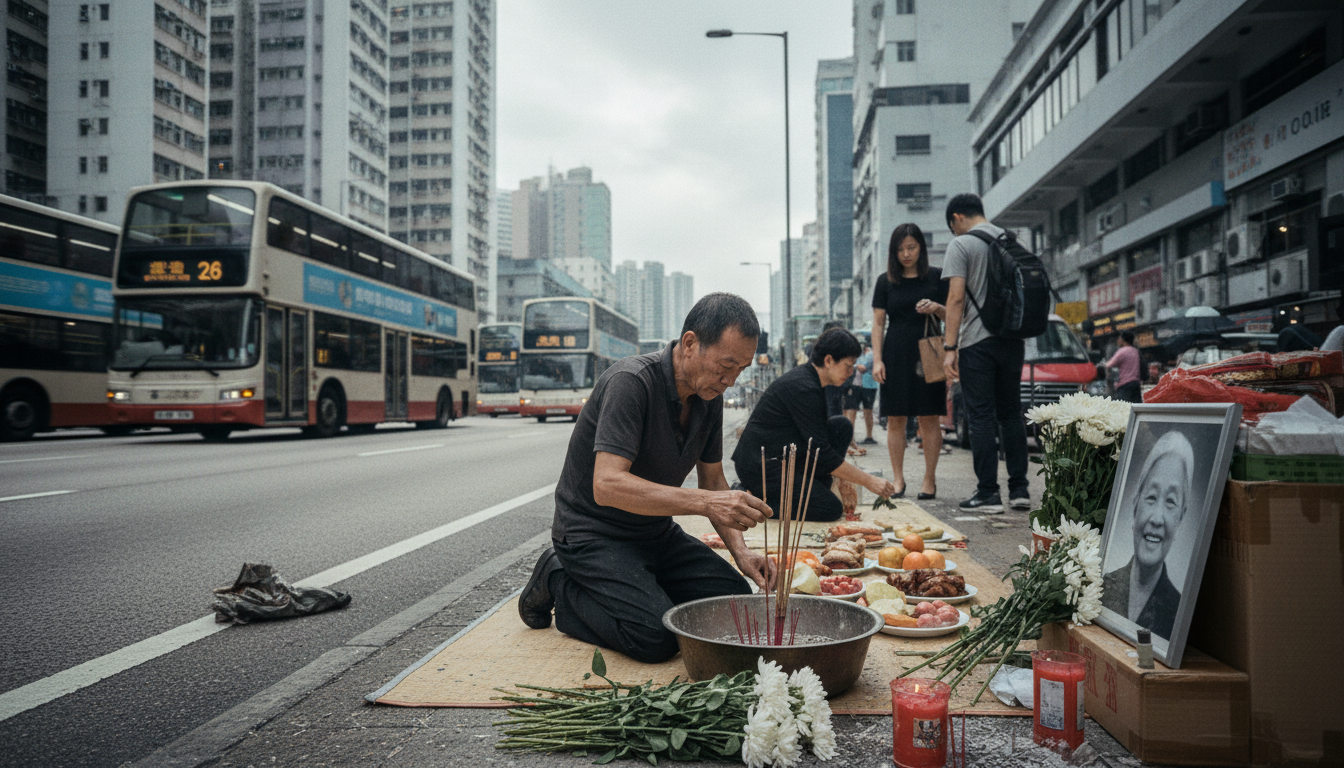
The public ritual was precise: Peter Mui Kai Ming, the eldest brother of late Cantopop icon Anita Mui, held a memorial for his mother, Tam Mei Kam, outside her former residence in Hong Kong. He and his Thai fiancée, May May, were observed carrying Tam’s portrait, incense, candles, joss paper, and other offerings [1]. This act of remembrance followed Mui’s exclusion from Tam Mei Kam’s funeral [1]. Hong Kong media reports indicate that Tam Mei Kam had reportedly not wanted to see her son, Peter Mui Kai Ming, explaining why he was unaware of the funeral arrangements [1].
Such a public demonstration of mourning, conducted outside the established family rites, signals a profound rupture in customary practice. In Hong Kong, as elsewhere, funerals traditionally serve as communal affirmations of kinship and respect for elders. The absence of a direct family member from these rites, let alone the staging of a parallel event, draws attention to deeply personal conflicts intersecting with cultural expectations of filial duty. This specific detail — a mother's reported wishes leading to a son's exclusion from her funeral — points to an estrangement where personal directives evidently altered the customary inclusion of a direct descendant in funerary planning.
The history of this relationship includes earlier reports. Peter Mui Kai Ming had previously proposed a funeral plan for his mother, described as costing RM778K [4]. This financial figure drew public attention, and according to a prior summary, criticism [4]. The exclusion from the official funeral and his subsequent roadside memorial can be understood in the context of this earlier proposal. It suggests a relationship already strained, where financial considerations and perceived self-interest may have complicated family dynamics.
Mui and his fiancée’s act of carrying offerings and a portrait of Tam to a public roadside underscores a deliberate effort to perform a duty of remembrance, even if denied participation in the official gathering. It presents a stark contrast between a private family decision to exclude and a public assertion of continued familial connection. While the official funeral proceeded according to one set of wishes, the roadside memorial stands as an alternative narrative: an individual’s attempt to fulfill filial obligations when formal collective participation is barred. This tension between formal exclusion and personal observance reveals how familial disputes, especially among public figures or their relatives, can become visible spectacles that invite wider interpretation of social norms and personal conduct.
This episode illustrates the enduring power of family narratives in public consciousness, and how they can be both upheld and challenged through individual actions. It closes not on a resolution, but on the enduring question of how personal grievances contend with the weight of cultural expectation surrounding death and remembrance.
Sources
Newsletter
Pacific Daily
A curated briefing from Thailand, Asia-Pacific and the world.