Premium Aviation Encloses Its Horizons
Singapore Airlines commits billions to heavier cabin privacy, trading the communal poise of long-haul flight for isolated compartments.
SINGAPORE
Long-haul passenger cabins are among the most contested geometries in global transport. Within the rigid cross-section of a widebody jet, airlines attempt to reconcile contradictory impulses: aerodynamic austerity with passenger ease. For decades, trans-Pacific aviation balanced these pressures by cultivating open sightlines, where high-yielding travelers purchased space through broad aisles and unhurried ergonomics.
That architectural restraint is yielding to partition walls.
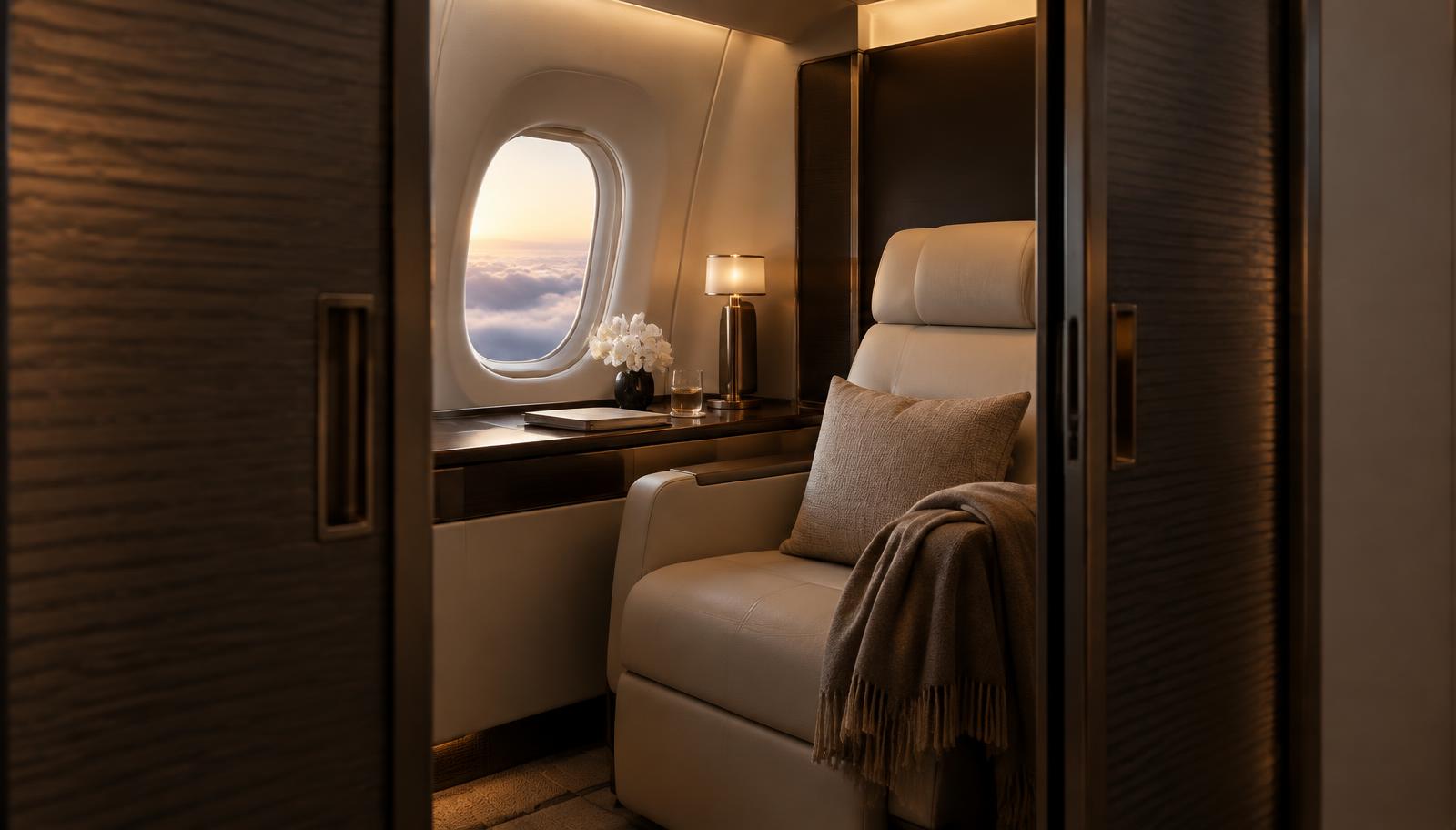
In November, Singapore Airlines revealed a capital investment of S$2 billion, reported by Reuters at $1.6 billion, to overhaul its long-haul fleet. The upgrade introduces enclosed suites with First Class double beds alongside Business Class seats framed by sliding privacy doors. This strategic motivation is familiar across the region, where legacy carriers face rivals upgrading their premium interiors to capture lucrative corporate traffic.
The Architecture of Seclusion
Yet the immediate reception reveals an unresolved friction. An appraisal by aviation review platform The Flight Club concluded that while the carrier's next-generation cabins are beautiful, the design falls short. The critique highlights a deeper structural reality in commercial aeronautics. When an airline installs full-height partitions, it inevitably alters the ergonomics of the surrounding frame, restricting passenger clearance.
The commercial impulse to build residential sanctuaries inside an airborne vessel strains against the physical limits of flight.
Commercial aviation marketing treats privacy as an unquestioned virtue. Wealthy travelers expect domestic solitude at cruising altitude, demanding miniature bedrooms that mask the physical disorientation of transcontinental transit. Carriers answer by installing double mattresses behind opaque screens. These sliding doors require mechanical tracks and structural bulkheads. In an airframe where every cubic inch must be justified against certified safety limits, physical barriers consume the very volume they claim to enhance.
Containment Above the Pacific
Beyond mechanical clearances, this shift signals an evolution in regional consumer expectations. The classic Asia-Pacific long-haul experience traditionally relied on attentive service rather than physical barricades. Crew presence was ambient and reassuring. By enclosing Business Class within solid partitions, airlines alter that social compact. Travelers no longer share a quiet room across an ocean; they sit sealed inside modular cubicles, isolated from the aisle.
Discretion is no longer measured by spaciousness, but by complete insulation from fellow passengers. Premium fliers pay to forget they occupy a collective fuselage.
At Singapore's primary air hub, where intercontinental routes converge daily, the metallic fuselages waiting on the tarmac remain precisely the same width as their predecessors. Inside them, however, the atmosphere has grown compartmentalized. In turning narrow pressurized cylinders into floating private apartments, aviation design has accepted a curious modern compromise: total visual seclusion purchased at the expense of breathing room.
Sources
Newsletter
Pacific Daily
A curated briefing from Thailand, Asia-Pacific and the world.