Launchpad Monopolies Stall Orbital Ambitions
Blue Origin’s postponed return exposes the vulnerability of single-pad infrastructure and commercial launch bottlenecks.
SINGAPORE
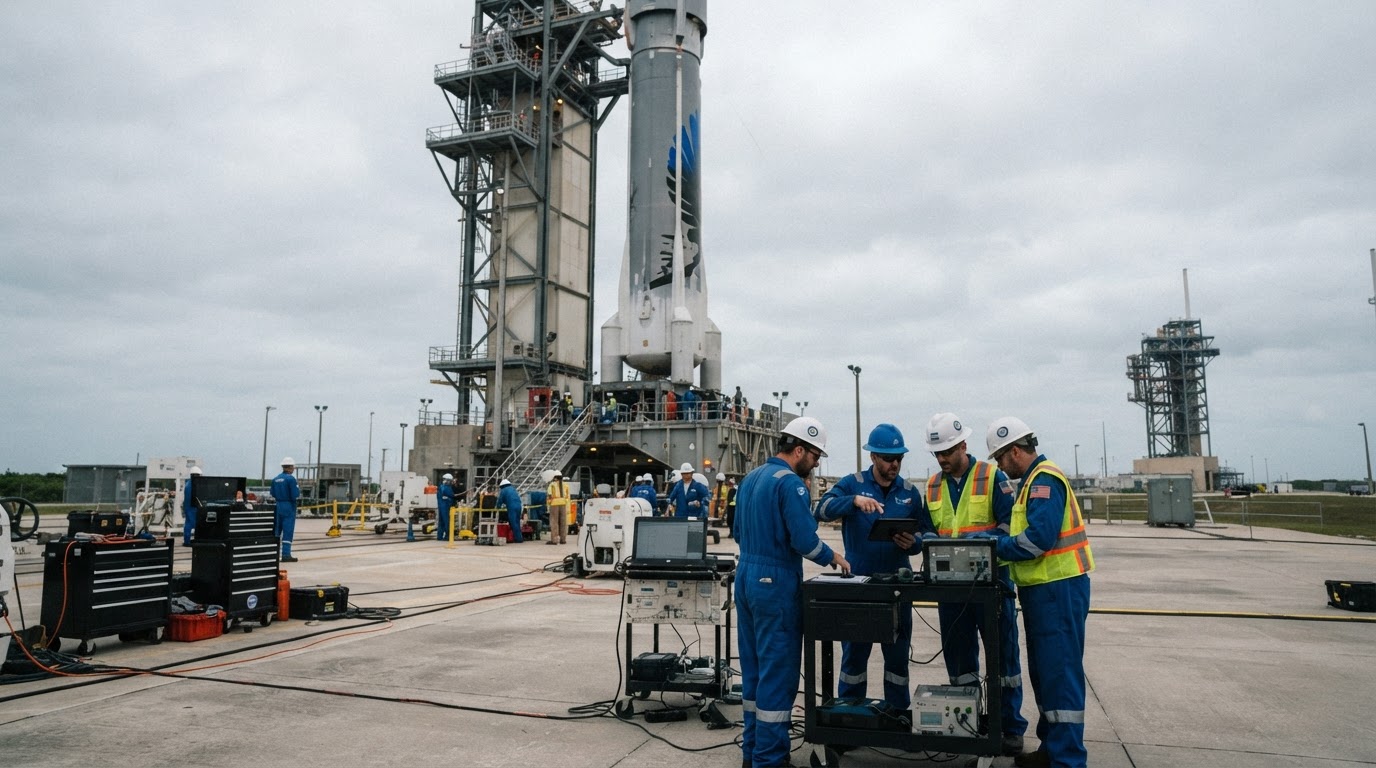
Commercial space deployment assumes that heavy-lift launch cadence can absorb mechanical catastrophe without systemic delay. When Blue Origin CEO Dave Limp notified staff on Thursday that the New Glenn rocket would remain grounded until January 2027, that assumption dissolved into industrial reality. The flagship orbital vehicle has not flown since May, when an explosion destroyed hardware on the company's only operational launchpad at Cape Canaveral Space Force Station in Florida, days ahead of a scheduled mission carrying Amazon satellites.
The setback halts what had appeared to be steady operational progress across previous testing cycles. Blue Origin reached orbit with its New Glenn launch in January 2025, despite missing a booster recovery, and followed in November 2025 by deploying Mars satellites alongside a successful booster landing. Yet the accident in May demonstrated how quickly capital commitments collide with physical limits. Operating from a single pad leaves zero redundancy; any structural failure shuts down the entire flight manifest.
The Bottleneck Behind Commercial Constellations
For commercial networks relying on orbital liftoffs, schedule slippage alters strategic calculations across multiple regions. Amazon planned its payload delivery around New Glenn’s lift capacity, seeking independent orbital placement rather than total reliance on established competitors. That pipeline now sits frozen through late 2026. While North American operators absorb the immediate manifest rescheduling, telecommunications planners across Asia-Pacific markets face secondary consequences as orbital constellation deployments slip past targeted calendar windows.
Hardware availability cannot easily substitute for dedicated infrastructure. Ground facilities demand specialized propellant systems, reinforced acoustic dampening, and rigorous ground support engineering. When an explosion compromises a solitary pad, rebuilding requires forensic reviews and structural certification that rival vehicle assembly itself in duration.
Defenders of private aerospace argue that cautious recertification preserves long-term mission reliability. Pushing a launch before completing launchpad repairs risks compound failures that could shutter operations permanently. Taking an additional quarter to ensure ground resilience represents disciplined risk management rather than managerial hesitation.
The Cost of Fragile Infrastructure
That technical caution, however, collides with the aggressive commercial timetables promised to satellite clients. The heavy-lift sector suffers from acute capacity scarcity. When a major vehicle family loses eight months of operations due to pad reconstruction, client payloads do not simply transfer to alternative domestic or regional providers; those alternative manifests are already fully booked years in advance.
Regional satellite operators in Asian commercial hubs that monitor global launch capacity must reckon with this concentration risk. Launch services remain geographically and physically constricted to a handful of coastal facilities in North America and select international sites. When a launchpad failure in Florida halts delivery of Amazon communication satellites, downstream orbital rollouts across trans-Pacific bandwidth networks absorb the delay.
The industrial trajectory from orbital flight in January 2025 to the January 2027 postponement illustrates a structural reality of the commercial space race. Designing an orbital heavy-lift booster is an immense engineering achievement, but maintaining redundant launch capacity determines whether commercial timetables endure. Until operators construct parallel ground complexes capable of surviving an explosion without halting fleet operations, the commercial cadence of private spaceflight remains chained to single points of physical failure.
Sources
Newsletter
Pacific Daily
A curated briefing from Thailand, Asia-Pacific and the world.