Coastal Tourism Chains Expose the Spatial Divide Between Global Sports and Local Shorelines
Consecutive professional golf tournaments in Mexico demonstrate how international entertainment calendars claim Pacific littoral zones while domestic traditions negotiate shrinking margins.
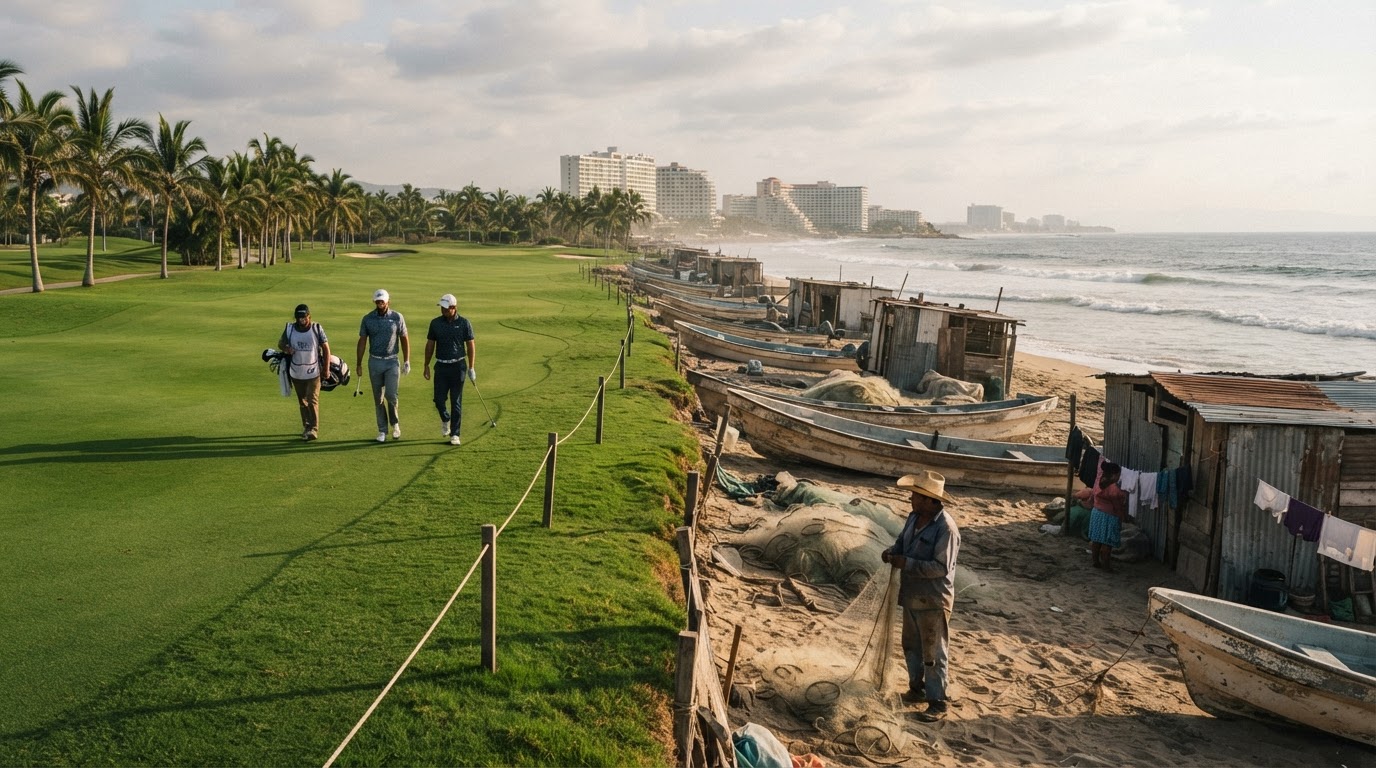
Coastal land has long anchored domestic civic ritual across the Pacific rim, yet national economic planners consistently treat the same shoreline as friction-free infrastructure for international sports broadcasts. In 2026, the PGA Tour interrupted its traditional calendar rhythm by consolidating two Mexican tournaments into consecutive weeks on its FedExCup Fall Schedule. Last week, the VidantaWorld Mexico Open unfolded in Nuevo Nayarit on the Greg Norman-designed Vidanta Vallarta Course, where Golf Channel broadcast three hours of daily coverage as Andrew Novak compiled a five-shot margin of victory. From Thursday through Sunday, the commercial apparatus moves northwest to Baja California Sur, installing the World Wide Technology Championship on the Tiger Woods-designed El Cardonal course at Diamante in Cabo San Lucas. Concurrently, the municipal waters of Los Cabos host Altars at Sea, the annual Day of the Dead boat parade.
This deliberate programming overlap exposes how inland scheduling models disrupt coastal space. Linking two resort tournaments within a back-to-back broadcast window reduces transport expenses for organizers, creating an efficient operational pipeline along the ocean. Yet the arrangement highlights an acute physical contrast. While international television crews track foreign touring professionals across gated turf, communal vessels commemorating the dead must maneuver around private marina infrastructure. Shorelines face competing demands. One use treats the shoreline as a temporary broadcast stage; the other relies on it as ancestral ground.
The Logic of Enclave Development
The administrative rationale behind consecutive touring dates in Nuevo Nayarit and Cabo San Lucas rests on commercial consolidation. Moving television personnel, corporate sponsors, and professional athletes along a single coastal corridor lowers aggregate overhead for sanctioning bodies while guaranteeing predictable content hours for overseas networks. Commercial advocates contend that recurring international golf stops elevate municipal visibility, inject overseas capital into private development funds, and sustain regional service employment through extended hotel occupancy. High-profile sporting stops undeniably attract affluent international visitors whose expenditures fiscal authorities actively pursue.
Staging global entertainment franchises along fragile oceanfront corridors privileges transient commercial revenue over enduring communal access to coastal waters.
That economic defence assumes shoreline real estate can be cordoned off without generating social friction. It cannot. Developing specialized resort courses along arid Pacific bluffs reconfigures public coastline into privatized corridors designed to repel casual civic entry. When tournament organizers assemble bespoke enclaves bearing the design signatures of celebrated athletes, the surrounding maritime communities find their customary physical access restricted to peripheral waterways. Broadcast figures demonstrate high television demand in North America, but that exposure rarely translates into expanded public utility for residents living beyond the perimeter gates.
Divided Littorals Across the Basin
Littoral zones throughout the Pacific basin confront identical structural pressures. National development agencies routinely assign prime oceanfront topography to foreign-branded leisure projects to capture foreign currency reserves, leaving local civic observances to negotiate fragmented public parcels. In Los Cabos, the spatial disparity appears unmistakable: corporate sporting entities secure elevated ocean bluffs, whereas cultural observances such as Altars at Sea must navigate maritime channels circumscribed by luxury hospitality properties. Coastlines cannot indefinitely absorb industrial-scale entertainment installations without constricting the traditional maritime practices that originally defined those waters.
The tournament sequence in Mexico demonstrates that policy decisions formulated in distant executive suites impose tangible physical burdens on coastal geography. Streamlining commercial sports logistics across adjacent seaside hubs optimizes corporate margins, but it accelerates the isolation of coastal ecosystems from residential life. As Golf Channel finishes transmitting tournament rounds from El Cardonal, an unresolved constraint governs the shoreline: national development policies continue to prioritize exportable recreational spectacles, leaving domestic communities to defend their cultural continuity along an increasingly privatized littoral edge.
Sources
Newsletter
Pacific Daily
A curated briefing from Thailand, Asia-Pacific and the world.