Air Traffic Control and the Durability of Technical Debt
The decision by the United States to retire magnetic media by 2028 illustrates how institutional caution complicates infrastructure renewal.
SINGAPORE
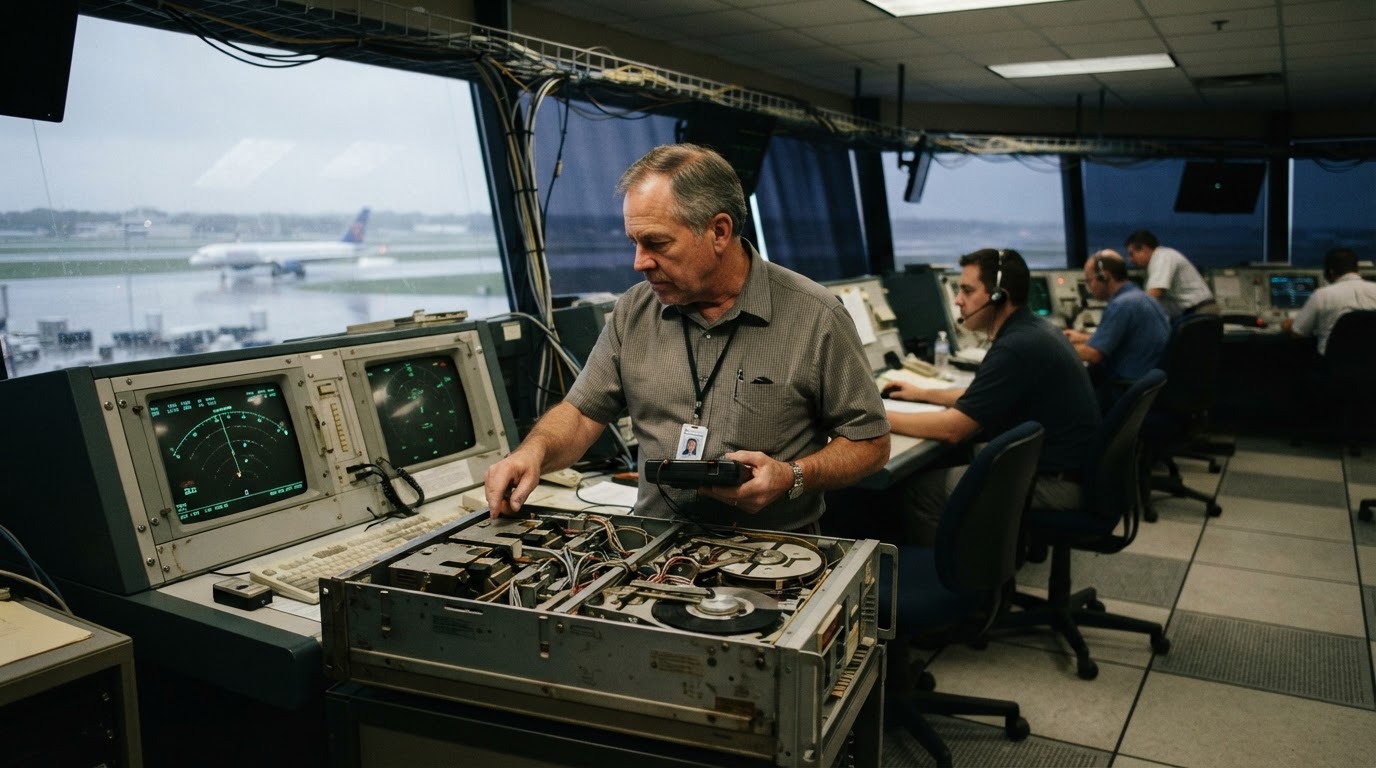
Aviation regulators operate on an institutional presumption that proven reliability outweighs technological novelty. When the US Federal Aviation Administration announced on a Thursday in Nov 2026 that it would replace floppy disks across more than 400 air traffic control facilities by the end of 2028, public discussion focused almost entirely on the antiquity of the medium. Yet treating magnetic storage as a historical curiosity misinterprets why critical infrastructure retains legacy systems long after consumer markets discard them.
The equipment slated for removal belongs to architectures originating in the 1980s. Across American flight sectors, including hubs such as Ronald Reagan International Airport in Arlington, Virginia, these magnetic units have delivered weather data and critical operational instructions without total architectural failure. The planned Enterprise Information Display System will consolidate four separate mechanisms dating to that earlier era into a unified platform. Transportation Secretary Sean Duffy and FAA Administrator Bryan Bedford face an overhaul that is fundamentally about managing operational disruption during a live transition rather than simply procuring newer hardware.
The Cost of Stability
Air traffic management systems balance two opposing priorities: absolute uptime and system modernisation. Upgrading an active flight control corridor carries immediate operational hazards that standard commercial networks rarely confront. A functioning platform, even one dependent on physical disks that ceased widespread manufacturing decades ago, offers predictable failure rates and total isolation from modern network vulnerabilities.
That insulation, however, eventually turns into acute vulnerability. Sourcing replacement physical parts creates supply chain bottlenecks that formal procurement budgets struggle to resolve. When hardware interfaces remain tethered to the 1980s, integration with modern digital telemetry becomes increasingly fragile. The United States is not unique in navigating this deferred maintenance, though the sheer scale of modernising 400 installations simultaneously creates a complex logistical schedule.
Modernisation Across Air Corridors
For international civil aviation, national transitions carry direct cross-border consequences. Flight routes between North America, Asia, and Europe depend on seamless operational handoffs and consistent weather telemetry. While international aviation bodies establish standard flight rules, the domestic architectures supporting those rules diverge significantly across major transit regions.
In high-density airspace, the pace of ground automation directly dictates sector throughput. Modernised interfaces permit controllers to process dynamic weather adjustments more rapidly, reducing ground delays that propagate across transpacific flight routes. Conversely, executing an overhaul across hundreds of towers introduces prolonged transition phases where controllers must alternate between legacy protocols and unproven software environments. Institutional memory often resides in physical workflows, meaning interface changes carry human factor risks that cannot be audited by code reviews alone.
What remains unsettled is whether the 2028 deadline can be met without compromising active traffic flow. Previous national aviation modernisation initiatives frequently encountered implementation friction when replacing core display networks. While retiring media formats from the 1980s is an operational necessity, the underlying challenge lies in executing that transition without exposing air traffic corridors to operational disruption.
Sources
Newsletter
Pacific Daily
A curated briefing from Thailand, Asia-Pacific and the world.