Singapore Airlines Bets on Waste Gas While Asia's Green Fuel Market Stalls
A modest three-year procurement deal underscores how far regional decarbonisation remains from commercial scale.
SINGAPORE
Island gateways across the Asia-Pacific depend entirely on long-haul transit connectivity for economic vitality, yet international civil aviation faces accelerating scrutiny to abandon conventional hydrocarbons before 2050. Both realities are firmly entrenched, and the physical arithmetic connecting them remains deeply unforgiving.
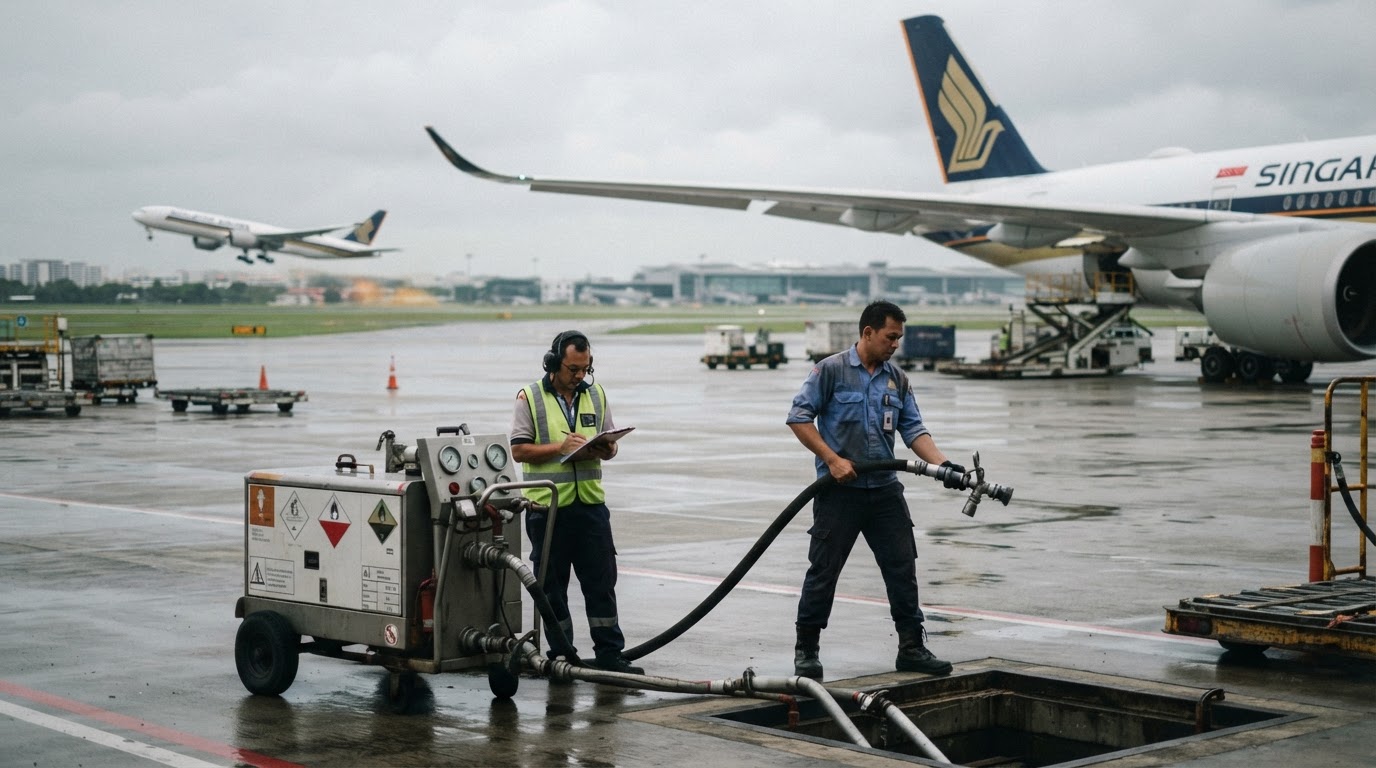
Singapore Airlines confirmed on Wednesday that it has agreed to purchase up to 4,800 tonnes of sustainable aviation fuel over three years from Aether Beacon. Refined from captured industrial waste gases at a planned local facility, the propellant will be delivered into operations at Changi Airport. The transaction establishes a technical precedent for converting domestic industrial emissions into certified turbine kerosene.
Yet 4,800 tonnes distributed across thirty-six months is an extraordinarily modest volume. A single international carrier operating wide-body fleets across the Pacific burns through equivalent fuel within days of routine operation. Measured against the aggregate burn rate of regional aviation, the purchase represents a controlled laboratory experiment rather than an industrial pivot.
The Geography of Production
Singapore's industrial planners have methodically prepared the physical ground for alternative fuel bunkering. Specialized facilities on Pulau Bukom are slated to begin producing sustainable aviation fuel from 2028, mirroring parallel government initiatives to introduce biomethane into domestic gas networks. Contracting early off-take with Aether Beacon allows Singapore Airlines to secure localized compliance volumes while domestic refiners construct their baseline capacity.
The transaction functions less as an emissions breakthrough than as a quiet hedge against severe regional supply shortages.
Beyond Singapore's maritime perimeter, the regional supply chain has effectively stalled. Across China, green jet fuel production facilities have deferred planned operational start-ups amid regulatory ambiguity and an absence of binding state demand mandates. Where Western regulators have enforced statutory blending quotas, Asian aviation authorities have avoided coercive mandates that might erode ticket yields or weaken regional transit competitiveness.
This absence of policy direction strands production economics. Building facilities capable of processing waste gases or non-fossil feedstocks demands immense capital outlay. Refiners cannot justify final investment decisions without firm off-take contracts, while commercial airlines decline long-term purchase obligations at steep premiums over standard jet fuel.
Divided Regional Priorities
The resulting divergence exposes sharp structural fault lines across Asia. While Singapore concentrates novel refining technology and locks in domestic off-take, secondary regional hubs remain spectators to the energy transition. If international aviation bodies enforce tighter carbon standards later this decade, secondary transit hubs will find themselves without access to local green refining capacity or secure delivery channels.
The market logic defending voluntary increments is understandable. Early off-take arrangements, even at 4,800 tonnes, deliver vital commercial visibility to novel waste-gas processing technologies without exposing airline balance sheets to unhedged balance-sheet shocks. Small tranches prove that alternative fuel can flow through existing hydrants without incident.
Yet demonstration projects cannot substitute for structural volume. Absorbing 4,800 tonnes across three years leaves the carrier's broader emissions trajectory essentially unaltered, even as Singapore targets a 2028 industrial ramp on Pulau Bukom. The policy architecture required to scale green fuel across Asia remains unbuilt, stranding aviation between voluntary corporate gestures and rigid 2050 climate realities.
Sources
Newsletter
Pacific Daily
A curated briefing from Thailand, Asia-Pacific and the world.