Collision of Palates: The Shifting Boundaries of Taste in Asia
KFC's Oreo chicken burger in China hints at more than culinary novelty.
SINGAPORE
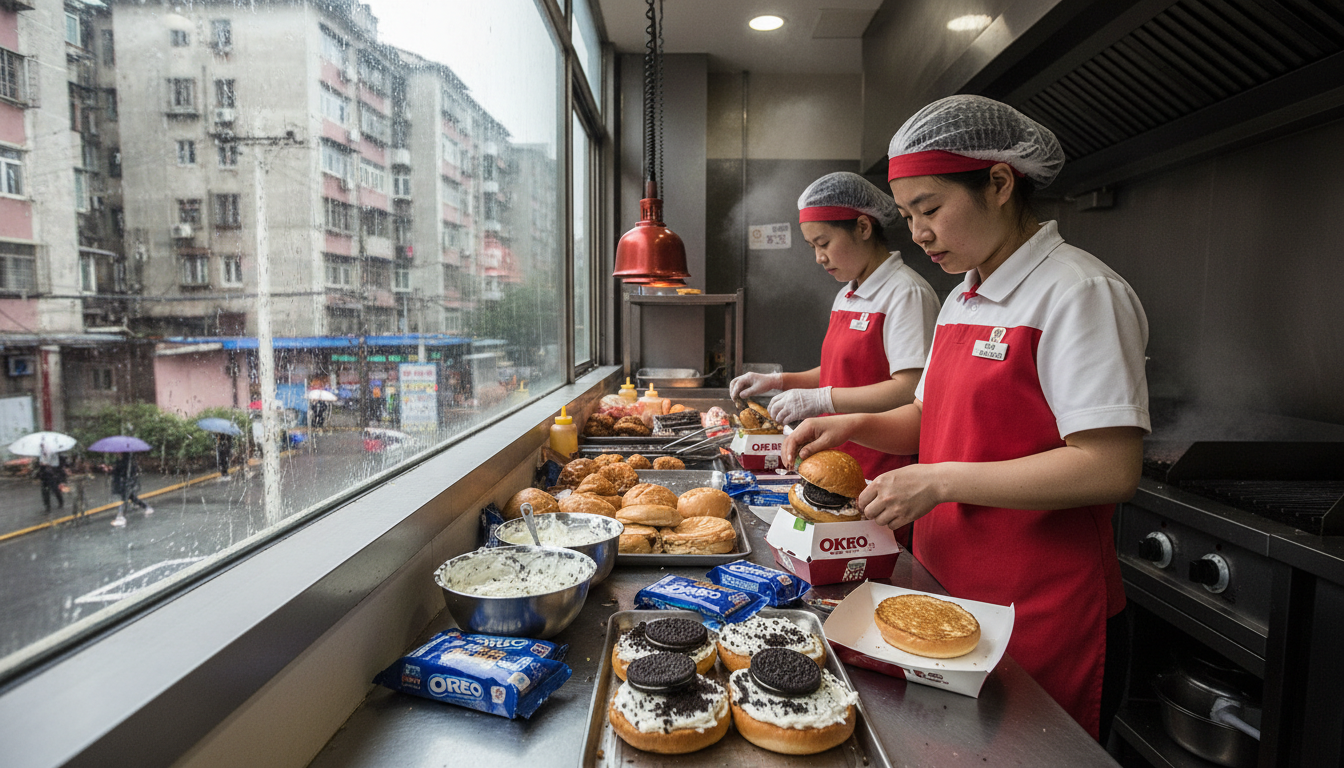
The image itself is unsettling: a fried chicken thigh, lettuce, crushed Oreo cookies mixed into mashed potatoes, all nestled between two black, Oreo-flavoured buns. This creation, dubbed the KFC x Oreo Original Recipe Chicken Burger, is currently available only in China. It is a limited-edition item, described as a collaboration that combines KFC's signature fried chicken with Oreo-inspired ingredients.
This is not a mere menu item; it is an experiment in sensory disjunction. The idea of sweet and savoury colliding is not new, but this particular combination pushes against conventional expectations of what a burger should be. The buns, designed to resemble the chocolate wafers of the cookie, signal a deliberate blurring of categories. What does it ask of those who encounter it? A willingness to suspend culinary logic, perhaps, or to embrace the provocative. The South China Morning Post noted in May 2026 that understanding the Asia-Pacific power struggle often requires looking beyond the obvious; perhaps the same applies to its changing palates.
The initial assessment, driven by marketing language, frames this as a quirky partnership. The Bangkok Post Life in August 2026 suggested the worlds of sweet and savoury have 'collided again' through this 'unlikely partnership.' Yet, framing it as mere collision risks missing the underlying cultural currents. Fast-food collaborations are commercial ventures, designed to generate interest and sales, but their success often reveals deeper shifts in consumer adventurousness or market saturation. When established brands like KFC and Oreo feel compelled to venture into such unconventional territory, it speaks to a market seeking novelty, or perhaps, a market so competitive that even fundamental flavour profiles are up for reinterpretation.
The challenge this presents to established food cultures, especially in a region as diverse as Asia, is significant. While this specific burger is limited to China, the broader trend of sweet-savoury fusion has precedents. Some cuisines integrate sweet and savoury elements within a meal's flavour balance. The KFC x Oreo burger, by contrast, appears to be an all-encompassing, singular statement. It suggests a comfort with radical flavour juxtaposition that could eventually inform offerings across the broader Asia-Pacific. The Malay Mail reported in July 2026 that Malaysia hosts the IAEA’s only Asia-Pacific nuclear security equipment hub, while The Japan Times noted in March 2026 how the war in Iran could help China and change Asia. These geopolitical observations highlight a wider regional landscape where shifts in balance and influence are constant.
This burger, with its black buns and cookie-laced potatoes, acts as a barometer. Its existence, even as a limited run, indicates a willingness of a major global brand to test the boundaries of taste perception in a specific market. The implication is not just about a temporary curiosity; it is a prediction that the tolerance for such culinary hybrids may broaden, demanding a similar re-evaluation of expectations from diners across the region. Whether these unconventional items become staples or fade into memory, their appearance suggests a landscape where the expected is increasingly challenged, and the very definition of 'food' is subject to playful, yet deliberate, deconstruction.
Sources
Newsletter
Pacific Daily
A curated briefing from Thailand, Asia-Pacific and the world.