Capital Depth and Late Volatility in Bayern Munich's Domestic Balance
An isolated scare at Europa Park Stadion illustrates how structural roster margins absorb operational errors before outcomes fracture.
SINGAPORE
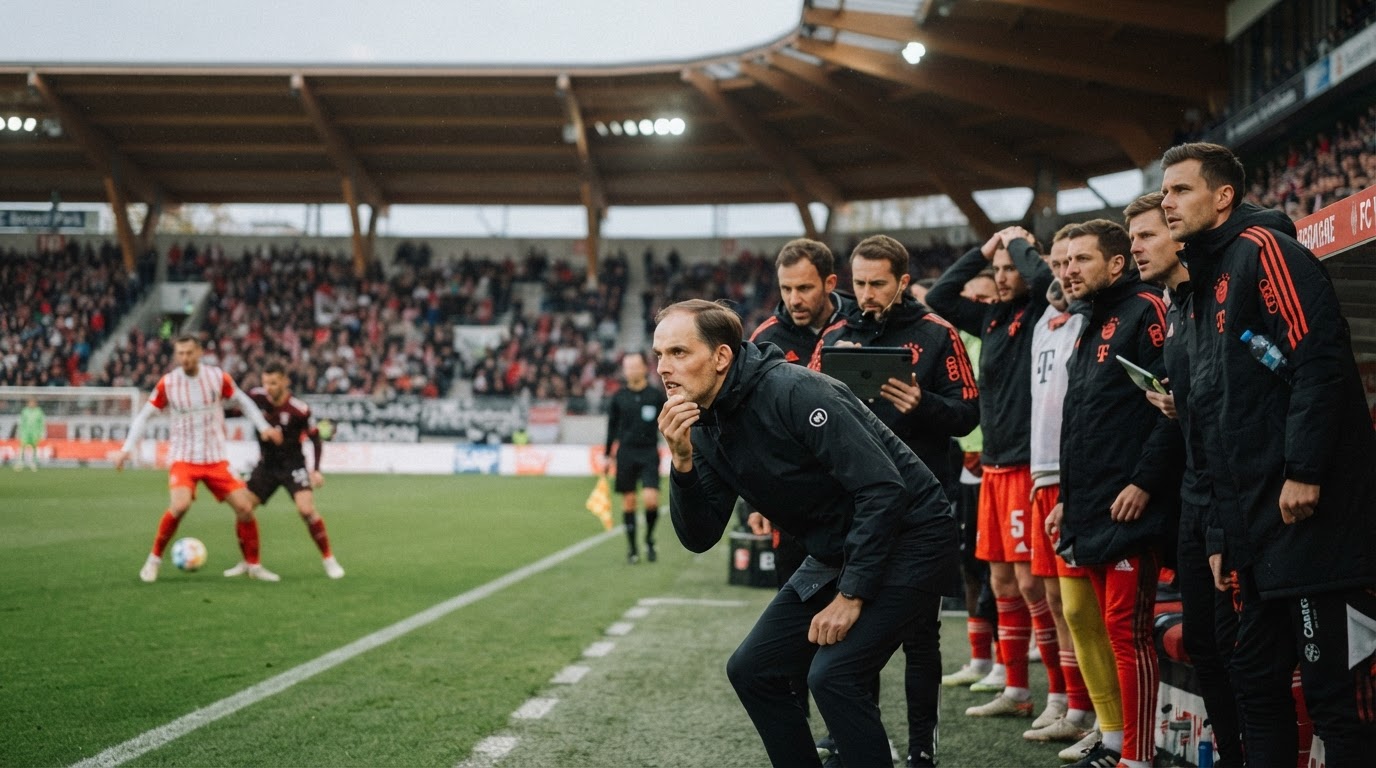
Operational margins determine sporting survival long before aesthetic form comes into question. On October 25, 2026, Bayern Munich preserved their unbeaten start to the Bundesliga campaign with a 3-1 victory against SC Freiburg at Europa Park Stadion. Match records show central defender Dayot Upamecano opening the scoring in the 17th minute after a forward sprint through the middle on a counter-attack. The match followed an orderly script until an own goal from Tom Bischof disrupted that lead, injecting sudden friction into what had seemed a controlled away assignment.
Freiburg mounted immediate pressure. For roughly twenty minutes, the host squad forced play into Bayern's defensive sector, hunting an equaliser that would alter the domestic table. Yet the structural buffer built into top-tier rosters operated as intended. When Freiburg overcommitted forward, Bayern capitalised on the resulting open space, and Michael Olise scored the third goal to seal the win.
Roster Cushioning Under Variance
Elite athletic institutions operate under heavy competition schedules where fatigue and tactical disruption are inevitable. The tactical puzzle is not whether mistakes happen, but whether the organisation possesses the capital depth to neutralise them when they do. An own goal by Tom Bischof represents pure match variance. In less resourceful structures, such an error frequently triggers collective panic, exposing teams to compounding failures.
Bayern absorbed that shock because their operational floor remains exceptionally high. Olise converted the decisive late opportunity precisely because Bayern retain match-winners capable of operating independently when collective passing rhythms stall. SC Freiburg exerted intense collective pressure, but systemic pressing carries asymmetric liabilities against superior transition talent. When the host side pushed up, they conceded the transitional space that Olise exploited.
Balance sheets insulate elite institutions against transient operational failures by funding decisive counter-leverage.
Broadcasters sell these moments as dramatic jeopardy. Commercial planners, by contrast, price European sporting franchises on their predictability. Global media interest in the Bundesliga relies on competitive tension existing on paper, even as the capital advantage of market leaders ensures structural stability at the summit. The late push at Europa Park Stadion produced theatrical tension, but the economic architecture of the contest tilted the ultimate outcome heavily toward the incumbent.
Structural Floor Against Future Opposition
Skeptics can reasonably argue that Bayern's late-game vulnerability against mid-table opposition signals deeper tactical exposure. Relying on counter-attacks from defenders like Upamecano and late bailouts from Olise suggests that Bayern's midfield control is not entirely leakproof. If unforced defensive errors recur against higher-calibre domestic rivals such as Bayer Leverkusen, the margin for recovery will narrow sharply.
Even so, Bayern leave Freiburg with maximum points because their structural insulation withstood the strain. Maintaining an undefeated domestic record across an autumn campaign does not demand flawless execution in every half. It requires the capacity to survive acute operational volatility and extract decisive finishes when the opponent overextends.
Whether this operational buffer holds across the winter depends on how effectively Bayern eliminate individual errors before facing opponents equipped to exploit them.
Sources
Newsletter
Pacific Daily
A curated briefing from Thailand, Asia-Pacific and the world.