AI-Driven Hiring Shift in India’s Tech Hubs Points to Regional Labor Market Pressures
A reported AI-driven hiring slowdown at multinational offshore tech centers in India signals an impending structural challenge for Asia-Pacific economies dependent on tech service models.
SINGAPORE
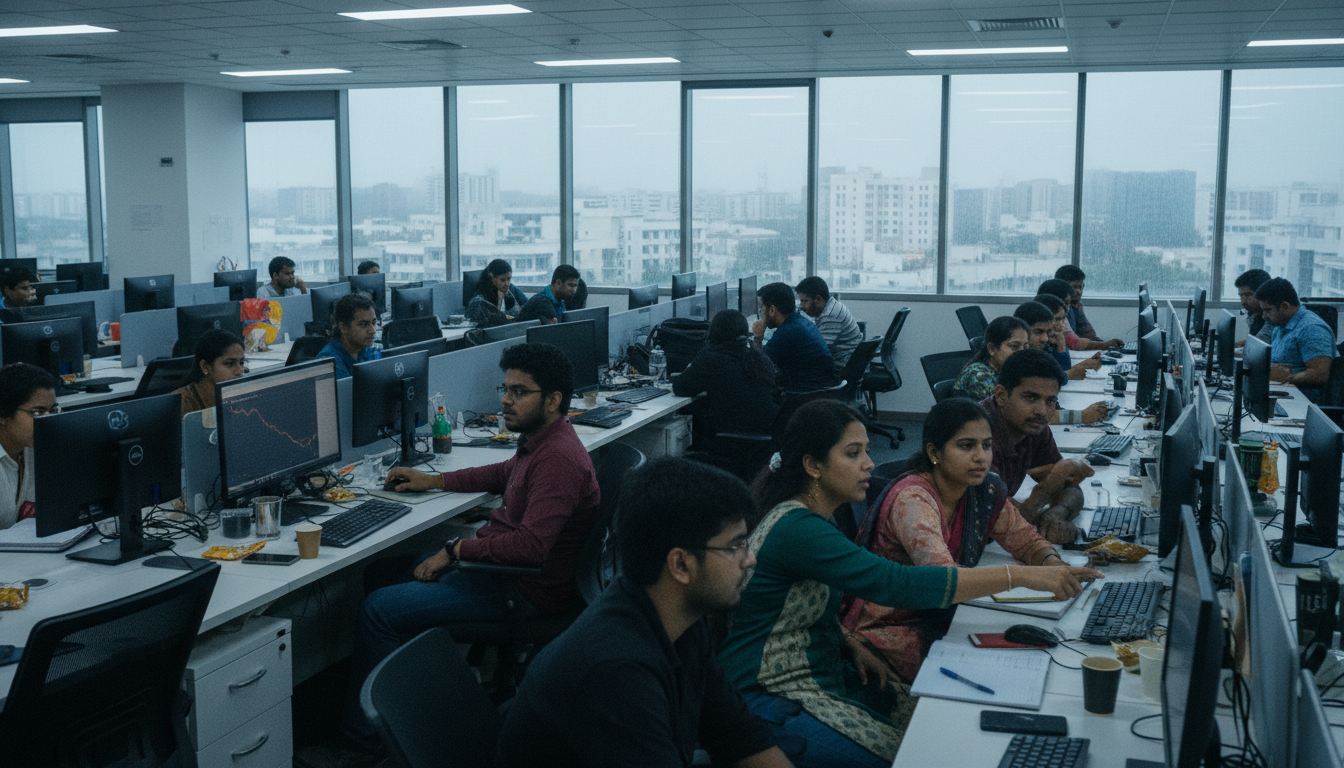
Multinationals' Indian offshore tech hubs face an AI-driven hiring slowdown, according to a Nikkei Asia report from October 9, 2026. This development, centered on significant employment hubs in India, suggests a fundamental change in how global companies manage technological operations and staffing. While India is the immediate focus, this trend has implications for other Asia-Pacific economies that rely on similar models of outsourcing and tech service provision.
Artificial intelligence is reshaping the demand for specific skill sets within the technology sector. The reported slowdown indicates that tasks traditionally performed by human workers are increasingly subject to automation or efficiency gains through AI. This is not merely a cyclical adjustment but a structural transformation, driven by ongoing technological evolution. The HSBC CEO, as reported by Livemint on May 20, 2026, urged staff to ‘not resist the change,’ noting that Artificial Intelligence will destroy certain jobs. This attributed claim underscores the potential scale of this transition.
For countries such as Thailand, Indonesia, and Vietnam, which are actively developing their tech capabilities and attracting foreign investment in IT services, India’s experience offers a cautionary signal. The traditional appeal of lower labor costs, a primary driver for establishing offshore hubs, could diminish as AI tools become more sophisticated and more widely adopted. Investments in human capital and educational systems must adapt to foster skills that complement, rather than compete with, AI technologies.
The challenge for regional economies is to integrate AI responsibly without undermining the stability of labor markets. The BBC reported on August 4, 2026, on workers caught in the AI transition, with one individual stating, "I feel like I dug my own grave." Such attributed human cost, if not managed, carries potential social and economic consequences. Governments across the region must consider policies that support workforce retraining and diversification of economic activities, moving beyond simple cost arbitrage in tech services.
Citigroup predicts strong deal activity in 2026 in Asia Pacific, an observation reported by The Business Times in 2026. This projection does not, however, specify the nature of employment within these deals. High deal activity could coincide with reduced hiring if new ventures prioritize AI-driven efficiency over human scale. The critical factor is not solely the volume of economic activity but its character and impact on job creation. Policymakers must examine the capital plans driving such activity.
The ongoing AI transition demands strategic responses from national policymakers. Relying solely on past models of economic growth for tech services may prove unsustainable. Any commitment to technological advancement must survive contact with a clear capital plan that accounts for potential employment shifts. The unresolved tension lies between the efficiencies gained through AI and the necessity of stable, inclusive employment across developing Asia-Pacific economies.
Sources
Newsletter
Pacific Daily
A curated briefing from Thailand, Asia-Pacific and the world.