Administrative Proceduralism Meets Political Settlement in Bangkok
The formal delay in reviewing Thaksin Shinawatra’s amnesty bid highlights the institutional friction governing Thailand’s elite accommodations.
BANGKOK
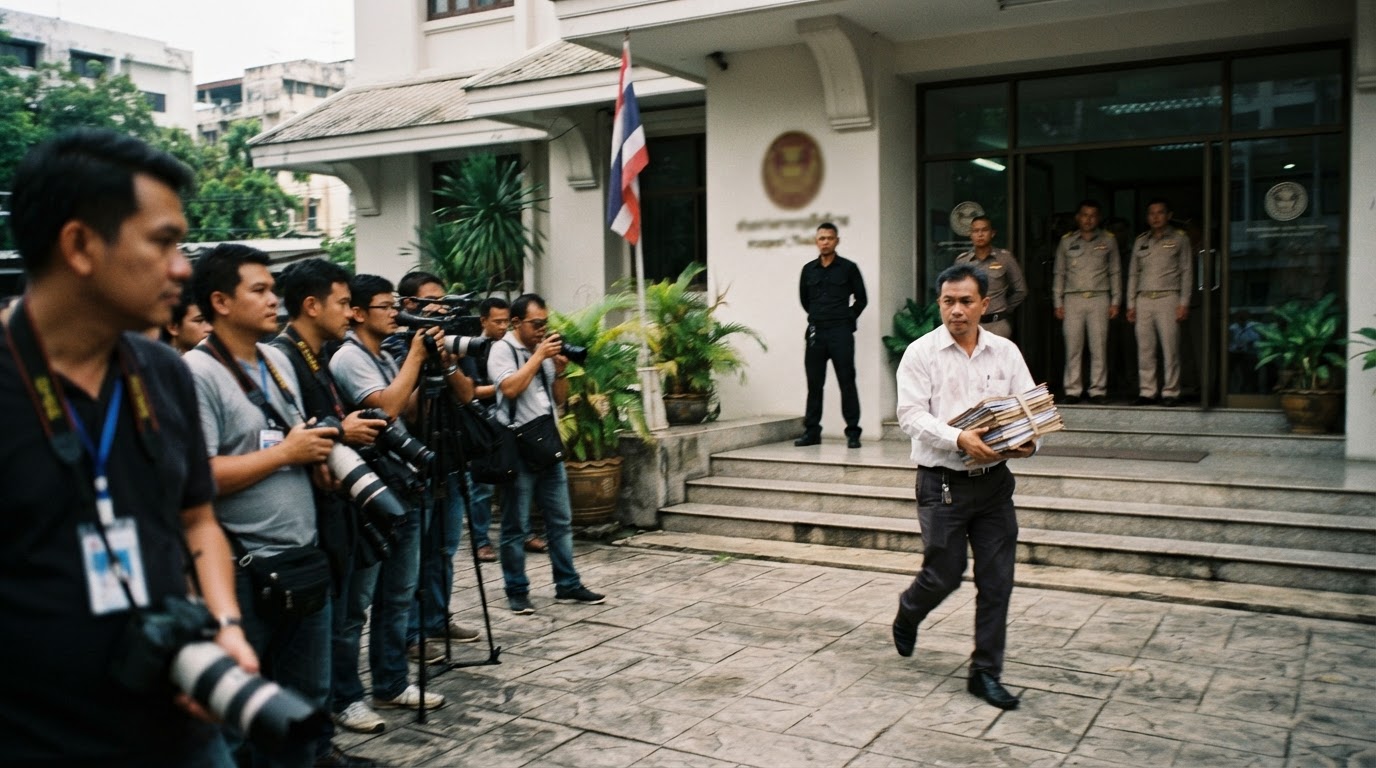
The formal paperwork has not arrived. Justice permanent secretary Piyasiri Wattanawarangkun confirmed that a subcommittee under his leadership had not yet received former prime minister Thaksin Shinawatra’s petition for amnesty in political cases. Official awareness remains confined to media reports. That procedural pause establishes where decision-making power currently resides.
Procedural distance shields the civil service from premature political exposure. By confirming that no filing has officially crossed his desk, Piyasiri draws a sharp operational boundary between political maneuvers in Bangkok and statutory administrative execution. Bureaucratic bodies handling political disputes operate under heavy legal scrutiny. When factional negotiations accelerate ahead of statutory due process, civil service leaders routinely deploy procedural formalities as defensive barricades. They decline to validate elite accommodations before the paperwork mandates formal review. This tactical hesitation prevents premature administrative ownership of a contentious political compromise, preserving institutional space while the broader political framework tests its stability.
The Mechanics of Bureaucratic Hesitation
Statutory sequencing governs administrative behavior in Thailand. Piyasiri chairs the designated subcommittee responsible for filtering amnesty applications before higher bodies can deliberate. Until an applicant submits verifiable documentation directly through prescribed channels, the ministry maintains no legal mandate to examine past political conflicts. Bureaucracy enforces inertia to protect itself against shifting factional currents.
Bureaucratic process serves as a shock absorber when political accommodations outpace statutory machinery.
The resulting tension exposes a structural divergence in how different branches of the state operate. Factional leaders rely on speed and broad accommodations to cement political realignments. Administrative bodies, by contrast, depend on strict adherence to statutory rules to defend their institutional survival. A petition seeking amnesty for long-standing political friction tests administrative boundaries. Civil servants understand that facilitating expedited legal relief without meticulous documentation creates legal vulnerabilities that persist long after immediate coalitions fracture. When political expediency demands swift results, the civil service counters with regulatory caution, ensuring every administrative step is documented to withstand future investigations.
Advocates of rapid political resolution offer an opposing calculation. Lingering political cases sustain factional discord, and prolonging legal uncertainty risks unraveling fragile elite pacts. From this perspective, administrative hesitation introduces unnecessary friction into a political settlement that requires closure. Deferring the formal examination of amnesty applications invites public suspicion that institutional inertia is obstructing broader national stabilization.
Institutional Costs of Elite Reconciliation
That counterargument ignores the legal realities facing state administrators. Political alliances in Bangkok shift rapidly, but personal administrative liability remains tied to individual civil servants. If Piyasiri’s subcommittee acts precipitously without formal filings, officials expose themselves to procedural challenges and statutory liability. Demanding strict adherence to procedural milestones is not obstructionism. It represents rational bureaucratic self-preservation in an environment where past political settlements have repeatedly collapsed into retrospective legal scrutiny. The permanent civil service refuses to absorb political risks generated by elected leaders.
Receipt of the dossier will not resolve these contradictions. Once Piyasiri’s subcommittee formally accepts the petition, attention will shift toward how the committee differentiates political cases from statutory violations. Applying statutory criteria uniformly will test whether administrative review functions as an independent regulatory screen or simply ratifies elite agreements.
The regional dimension across Asia reflects broader concerns over institutional predictability. International partners evaluate Thailand not merely by coalition agreements, but by the resilience of its administrative architecture under political strain. How regulatory bodies navigate elite reconciliation indicates whether statutory institutions can maintain functional autonomy against factional gravity. For now, the structural constraint remains firm: political compromise cannot advance until the civil service formally opens the docket.
Sources
Newsletter
Pacific Daily
A curated briefing from Thailand, Asia-Pacific and the world.