The Balance Sheet of Amazon Highway BR-319
State infrastructure projects alter regional land incentives long before paving crews complete their routes
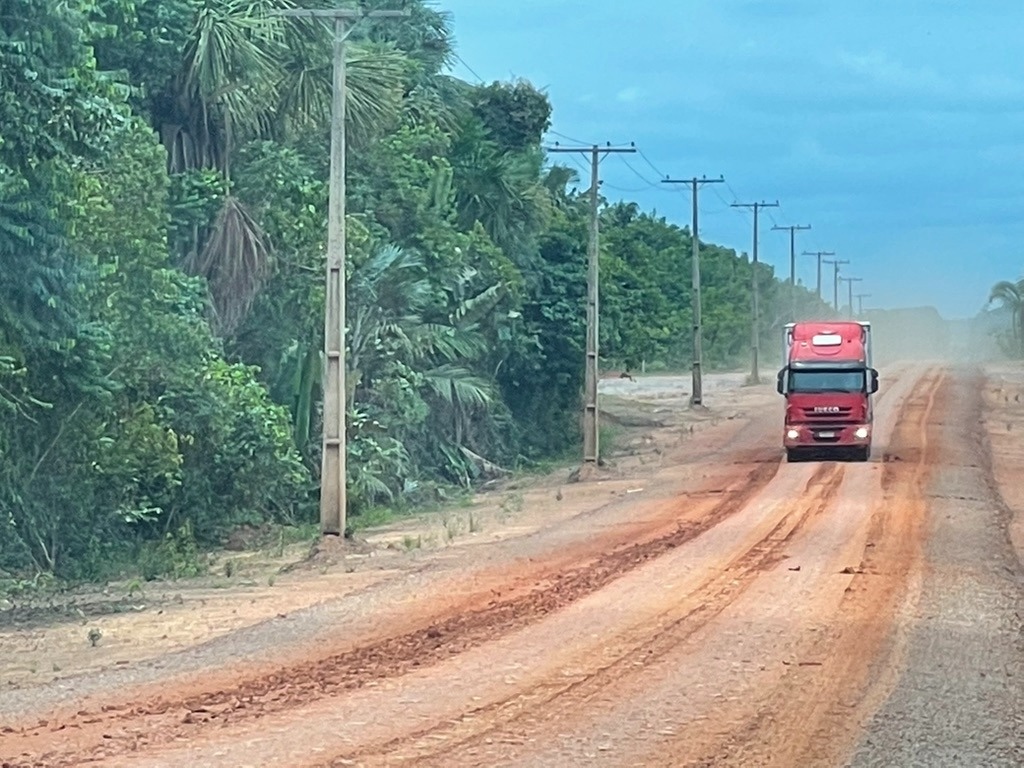
Public transport planning frequently operates on a persistent structural miscalculation: administrative authorities assume that arterial corridors distribute state governance, whereas unmonitored roads distribute commercial access. Capital enters isolated geography far faster than regulatory oversight can establish institutional control. Under such asymmetric timing, the economic beneficiaries are rarely the fiscal authorities financing the project. Peripheral arteries create immediate commercial opportunities for actors unburdened by compliance costs.
Brazil offers an immediate case study along the BR-319 highway. Running between Manaus and Porto Velho, the route cuts across one of the Brazilian Amazon's largest stretches of forest. An academic study affiliated with the Center for Climate Change, CBioClima, and Paulo University (USP), co-authored by Lucas Ferrante, demonstrates that criminal organizations now dominate expansive areas of land along the corridor. Their operations combine illegal logging, illegal gold mining, land grabbing and cattle ranching. The mechanism behind this territorial shift is structural rather than accidental. Upgrading a remote corridor reduces future transport penalties, which swiftly inflates the speculative value of adjacent forest tracts. Illicit networks clear tracts to establish informal ownership, betting on political regularisation or profitable resale.
The Speculation Cycle
Market distortions along BR-319 did not wait for finished asphalt. Engineers initially laid the road during the 1970s, but authorities left it largely abandoned by 1998. Deforestation surged abruptly after 2015, when then-president Dilma Rousseff authorized the first maintenance work on the highway. That administrative decision reordered private risk calculations across the entire basin. Her successor, Jair Bolsonaro, promised to pave the road, accelerating land speculation alongside the conversion of large forest areas into cattle pasture. What appeared to be standard public works planning acted instead as a powerful economic catalyst for informal colonization.
Every public commitment to infrastructure functions as an unhedged operational subsidy for illicit extractors. Road improvements compress the transport discount imposed on heavy goods such as timber, gold and cattle. Commercial operators value acreage against projected freight efficiency rather than present conditions. Because enforcement presence remains negligible across interior expanses, syndicated networks capture this land value without internalizing administrative or ecological liabilities. Public treasuries fund maintenance and repairs, while private cartels harvest the financial upside. Private incentives align squarely behind rapid forest conversion before state regulators can assert zoning discipline.
Highway proponents counter that overland connectivity is indispensable for regional integration, arguing that reliable roads cut freight friction between northern manufacturing centers and southern consumer markets. Proponents contend that paving allows public services, trade and environmental monitoring teams to travel efficiently. Historical evidence across frontier corridors contradicts that sequence. Illicit extraction regularly outpaces institutional enforcement. Once physical entry opens, unauthorized clearing outstrips bureaucratic capacity to enforce legal land titles. The theoretical dividend of state access evaporates when unregulated extraction captures the corridor first.
Corridors and Organized Crime
These dynamics reveal systemic vulnerabilities that extend across the Pacific Rim. Assessments by the United Nations on Transnational Organized Crime record how logistical corridors attract syndicated operations across land and sea. When governments expand transport infrastructure without first anchoring enforceable administration, non-state groups capture the jurisdictional vacuum. Similar extraction patterns appear wherever physical access expands ahead of regulatory presence. Transport arteries intended to foster lawful commerce instead become conduits for non-compliant syndicates operating beyond state scrutiny.
Fiscal expenditure cannot be judged strictly on engineering benchmarks or travel duration. Lacking clear property boundaries and continuous administrative oversight, maintenance allocations act primarily as capital incentives for unlawful enterprise. Physical roadway completion matters less than the commercial reactions unleashed by the announcement of work. The fundamental dilemma remains unresolved: until governments establish operational rule of law prior to grading transit lines, corridors such as BR-319 will continue to underwrite the illicit cartels that displace state authority. Infrastructure without governance is simply an asset transfer to the margins.
Sources
Newsletter
Pacific Daily
A curated briefing from Thailand, Asia-Pacific and the world.