A Museum's Moving Exhibition: Stability Amidst Unstable Times?
The Singapore Art Museum's latest show, 'The Present Is Unstable,' challenges traditional notions of display and interpretation, prompting a re-evaluation of cultural institutions' roles.
SINGAPORE
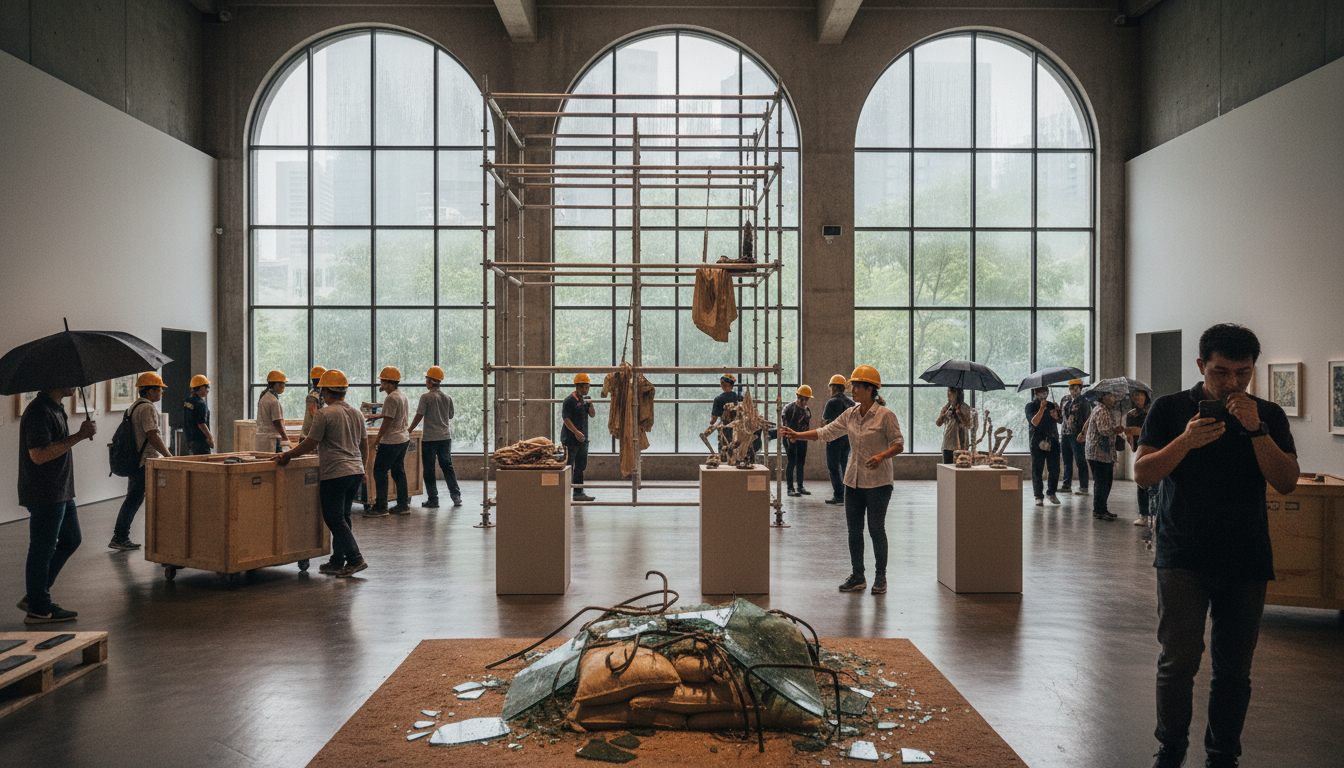
The Singapore Art Museum (SAM) will launch a new exhibition on October 2, 2026, titled 'SAMCollection: The Present Is Unstable.' This show, drawn from the museum's permanent collection, explicitly invites public interpretation without fixed themes. Significantly, all current works are scheduled to be changed by February 2027. This means the exhibition will look entirely different just four months after its opening.
Such an approach signals a departure from the static exhibition model, where a collection is presented as a fixed narrative. Curator Ong Puay Khim noted that the instability of the world today serves as the organizing principle for the exhibition. Public programs accompanying the show include activities such as drag and Butoh dance, suggesting an expansive view of engagement beyond passive viewing.
The museum's decision to embrace flux for its collection offers a commentary on the very nature of cultural preservation in an era defined by rapid shifts. While conventional wisdom holds that museums provide a stable repository for history and art, SAM's design suggests a different priority: perhaps relevance through adaptability. This strategy implicitly questions the enduring value of a singular, authoritative curatorial voice, instead positioning the audience as active participants in constructing meaning. The ongoing rotation of works could be seen as an acknowledgment that the 'present' is indeed unstable, and any attempt to freeze it in time through art risks becoming quickly dated.
However, constant evolution could also present a challenge to the museum's role as an educational institution. A perpetually changing exhibition might offer a fresh perspective for repeat visitors. Yet, it could also fragment the visitor experience, making it difficult to engage deeply with specific works or to trace a coherent artistic progression. For institutions across the Asia-Pacific that often balance preservation with public engagement, SAM's experiment offers a practical case study in how far an institution can push the boundaries of dynamism before risking its foundational purpose. The stated goal of cultivating new collectors, as seen with Singapore Gallery Month events earlier in 2026, suggests an institutional imperative to remain current and appealing.
SAM's choice to reflect instability through its physical presentation is a precise observation. It positions the museum not as a passive mirror of an unstable world but as an active participant in that instability, using its own institutional form to embody a broader cultural condition. What remains is whether this active embrace of impermanence ultimately strengthens the museum's connection with its audience or dilutes its ability to convey lasting cultural narratives.
Sources
Newsletter
Pacific Daily
A curated briefing from Thailand, Asia-Pacific and the world.