A Monarch's Final Voyage: Norway's Signal to the Asia-Pacific
King Harald V's CO2-absorbing sarcophagus offers an unexpected lens on legacy and environmental responsibility.
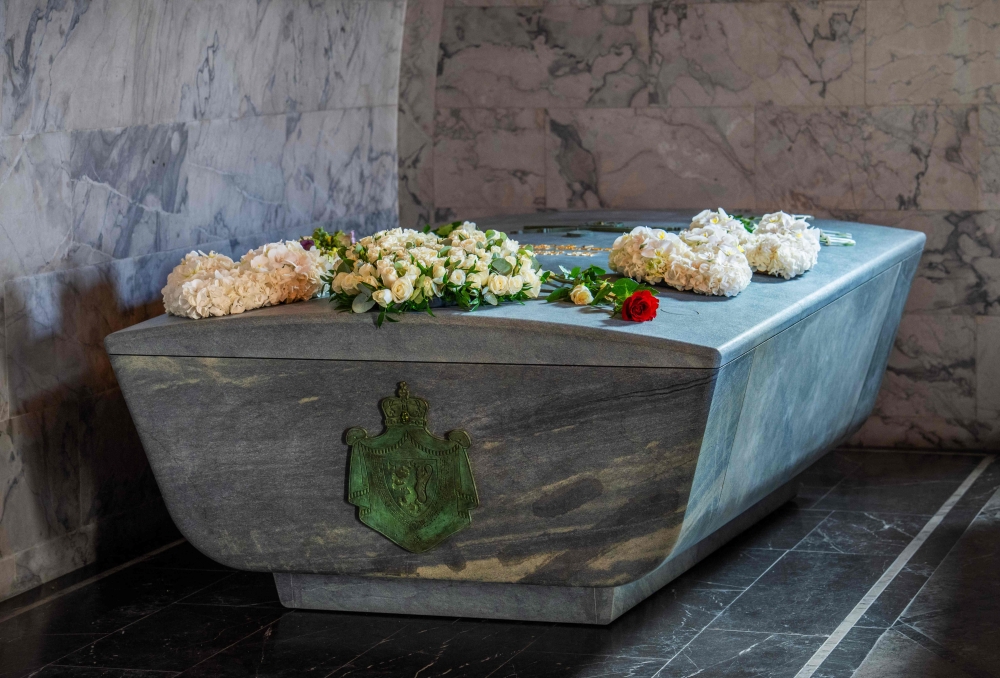
SINGAPORE
The final resting place of Norway's King Harald V, a ship-shaped sarcophagus carved from a CO2-absorbing material, marks not merely the conclusion of a life, but also, for those observing from distant shores, a striking consideration of legacy. The King, who died at 89, was noted as a reform-minded head of state. Now, his interment offers a quiet, material statement that extends beyond the fjords of his homeland, hinting at shifts in how nations, even monarchies, perceive their enduring place in a warming world.
This specific detail of the King's entombment, reported by Malay Mail Life on 2026-09-19, is not merely a curiosity. It is an artifact of intent. To choose a sarcophagus designed to absorb carbon dioxide, even if symbolically, is to acknowledge a responsibility that reaches past the traditional markers of sovereignty. It places the very act of eternal rest within a modern environmental context.
For a region like the Asia-Pacific, often confronting its own complex relationship with industry, development, and environmental consequence, such gestures from afar carry weight. The image of a monarch, literally encased in a solution to a global problem, prompts a question: what does this ask of other nations, other leaders, other societies? It is not merely about kings, but about how national identity, history, and even death are beginning to intersect with the urgent narratives of climate change.
A Silent, Material Statement
The immediate impact of such a choice is not economic or legislative; it is narrative. It embeds an environmental consciousness into the very fabric of national memory. An attributed claim from Malay Mail Life notes the king was laid to rest in a "CO2-absorbing sarcophagus." This detail, however understated, presents a counterpoint to the more overt declarations and policies that typically dominate environmental discourse. It is a quiet, yet deliberate, act of alignment with a future-oriented principle.
One could argue that the practical impact of a single sarcophagus, however advanced, on global carbon levels is not readily quantifiable. This perspective, focusing on literal quantitative effect, suggests the gesture is more performative than substantive. Indeed, the material itself is merely a tool, and its effectiveness as a large-scale solution for carbon absorption remains unquantified in the available facts. The cost implications or the broader availability of such materials are also not stated. However, this counterargument overlooks the cultural and symbolic power of such an act, especially when undertaken by a figurehead whose role is often defined by continuity and tradition.
The King's journey to this final resting place was documented over several months. Reuters reported King Harald V's death on 2026-08-28, at 89 years old. Norway bid farewell to the late King Harald on 2026-09-09, as reported by Reuters. The timing of his entombment, marked by this particular sarcophagus, adds a distinct final chapter to a life of reform, elevating an environmental principle to a position of enduring significance.
In the Asia-Pacific, where ancient customs often meet modern challenges, the Norwegian precedent is not one to be directly imitated, but to be considered. It implies that even the most sacred of traditions can be re-imagined to reflect contemporary values. The question is not whether other nations will adopt CO2-absorbing funerary practices, but how they might integrate environmental responsibility into their own distinct expressions of legacy and honor. The ship-shaped sarcophagus, a symbolic vessel for a king known for reform, sets sail not just for the afterlife, but for a new horizon of national consciousness.
Sources
Newsletter
Pacific Daily
A curated briefing from Thailand, Asia-Pacific and the world.