Why Mexico's Intercepted Avocado Cargo Resets Pacific Biosecurity Calculations
The destruction of 52 tonnes of export fruit across four Mexican states underscores how fragile trans-Pacific agricultural corridors remain when invasive pests evade orchard controls.
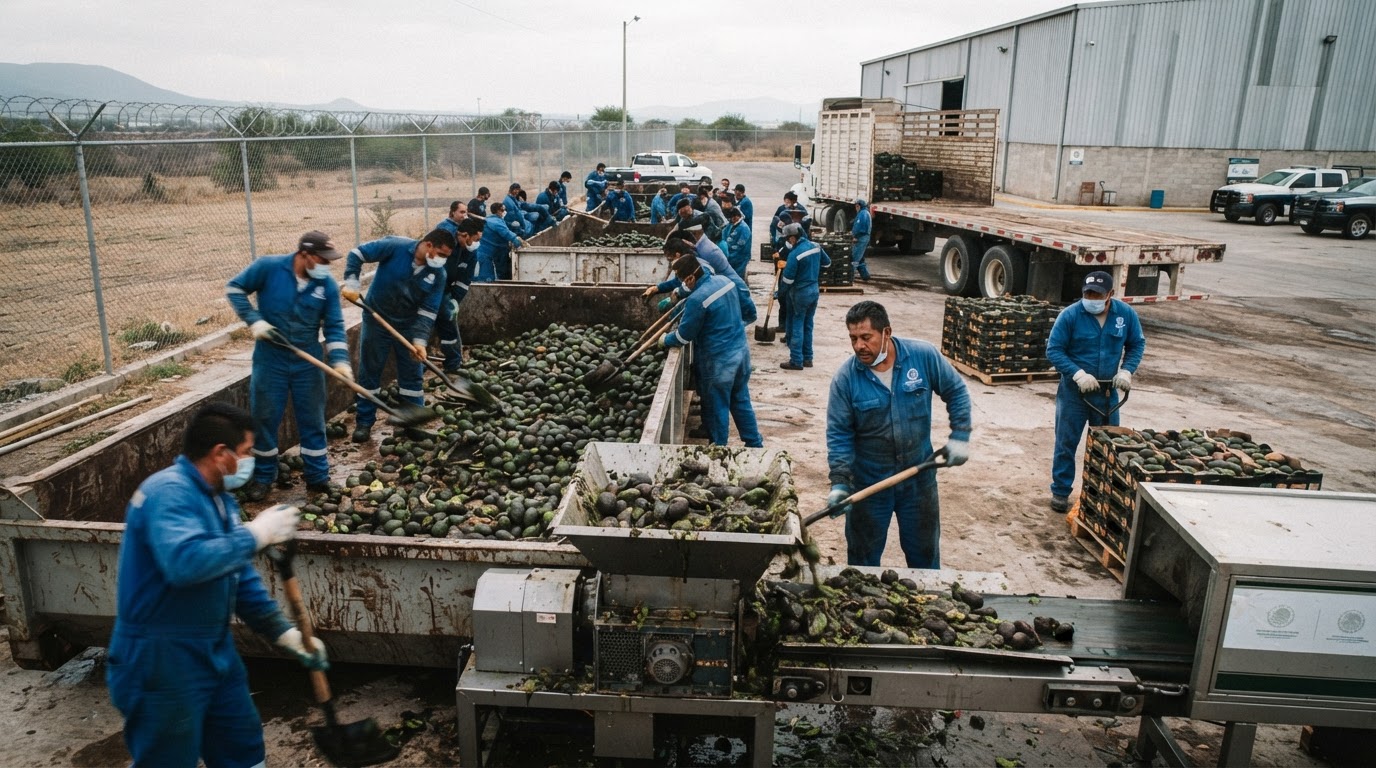
Agricultural export corridors across the Pacific Rim function on an unspoken compact of domestic containment, where importing nations outsource biosecurity enforcement to origin ports. That administrative equilibrium broke down when Mexican phytosanitary authorities halted outbound consignments across Michoacán, Jalisco, Colima and Nayarit. The immediate trigger was uncomfortably concrete: inspectors uncovered the avocado seed weevil inside commercial fruit destined for foreign markets. Ensuing quarantine interventions forced growers to destroy approximately 52 tonnes of avocados over the weekend, demonstrating how swiftly a biological vector can interrupt high-volume international trade.
The discovery arrived after climatic disruption battered the same growing corridors, following weeks after Hurricane Simon brought severe coastal floods and evacuations along Mexico's Pacific littoral in October. Heavy rains and systemic logistical friction frequently complicate field containment protocols. For export economies along the Pacific basin, the quarantine crisis exposes an enduring structural vulnerability. National export channels routinely rely on pre-clearance regimes to maintain velocity, yet biological realities frequently overwhelm regulatory paperwork when pests establish a foothold across multiple contiguous territories.
The Fragility of Port Protocols
Phytosanitary regulators operate with minimal margin for error because the biology of Curculionidae defies non-destructive inspection. The snout beetle penetrates the outer skin to deposit one or two eggs deep within developing fruit. Larvae subsequently burrow into the central seed, where incubation proceeds entirely hidden from optical sorting lines until adult insects emerge. Michoacán Environment Minister Alejandro Méndez confirmed the presence of the infestation as state regulators and the National Service for Agrifood Health, Safety and Quality, known as Senasica, intervened to freeze cross-border dispatches.
The discovery of internal larvae within commercial fruit reveals that farm-gate certification can break down before consignments ever reach maritime terminals.
Halting 52 tonnes of produce prevents immediate biological contamination abroad, but the geographical dispersion across four states points to deeper surveillance lapses. When an aggressive pest surfaces simultaneously across Michoacán, Jalisco, Colima and Nayarit, eradication ceases to be an isolated orchard dispute. What emerges instead is an administrative liability that rattles consumer markets reliant on predictable agricultural transshipment.
Competing Pressures on Pacific Trade
Industry advocates often argue that swift intervention proves the efficacy of modern phytosanitary screening. In their telling, Senasica identified the vector precisely where a defensive barrier should operate, preventing contaminated cargo from boarding trans-Pacific vessels. According to this reasoning, mandatory destruction is evidence of institutional resilience rather than systemic failure.
That defence underestimates the commercial consequences for destination markets. Importers across the Pacific rim maintain strict pest-free designations precisely because domestic agricultural ecologies lack native resistance to foreign Curculionidae strains. An intercepted consignment inevitably triggers heightened scrutiny across entire bilateral corridors. Secondary sampling protocols expand, clearance timetables stretch, and freight storage expenses climb for compliant and non-compliant producers alike.
Trade stability across the ocean hinges on absolute confidence in origin-point verification. If monitoring fails to identify the avocado seed weevil before packing houses consolidate export pallets, border agencies must treat every incoming container as an ecological hazard. Mexican authorities prevented 52 tonnes of infested fruit from departing national shores, but the operational dilemma now transfers directly to receiving ports. Agricultural authorities across regional destinations face an unresolved structural friction between customs velocity and the compounding threat of invasive infestation.
Sources
Newsletter
Pacific Daily
A curated briefing from Thailand, Asia-Pacific and the world.