Why a Homemade Hoverboard Over the Yangtze Outpaces Corporate R&D
A two-month private build in Hubei highlights how component dispersion shifts hardware agility away from centralized corporate laboratories.
SINGAPORE
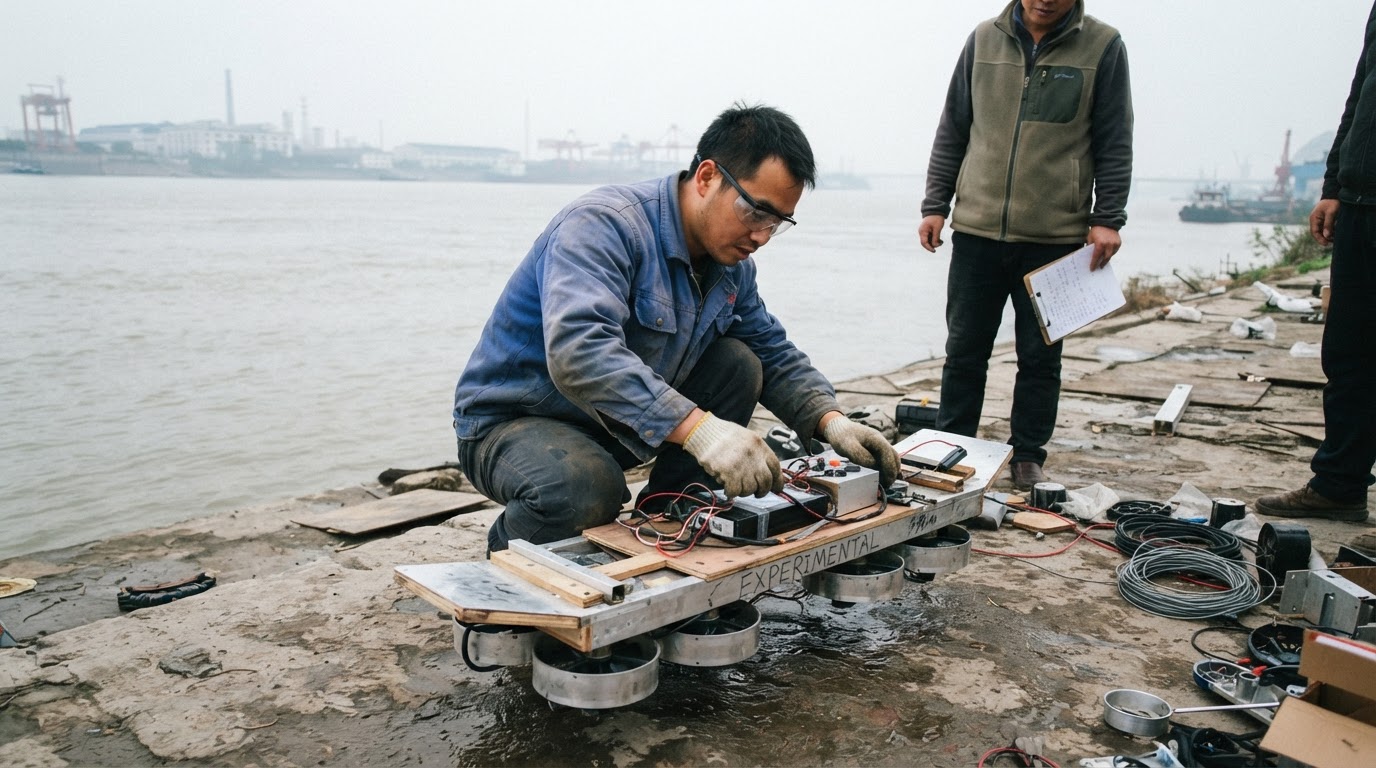
Hardware manufacturing shifts become visible when individual fabricators bypass corporate timetables. On Oct 15, a 26-year-old creator named Song Xingyu flew a handcrafted manned hoverboard across the Yangtze River and surrounding mountains in Hubei province. The build required about two months of physical assembly, drawing on self-taught mechanical engineering and custom flight programming. On that exact date in the United States, Tesla demonstrated its redesigned Roadster climbing a curved vertical ramp. These parallel spectacles mark a stark divergence in industrial delivery. While corporate aerospace and automotive firms spend years orchestrating controlled technical demonstrations, open-market component access now allows independent makers to assemble viable multi-rotor platforms in weeks.
Operating online as Amazing Ayu, Song accumulated more than 3 million social media followers by documenting working propulsion rigs from his base in Enshi. That an independent maker produced a functional aerial platform within sixty days indicates that precision microcontrollers, high-discharge battery packs, and high-torque electric motors are no longer confined to institutional laboratories. Sourcing logistics have inverted. Rather than commissioning bespoke industrial tooling, individual builders can procure standardized electronic speed controllers and composite frames directly through domestic parcel logistics. Rapid hardware iteration has substituted for corporate balance sheets.
Hardware dispersion across inland hubs
Component availability explains this compression of development cycles. Inland provinces now sit downstream from dense regional manufacturing clusters that produce modular avionics at minimal marginal cost. Because these parts follow standardized communication protocols, an individual fabricator can integrate motor arrays without specialized defense contracts or venture backing. Technical execution is no longer the exclusive preserve of well-funded metropolitan centers.
Skeptics correctly point out that an uncertified river flight does not constitute operational passenger aviation. Experimental hobby craft operate without redundant avionics, certified structural tolerances, or formal rotor stress evaluations. Navigating thermal air currents over water on a home-built deck introduces severe personal danger, which distinguishes viral social media demonstrations from transport systems. Video documentation also leaves battery depletion rates and motor synchronization thresholds unverified. Furthermore, civil aviation regulators operate strict frameworks that prevent uncertified vertical-lift machinery from entering commercial flight corridors.
Regulatory limits and institutional hurdles
Administrative statutes now face friction from this democratized fabrication speed. Airspace regulators monitor low-altitude corridors through rigid certification steps that independent builders cannot realistically finance. If an improvised aerial unit encounters electrical failure over populated terrain, flight authorities will move swiftly to curtail unauthorized operations. The ultimate barrier separating hobbyist engineering from commercial scale is not the difficulty of assembly, but the heavy financial burden of formal airworthiness certification.
Tesla relied on corporate capital to run a redesigned vehicle up an engineered incline. By contrast, Song’s demonstration across the Yangtze River points to advanced propulsion hardware migrating into private hands. Manufacturing initiative is dispersing across inland regions. The trajectory of this low-altitude shift now depends on whether civil aviation authorities choose blanket operational bans or establish formal testing corridors for independent flight hardware.
Sources
Newsletter
Pacific Daily
A curated briefing from Thailand, Asia-Pacific and the world.