When Pop Spectacle Meets Particulate Realities
A haze advisory in Singapore shows how regional environmental friction catches up with global arena tours
SINGAPORE
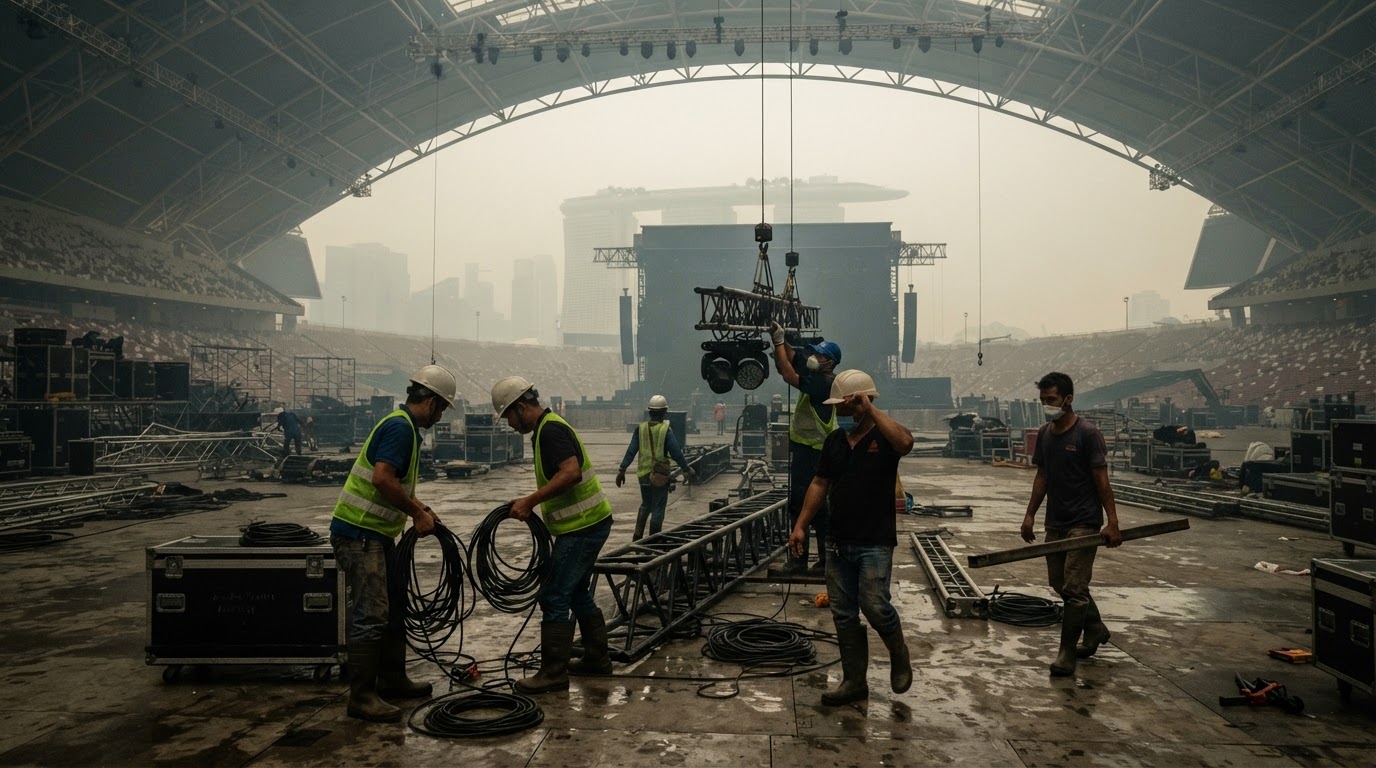
Across Singapore, the arrival of transboundary smoke alters urban routines quietly. Windows slide shut, while running tracks along the waterfront stand deserted. When live events company AEG Presents Asia published an advisory on Thursday, Oct 15, asking ticket holders to take health precautions against worsening haze ahead of BigBang's weekend concerts, the notice felt at once customary and quietly jarring. Pop arena tours operate on the aesthetic promise of absolute control, yet airborne particulate remains entirely beyond the reach of stage design.
Fans had spent months anticipating the South Korean group's return to the city. Performers Daesung, G-Dragon and Taeyang command an extensive regional following, drawing audiences into Singapore where commercial entertainment forms an explicit pillar of regional tourism strategy. Arena spectacles are intentionally engineered to suspend civic anxieties, enclosing thousands inside acoustic spaces where little intrudes except scripted euphoria. Outside those insulated walls, however, atmospheric currents carry smoke across national borders without regard for performance itineraries.
The Limits of Venue Engineering
Live entertainment operations generally address physical friction through technical scale. Amplification systems overcome cavernous echoes, while high-tensile scaffolding supports elaborate lighting grids designed to conceal the venue structure. Yet the notice issued on Thursday points to an operational boundary where logistical mastery gives way to individual mitigation. By advising ticket holders to monitor their personal physical tolerance and adopt protective habits before entering the crowd, the promoter effectively transferred environmental risk management directly onto individual spectators.
Mass entertainment tours operate on absolute control, yet an airborne particulate count remains entirely beyond the reach of stage design.
This dynamic exposes an uneasy contractual tension. An audience member purchasing entry to an international tour expects an insulated sanctuary, an evening decoupled from the environmental strains of Southeast Asia's dry seasons. Instead, municipal reality follows the crowd straight to the turnstiles. Promoters can oversee security access and indoor seating, but the surrounding ambient atmosphere belongs to an unmanaged regional commons.
Shifting Environmental Burdens
Seasonal smoke across the region is neither novel nor accidental. Land clearing and dry weather patterns repeatedly test municipal governance, leaving local populations to track air quality as an ordinary chore of daily life. The notable shift signaled by the advisory is how directly that ecological burden now encroaches on high-cost escapism. When spectators heading to weekend performances on Saturday or Sunday must factor smoke inhalation into their concert preparation, mass culture ceases to function as an impenetrable bubble.
This calculation highlights an underlying vulnerability for cities competing as major tour hubs. Hosting major acts requires complex international transit alongside dense crowd concentration, both of which presume stable environmental baselines. Transboundary smoke reveals the fragility of that premise, introducing environmental frictions that public relations phrasing cannot entirely resolve.
Fan forums quickly mirrored this dual reality, pairing practical discussions about protective respiratory masks alongside song setlists. That juxtaposition captures the unresolved tension confronting modern urban gatherings. The production proceeds indoors while the lighting rigs flare on cue. Daesung, G-Dragon and Taeyang take the stage under climate-controlled air, but the dull gray sky lingering over Singapore reminds every attendee that no ticket purchase offers full insulation from the climate outside.
Sources
Newsletter
Pacific Daily
A curated briefing from Thailand, Asia-Pacific and the world.