Tokyo Tests Its Space Architecture on the Road to Mars
The upcoming H3 launch carrying the MMX probe balances international scientific partnerships against the operational realities of sovereign heavy-lift flight
TOKYO
On Tuesday, Oct 20, at 4.41am, a flagship H3 rocket is scheduled to lift off from the Tanegashima Space Center in Minamitane, Kagoshima prefecture. The vehicle carries the Martian Moons eXploration probe, known as MMX, on an unmanned trajectory toward the Martian system. While official statements focus on the scientific promise of retrieving extraterrestrial soil, the operational reality of the flight carries far heavier industrial implications. Entrusting an unprecedented round-trip interplanetary profile to a relatively new launcher indicates that Tokyo is willing to link its highest-profile scientific ambitions directly to domestic aerospace infrastructure.
The stated scientific objective is ambitious. Japanese scientists designed the mission to retrieve samples from a Martian moon, gathering material that could clarify the origins of the Solar System and life on Earth. Doing so requires an unmanned vessel capable of navigating deep space, conducting precision operations around Mars, and executing an Earth-return leg. That logistical sequence represents a major step forward from single-direction orbital observation. Yet the underlying tension lies in the platform chosen to send it there, testing the structural execution of the Japan Aerospace Exploration Agency at a critical juncture.
Institutional stakes in Kagoshima
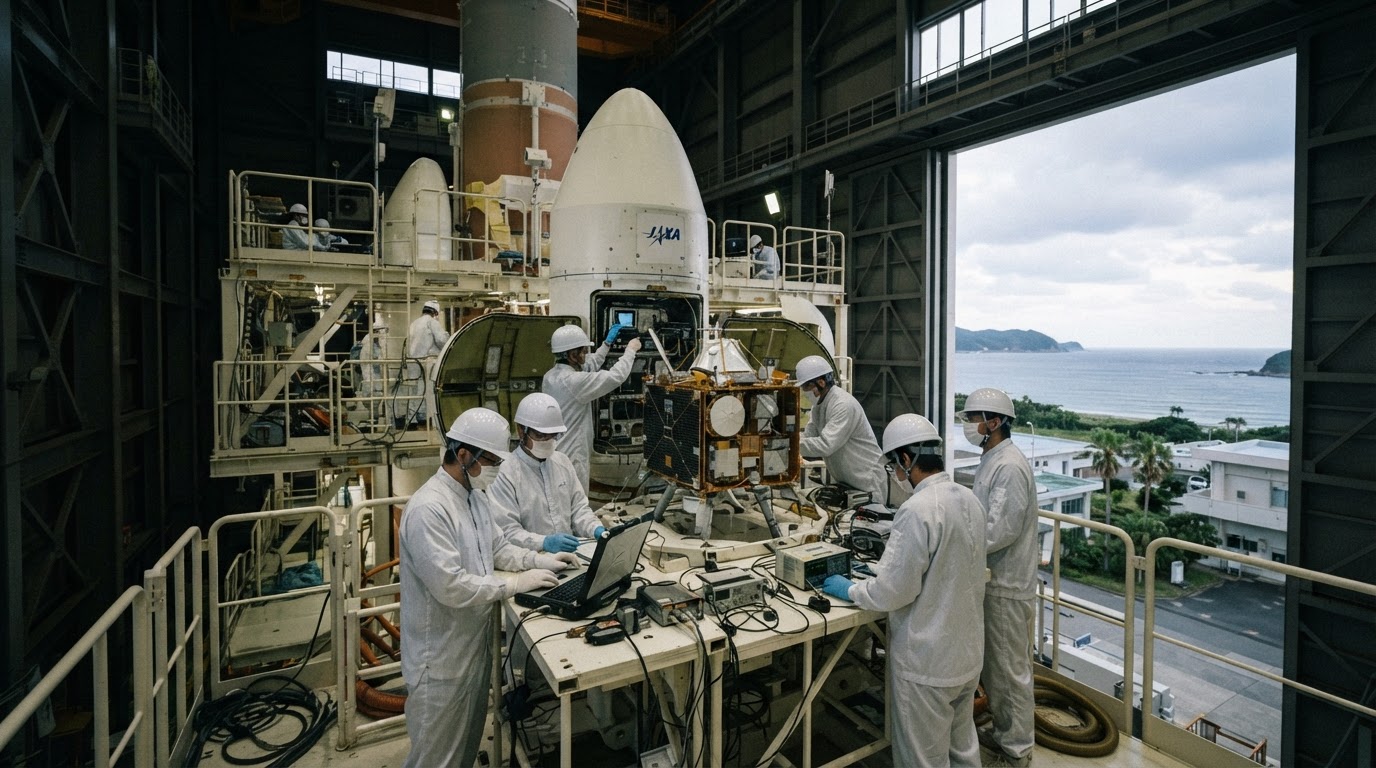
Preparation for this moment has followed a deliberate timetable. Yasuhiro Kawakatsu, project manager of the Mars Moons eXploration mission, stood before the assembled MMX spacecraft at Tanegashima on Aug 13, 2026, signalling that integration was entering its final operational phase. The probe itself is not an isolated national exercise; it incorporates direct collaboration with United States and European space agencies. These international arrangements demonstrate Tokyo's capacity to convene elite scientific consortia.
The operational reality of the flight carries far heavier industrial implications than simple planetary sampling.
Skeptics might argue that reliance on foreign scientific partners dilutes the sovereign utility of the exercise, creating programmatic vulnerabilities should partner components falter. Proponents, conversely, often maintain that deep-space scientific endeavours are inherently collaborative and that distributed development lowers mission risk. Both perspectives underestimate the specific balance JAXA has struck. While international partners contributed instrumentation, the launch apparatus and the complex sample-return architecture remain anchored to Japanese engineering and launch sites.
Strategic autonomy versus technical risk
For regional aerospace observers across Asia, the launch represents a decisive data point regarding sovereign launch reliability. Heavy-lift capability is not merely an instrument of academic inquiry; it underpins commercial payload competitiveness, telecommunications security, and orbital sovereignty. If the flagship H3 booster reliably dispatches a complex payload toward Mars, it confirms that Japanese launch providers can manage high-energy orbital insertions that rival existing Western and regional heavy-lift options. A successful departure proves the H3 can handle missions where launch timing admits zero margin for error.
Substantial operational risks accompany that ambition. Interplanetary sample return requires sustained mechanical precision across multiple years and distinct gravitational environments. Every stage, from leaving Kagoshima to Martian arrival and subsequent Earth return, demands faultless propulsion and trajectory control. If mechanical discrepancies arise, the financial and programmatic exposure falls squarely on the host agency rather than external contributors.
Clear sky over Tanegashima will answer only the immediate question of booster performance. The broader institutional test will unfold across years of interplanetary navigation, testing whether Tokyo can balance delicate international scientific cooperation against the relentless technical demands of long-range spaceflight.
Sources
Newsletter
Pacific Daily
A curated briefing from Thailand, Asia-Pacific and the world.