The Treatment Buffer
Public anxiety over discoloured rain exposes the operational burden placed on municipal water processing during transboundary air pollution.
SINGAPORE
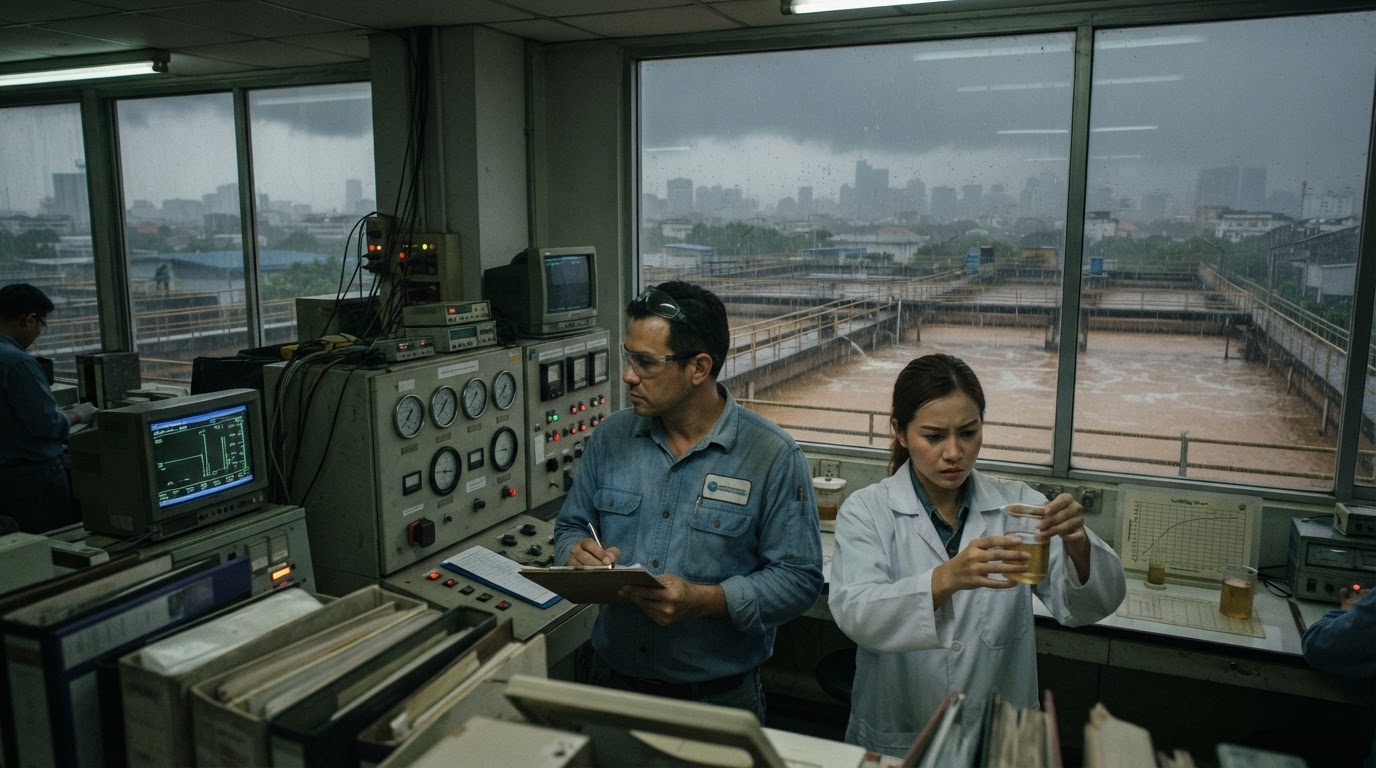
Municipal utility systems absorb industrial and environmental fallout long before regulatory disputes between sovereign capitals reach a settlement. When videos showing blackish rainwater circulated across social media platforms in Singapore during late October 2026, consumer anxiety focused immediately on domestic drinking supplies. Minister for Sustainability and the Environment Grace Fu responded on Saturday, Oct 24, from the water quality laboratory of national water agency PUB, assuring residents that treated potable water remained safe. Her intervention highlighted how atmospheric pollution rapidly translates into concerns over utility reliability. Catchment integrity forms the baseline of domestic confidence, making visible contamination in open precipitation an immediate institutional challenge.
The immediate dispute demonstrates how cross-border particulate disruption shifts municipal management from ambient air quality monitoring to physical processing facilities. Upstream land conversion and seasonal agricultural fires generate extensive regional atmospheric loads that border controls cannot impede. Public concern intensified because raw precipitation deposited noticeable residue onto residential surfaces and outdoor collection points. Rainwater gathered during hazy episodes turns demonstrably acidic while carrying elevated concentrations of airborne particulates. Such visual evidence creates friction between household perception and technical safety benchmarks, forcing state agencies to deploy rapid public verifications directly from analytical laboratories. The laboratory setting served as visual proof that technical barriers remained functional.
Industrial Overhead
Filtering degraded rainwater converts an external cross-border liability into a recurrent domestic operational expenditure. Water utilities rely on multi-stage purification assets to separate raw surface runoff from municipal distribution lines, protecting urban households from atmospheric hazards. This physical infrastructure isolates consumer taps from precipitation anomalies, but processing heavier particulate volumes demands enhanced chemical dosage and strict operational oversight. Catchment basins receive the unmitigated burden of regional particulate fallout whenever regional clearing intensifies. Urban utilities must therefore operate as industrial shock absorbers for events occurring far beyond national borders.
Rest assured that the PM2.5 haze particles will be removed during this comprehensive treatment process,
Ms Fu stressed that elevated PM2.5 concentrations undergo systematic extraction during plant-level purification sequences. Raw runoff gathered across regional catchments, including Bedok Reservoir where local air indicators registered improvements on the morning of Oct 19, moves through closed filtration loops prior to pipeline release. While engineering safeguards protect drinking standards, operating utility plants under persistent particulate stress increases continuous chemical consumption and equipment maintenance. Downstream municipal utilities effectively fund the operational buffer required to neutralize transboundary pollution originating entirely beyond their sovereign regulatory reach.
Structural Asymmetry
The reliance on utility filtration reflects a deep structural imbalance between regional resource exploitation and downstream urban infrastructure. Agricultural enterprises and concession holders in rural interiors proceed without internalizing the environmental costs their burning imposes on distant metropolitan centers. Urban rate payers and municipal agencies absorb that financial and technical friction through escalated water purification protocols. Even as laboratory testing confirms that domestic supplies satisfy statutory potable thresholds, consumer skepticism resurfaces whenever visible sediment accumulates in open drains. Trust in public networks erodes when physical pollution becomes tangible to ordinary citizens.
Operational pressures multiply when regional atmospheric haze persists across continuous operational cycles rather than dissipating within days. Ms Fu advised that Singapore should prepare for prolonged haze through November. Sustained haze episodes force water treatment assets to handle protracted particulate inputs without standard seasonal flushing cycles. Neutralizing acidic, particulate-heavy inflows remains technically viable for modern facilities, but sustained operation compresses routine maintenance schedules and ties up laboratory personnel in continuous monitoring. When elevated turbidity persists for weeks, processing margins tighten across every reservoir intake.
Singapore possesses the administrative coordination and fiscal reserves necessary to maintain filtration margins without compromising household delivery. Municipal authorities across less capitalised regional corridors lack comparable multi-barrier treatment plants, leaving local populations vulnerable when surface catchments become compromised. This technical resilience in Singapore proves that advanced engineering can temporarily shield urban centers from environmental degradation. That defensive posture cannot resolve the wider governance failure governing regional agro-industrial practices. Ultimately, municipal security across the region remains hostage to land-clearing patterns that utility engineers cannot control.
Sources
Newsletter
Pacific Daily
A curated briefing from Thailand, Asia-Pacific and the world.