The Territorial Ledger of Mexican Autonomy
Three decades after the 1994 rebellion, administrative occupations expose the friction between political symbolism and physical leverage.
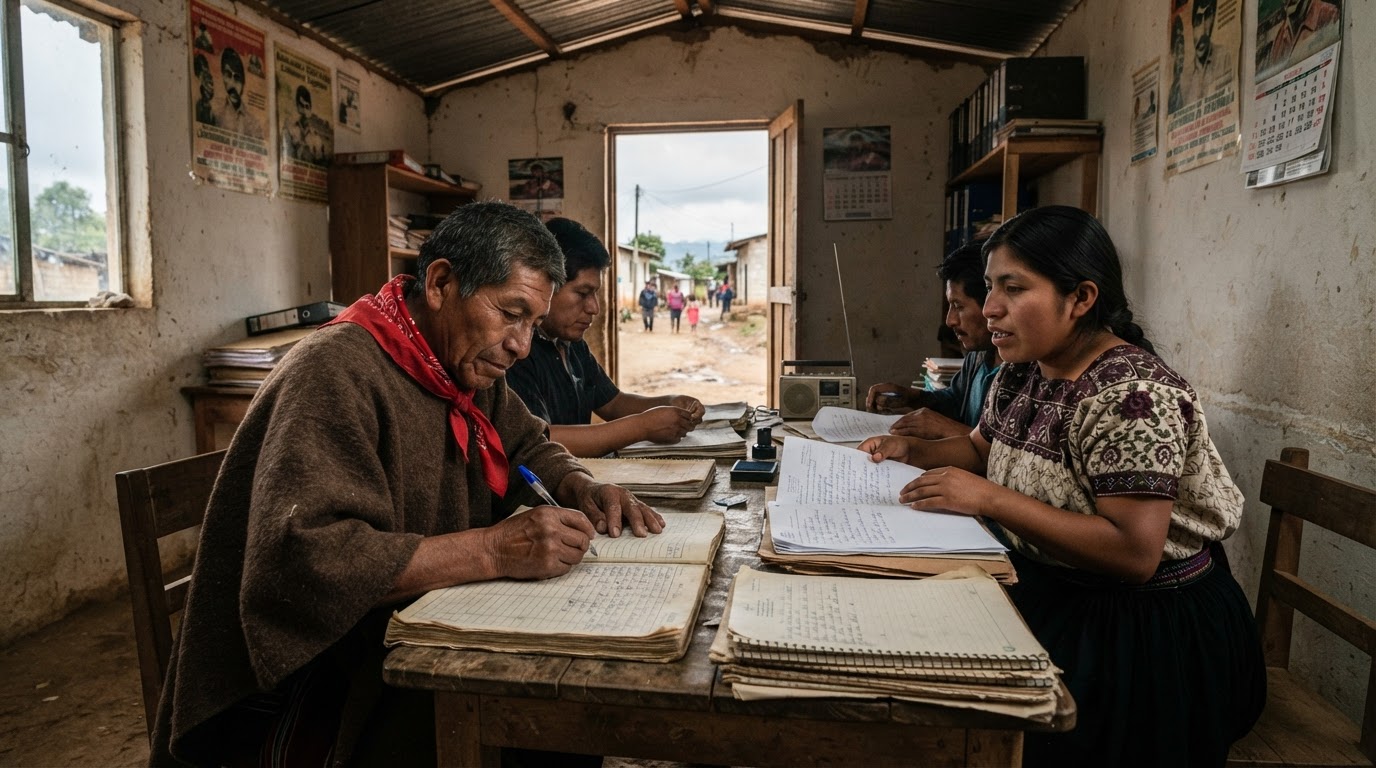
In territorial contests, control over physical infrastructure frequently offers a clearer metric of political durability than commemorative calendars. Thirty years after Comandanta Ramona, a Tzotzil representative of the Zapatista Army of National Liberation, led a masked delegation into Mexico City to help establish the Congreso Nacional Indígena, delegates convened this October inside an occupied government facility. Otomí women seized the federal Indigenous affairs building six years ago, converting the space into the Casa de los Pueblos y Comunidades Indígenas Samir Flores Soberanes, dedicated to the land and water defender assassinated in Morelos in 2019.
Holding administrative real estate in the national capital secures an undeniable public platform for regional delegations. Yet analytical assessment suggests that static building occupations also trace the operational boundaries confronting Indigenous self-determination across Mexico. When assembly delegates spend three days examining territorial conflicts across Puebla, Oaxaca, Veracruz, Jalisco, and Sonora, the core structural disputes center on natural resources, particularly contested water supplies and agrarian tenure.
The Mechanics of Enclosure
Examining spatial dynamics reveals how structural incentives have separated grassroots governance from federal priorities. Following the initial uprising in 1994, autonomous municipal administration established an operating framework that maintained civil oversight outside official state apparatuses. That localized network organized public life across southern rural strongholds for decades, providing immediate geographic leverage against federal jurisdiction.
Subsequent organizational shifts altered that institutional balance. When the rebel movement announced the dissolution of its autonomous municipalities, it effectively retired a formal administrative model that had anchored local self-rule. International delegations dispatched across the Atlantic to Spain generated diplomatic coverage, but symbolic projection abroad leaves local extractive pressures unaddressed. Demonstrations in foreign capitals or sit-ins within metropolitan office blocks cannot substitute for continuous control over river networks, aquifers, and transport corridors.
From an institutional perspective, state planners frequently accommodate fixed urban demonstrations with minimal administrative disruption. A occupied municipal building functions economically as a contained perimeter, allowing activist assemblies to gather while commercial supply chains and logistical projects proceed unimpeded across rural territories. The killing of Samir Flores Soberanes in Morelos during disputes over local infrastructure demonstrates the acute physical risks borne by communities defending rural basins against state-backed projects.
Shifting Ground
Physical resource distribution remains the baseline determinant of sovereign authority. State planners can absorb long-term administrative sit-ins in Mexico City as manageable friction, provided critical transit arteries, industrial water concessions, and agricultural acreage remain intact. Conversely, grassroots coalitions in provinces like Sonora and Veracruz must finance community defense over vast geographic distances with negligible institutional capital.
Physical tenure across communal watersheds proves far harder to sustain than symbolic occupation in the capital.
Grassroots coalitions confront an asymmetrical playing field. Urban meeting halls provide vital coordination through shared frameworks like the Congreso Nacional Indígena, but retaining collective cohesion against commercial concessions requires spatial enforcement that national assemblies cannot independently supply. Autonomy endures through physical control of regional assets rather than symbolic municipal residency. The durability of this movement will ultimately depend on whether rural assemblies retain tangible control over their land and water after the delegates leave the capital.
Sources
Newsletter
Pacific Daily
A curated briefing from Thailand, Asia-Pacific and the world.