The Hidden Costs Behind Low-Impact Hospitality Real Estate
Gamaya Farms tests whether hyper-local construction can generate sustainable operating yields on compressed rural floor plans.
SINGAPORE
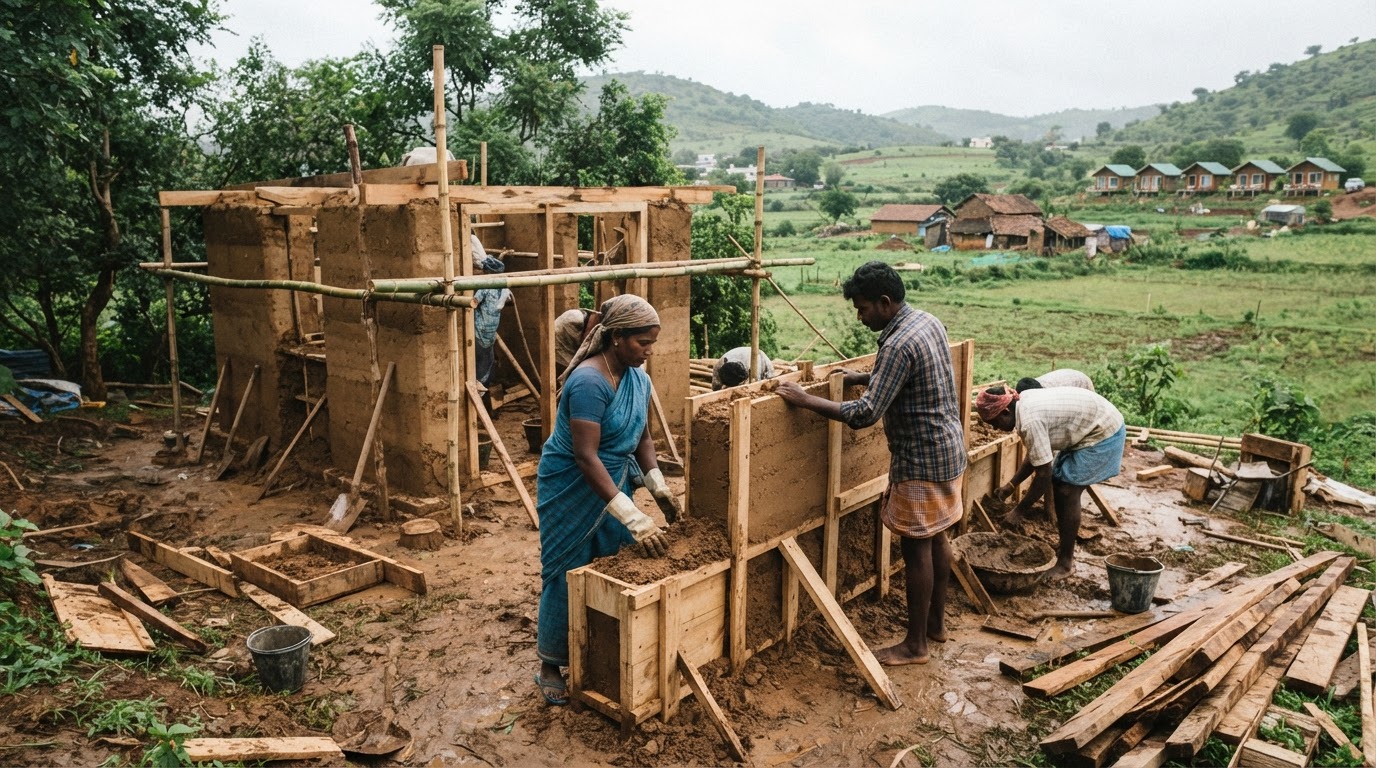
Eco-resort developments in peri-urban corridors operate on a financial tension between architectural discretion and operational scale. Gamaya Farms, a low-profile resort project located in the town of Vikarabad near Hyderabad, reflects this capital calculation. Designed by architecture studio Biome Environmental Solutions, the property encloses a total built area of 854 square metres. Its primary envelope relies on compressed earth brick walls beneath a hill-like roof clad in local stone, configured to blend into the surrounding topography.
From a development perspective, camouflaging physical infrastructure serves an explicit commercial niche. Urban wealth leaving Hyderabad for weekend leisure seeks rural retreat aesthetics, yet the underlying economics of projects under 1,000 square metres remain inherently demanding. Building out 854 square metres using compressed earth bricks and specialised masonry alters the standard cost schedule of rural hospitality assets. While raw earth reduces industrial logistics expenses, bespoke masonry demands intense on-site labour, shifting capital outlay from material purchase to assembly supervision.
Capital Concentration on Small Footprints
Hospitality returns depend on revenue-generating space relative to capital deployed. Conventional resorts scale operational margins by spreading fixed costs across extensive room inventories and repetitive concrete shells. Gamaya Farms pursues an opposite layout, restricting physical presence beneath a stone-covered roof to maintain aesthetic integration with the site.
Physical concealment alters operational efficiency by limiting commercial densities to a compact built envelope.
This deliberate constraint directly affects operational carrying costs. When an operator limits built area to 854 square metres, each square metre must generate sufficient revenue to service the land and design overhead. Energy efficiency achieved via thermal mass and earth bricks reduces utility liabilities over long holding cycles. Yet the initial yield profile faces compression because low-impact building techniques do not offer standard modular efficiencies. Financing structures for boutique developments routinely underestimate the operational friction of decentralised, small-scale compounds, where maintenance of bespoke natural materials requires ongoing manual upkeep rather than off-the-shelf facility management.
The Yield Equation for Peri-Urban Resorts
Regional investors monitoring the expansion of leisure assets around secondary and tertiary metropolitan hubs must separate design intent from asset performance. The technical achievement of Biome Environmental Solutions in integrating the Vikarabad complex into its surroundings proves that alternative materials can satisfy structural demands on a rural site. What remains unproven is the scalability of such physical profiles within standard institutional hospitality portfolios.
Small footprints compress overhead only until operational realities take over. Food and beverage provision, guest services, and administration must all operate inside or alongside an 854-square-metre envelope without breaking the low-profile character that defines the project. If staffing ratios and maintenance requirements on natural materials outpace the savings gained from reduced mechanical cooling, the yield model erodes. For secondary-market tourism investments near regional hubs like Hyderabad, the long-term feasibility of disguised architecture rests on whether guest premiums can permanently offset the structural absence of operational economies of scale.
Sources
Newsletter
Pacific Daily
A curated briefing from Thailand, Asia-Pacific and the world.