Shanghai's Tennis Stage Highlights Asia's Enduring Infrastructure Divide
The all-Spanish Masters final at Qizhong Arena demonstrates how premier regional venues continue to host foreign athletic dominance rather than cultivate domestic parity.
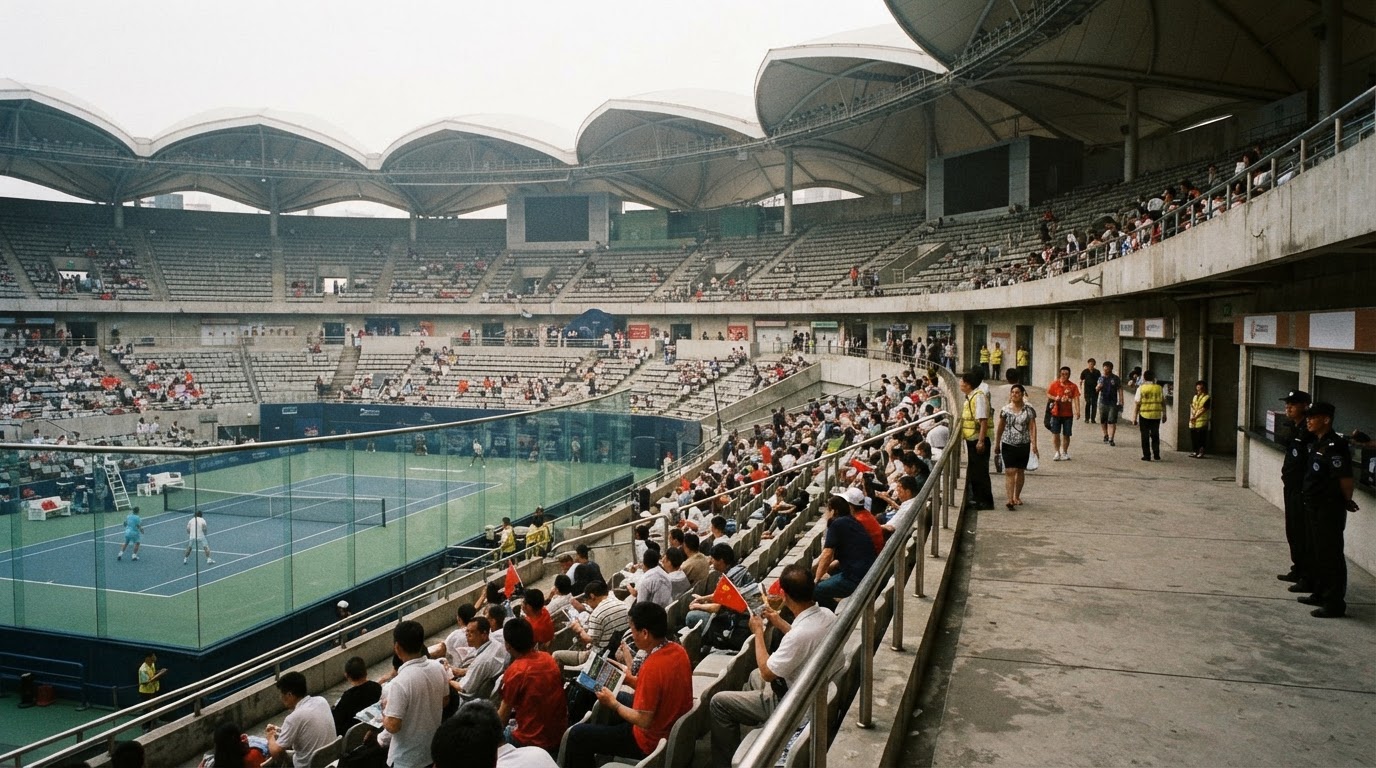
SHANGHAI
Physical venue construction does not produce competitive parity.
On October 18, 2026, Spain's Alejandro Davidovich Fokina recovered from a 1-6 opening set to defeat compatriot Rafael Jodar at the Qizhong Forest Sports City Arena in Shanghai, China, securing the ATP Masters 1000 title. Match records document an intense individual turnaround between two Spanish professionals competing on an Asian centre court. For municipal planners and regional sports authorities observing from the gallery, the tournament ended on an institutional contradiction: while Chinese capital delivered seamless operational execution, domestic player systems remained entirely absent from the final contest.
Municipal investment in high-capacity venues has long defined China's strategy for anchoring top-tier tour dates. Staging an ATP Masters 1000 event guarantees broadcast exposure, prestige, and commercial activity within the Asia-Pacific corridor. Available evidence suggests that Qizhong Forest Sports City Arena fulfills every logistical obligation required by international sporting federations. Yet building advanced sporting venues does not alter player cultivation pipelines. Spain produced both finalists; Shanghai provided the stage.
Capability and athletic output
Assessing what capability has actually shifted requires separating logistical competence from competitive sovereignty. Operational capacity in Shanghai is demonstrable and verified by decades of hosting global tournaments. In contrast, the inference that venue construction generates home-grown sporting parity lacks supporting empirical evidence across regional circuits. International athletic federations and European academies continue to nurture the talent that claims ranking points and tournament silverware, while host cities shoulder venue upkeep and operational expenditures.
Advocates of municipal sporting investments routinely contend that elite foreign competition accelerates local athletic development. Exposure to world-class performers such as Davidovich Fokina and Jodar theoretically offers aspiring regional athletes observable benchmarks of tactical precision and physical conditioning. Tournament revenues and corporate sponsorships also channel capital into local governing bodies, creating potential funds for grassroots infrastructure.
"Logistical competence must not be confused with competitive development."
Yet this argument presumes a direct developmental pipeline that tournament hosting alone cannot create. Calendar inclusion represents a contractual service delivery, not a structural transfer of coaching methodology or high-performance institutional knowledge. Across the wider Asia-Pacific territory, sports administrators repeatedly confront the reality that staging elite tournaments fails to bridge the developmental gap separating regional contenders from European counterparts. Verified results from the October 2026 final confirm that while Shanghai can stage European sporting excellence, local athletic output remains governed by entirely separate structural constraints.
The strategic tension confronting regional sporting authorities therefore remains unresolved. Substantial capital expenditure has secured Qizhong Forest Sports City Arena an enduring position on the professional circuit. Until national federations balance concrete arena investments with long-term, systematic development of domestic players and coaches, Asia's flagship venues will continue operating as rented stages for foreign competition.
Sources
Newsletter
Pacific Daily
A curated briefing from Thailand, Asia-Pacific and the world.