Scrutiny Reaches Thailand's Coalition Over Offshore Gaming Shares
A parliamentary inquiry into an Australian start-up investor tests the boundary between opaque cross-border wealth and domestic political accountability.
SINGAPORE
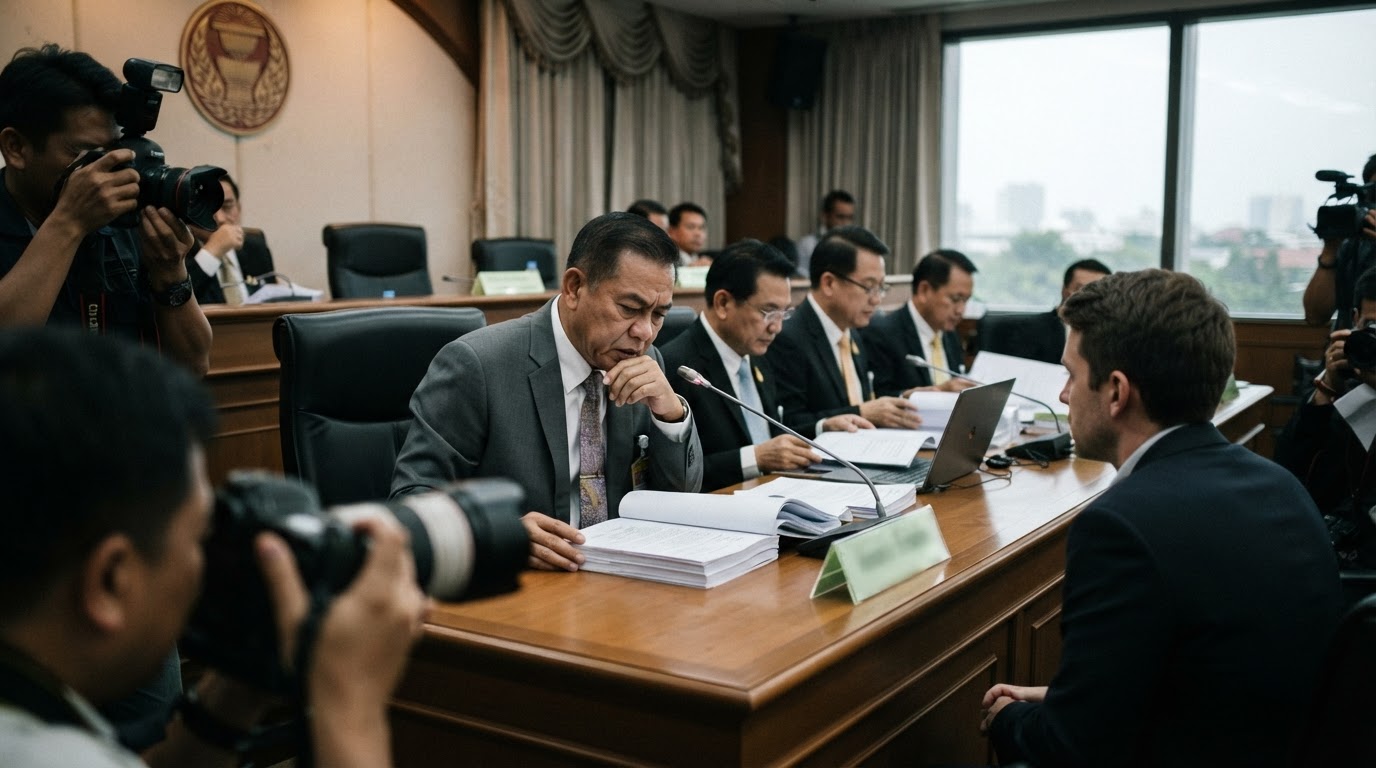
Parliamentary ethics inquiries in Thailand usually stall before they touch the financial machinery that sustains modern political families. When Bhumjaithai Party MP Suchada Zhang Thaensap accompanied her Australian husband, Taiyang Zhang, to Thailand's Department of Special Investigation on October 20, the formal setting of bureaucratic interrogation collided with an increasingly volatile legislative dispute. Investigators summoned Zhang to answer questions regarding his former shareholding in an entity associated with an overseas online gambling business. The session followed accusations aired during a parliamentary session by People's Party MP Rangsiman Rome, who challenged the integrity of sitting lawmakers tied through marriage to cross-border financial networks.
Online gambling remains illegal under Thai law, yet foreign digital operations routinely intersect with domestic capital. In recent legislative debates, Rome pointed directly to offshore corporate structures registered across jurisdictions like the British Virgin Islands and Curacao, alongside digital operations like Shuffle. Public records scrutinized during legislative sessions touched on corporate assets worth THB 1900000000, as well as an overseas stake recorded at 1.47 percent. When regulatory scrutiny sharpens, the immediate public posture is defensive silence. Suchada denied the allegations, insisting her husband was an upright individual and that his character was the reason she married him, while declining to elaborate beyond describing him as a start-up entrepreneur.
The Shield of Corporate Opacity
Family assets registered in multiple jurisdictions present an acute enforcement puzzle for agencies like the Department of Special Investigation and the National Anti-Corruption Commission. Cross-border holding vehicles allow beneficial owners to distance themselves from operational gambling enterprises, exploiting jurisdictional boundaries between Australia, the United Kingdom, and Southeast Asia. When a lawmaker declares household wealth, the technical origin of foreign equity often slips through regulatory cracks. Start-up capital frequently functions as a convenient euphemism for complex corporate structures designed to insulate investors from sovereign enforcement.
Such opacity carries tangible consequences for Thai governance. While small-scale domestic gambling incurs aggressive police sweeps, affluent political figures navigate regulatory questions through procedural deferrals. Suchada maintained that her husband had conducted himself legitimately, yet the reluctance to specify his business ventures fuels public skepticism toward ruling coalitions. Coalition dynamics already carry tension following leadership volatility surrounding figures such as Anutin Charnvirakul, making any perception of ministerial impropriety politically expensive.
Accountability at the Regulatory Border
Defenders of the lawmaker argue that marriage to a foreign entrepreneur does not make an elected official liable for commercial arrangements concluded across external jurisdictions. They note that holding a minor equity position abroad does not automatically demonstrate operational control or domestic wrongdoing under Thai statutes. Taiyang Zhang reported voluntarily to the DSI to present documentation, demonstrating formal compliance with the summons.
Formal cooperation with investigators rarely resolves the deeper conflict between offshore commercial profit and statutory integrity.
Thai enforcement agencies now face a critical credibility test. If the Department of Special Investigation treats offshore equity stakes as beyond its administrative remit, it implicitly confirms that foreign commercial registration shields ruling-class households from statutory standards. If investigators press deeper into the paper trail connecting Curacao licensing and Bangkok asset registries, they risk antagonizing influential parliamentary factions. The broader pattern remains stubborn: domestic public authority continues to demand rigorous compliance from regular citizens, while the foreign equity networks of political households remain comfortably insulated behind corporate veils.
Sources
Newsletter
Pacific Daily
A curated briefing from Thailand, Asia-Pacific and the world.