Network Firewalls and the Strategic Limits of Retail Defense
The defensive recalibration at Yoshinoya exposes how high-frequency consumer commerce across Japan has outgrown its digital infrastructure.
SINGAPORE
Retail security in East Asia historically treated digital boundaries as secondary utilities, managed well behind physical distribution and central treasury accounting. That administrative comfort collapsed in October 2026 when Nikkei Asia reported that Japanese dining operator Yoshinoya reinforced its network firewall amid a widespread sweep of corporate data breaches across Japan. For an enterprise built on rapid counter turnover, perimeter filtering is no longer peripheral maintenance. It determines whether basic daily transactions can proceed. Yet evaluating this shift requires asking what technical capability has actually changed, rather than accepting corporate assertions of safety.
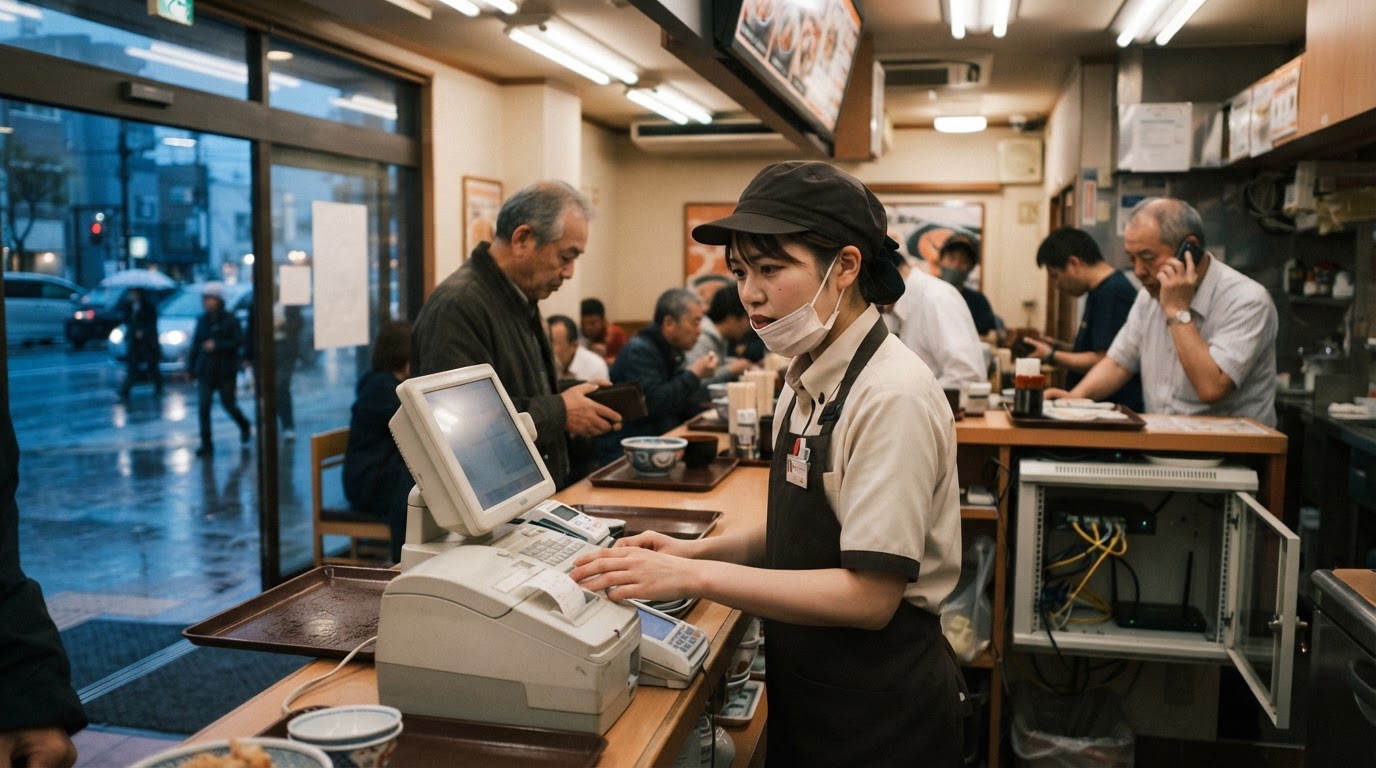
Chain food service relies on uninterrupted throughput. Fast-casual dining groups assemble sprawling webs of point-of-sale hardware, mobile payment connectors, and inventory trackers across hundreds of urban storefronts. Each node offers functional convenience. Simultaneously, each creates an entry portal for external actors probing corporate networks. When systemic intrusions hit domestic infrastructure, counter-service operations become acute points of systemic friction because enterprise continuity depends on instantaneous data transmission between remote terminals and headquarters.
The Architecture of Consumer Vulnerability
Historically, commercial food enterprises concentrated protective resources on centralized databases while treating local cash drawers and regional terminals as dumb operational endpoints. Recent intrusions across corporate Japan dismantled that assumption. Peripheral devices and franchise connections routinely serve as lateral staging grounds, granting unauthorized actors pathways into core platforms without confronting central access gates.
Erecting rigid digital perimeters around high-frequency commercial kitchens illustrates how deeply everyday consumer transactions now depend on defensive architecture.
Adjusting network firewalls alters perimeter filtering, yet it introduces operational friction into high-speed retail environments. Strict inbound and outbound inspection requires constant validation of traffic between regional outlets, central databases, and third-party delivery interfaces. Calibrate the firewall too permissively, and sensitive customer data leaks through unmonitored lateral connections. Calibrate it too rigorously, and local ordering terminals experience processing latency that stalls customer queues during peak dining windows.
Corporate executives frequently argue that commercially standard firewall deployments provide adequate insulation against external compromise. That claim rests on an unexamined premise. Raising an external perimeter changes boundary inspection, but it does nothing to rectify internal access vulnerabilities, unpatched legacy hardware, or fragmented supply-chain connections. Passive walls cannot replace systematic identity verification across thousands of active commercial registers.
Regional Ramifications and Structural Limits
The operational lessons reach far beyond Tokyo. Consumer restaurant groups across the Asia-Pacific routinely export unified enterprise architecture and standardized retail management platforms to overseas franchise operations to maintain uniformity. An architectural fragility exposed within Japanese headquarters signals unaddressed exposure throughout connected regional retail operations. When domestic networks buckle or require rapid structural firewalls, remote regional storefronts face immediate operational exposure or operational isolation.
Governments and commercial oversight bodies throughout the region are tightening data custody mandates and imposing stricter liability on retail platforms. For mass-market dining operators, this shift transforms network hygiene from an invisible back-office expense into a core test of corporate survival. Yoshinoya's reinforced firewall marks an unavoidable adjustment to hostile network conditions, yet the fundamental operational contradiction remains completely unyielding: consumer food chains demand frictionless, sub-second terminal response across thousands of dispersed physical outlets, while modern cybersecurity demands rigorous authentication that inherently slows and controls traffic. That technical friction cannot be resolved through firewall filters alone.
Sources
Newsletter
Pacific Daily
A curated briefing from Thailand, Asia-Pacific and the world.