Empty Courtyards in the Megacity
Mexico City records a fertility rate of 0.8 as economic strain reshapes urban domestic life across the Pacific Rim
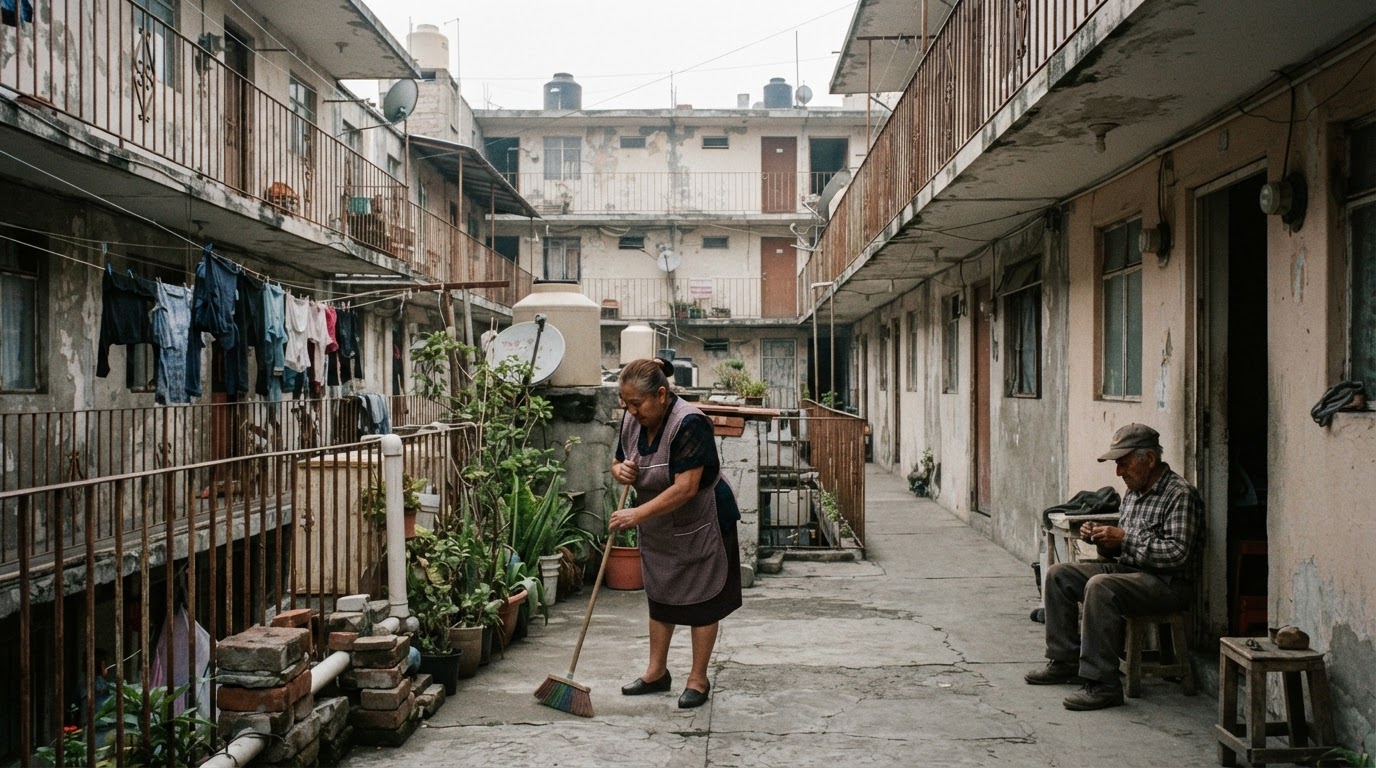
Sunlight settles over concrete apartment balconies across Mexico City, where clotheslines carry solitary wardrobes rather than children's school uniforms. The capital's residential quarters, shaped across decades around extended households, are adjusting to an unprecedented silence. Domestic courtyards that once accommodated three generations under single tenancy agreements increasingly operate as individual rentals. The demographic rhythm that long defined metropolitan life has slowed, revealing structural anxieties that marketing campaigns around urban vitality routinely bypass.
Data published by INEGI from the 2025 Intercensal Survey confirms the shift in sharp mathematical terms. Mexico has formally surpassed 130 million residents, yet the aggregate growth conceals an acute domestic contraction at its core. Nationwide fertility has fallen steeply, culminating in Mexico City registering a rate of just 0.8 children per woman. That statistic places the metropolis alongside the lowest fertility capitals across East Asia and the Pacific, disrupting historical assumptions about Latin American household growth.
The Cost of the Future
Generational memory offers a clear contrast. In earlier decades, large family units were standard across Mexican states, underpinned by limited access to reproductive health resources, lower educational attainment among women, and rigid conventions where men worked as sole breadwinners while women maintained domestic spheres. The expansion of educational opportunities and broader contraceptive access dismantled much of that framework over several generations, setting baseline family sizes on a long-term downward trajectory.
Yet current decisions among young adults point beyond expanded reproductive autonomy. An exploratory survey conducted by Mexico News Daily among adults aged 25 to 35 indicates that voluntary childlessness is increasingly dictated by external pressures. Participants repeatedly cited compounding financial strain, persistent security concerns, and broad apprehension regarding economic stability. The calculations keeping nursery rooms vacant are pragmatic appraisals of living costs, housing availability, and uncertain employment prospects.
The calculations keeping nursery rooms vacant are pragmatic appraisals of living costs, housing availability, and uncertain employment prospects.
Skeptics of demographic panic frequently observe that falling fertility merely marks natural convergence with affluent urban economies. From this perspective, lower birth numbers reflect female empowerment, higher educational attainment, and standard metropolitan lifestyle adjustments rather than structural failure. When incomes diversify and career paths extend, delaying or foregoing parenthood becomes a deliberate personal preference rather than an involuntary concession.
Shifting Metropolitan Geography
That argument captures educational progress but understates the compulsory nature of modern urban expense. When young couples navigate escalating consumer rents alongside precarious formal earnings, domestic planning ceases to be purely aspirational. The desire for domestic stability remains intact, but the material threshold required to support another dependent has moved out of reach for median wage earners.
The resulting demographic contraction carries concrete consequences for Pacific Rim economies facing similar trajectories. A capital recording 0.8 children per woman must eventually manage shrinking labour intakes, school closures, and strained municipal pension obligations, even as overall national headcounts register nominal gains. Economic expansion that fails to secure basic domestic affordability eventually suppresses the population base that generates municipal productivity.
Evening falls across the residential avenues of the capital, where park benches and neighborhood plazas host elderly strollers and companion animals rather than young families. The modern city offers consumer mobility and commercial sophistication, but its spatial economy extracts a compounding price from domestic reproduction. Until living costs align with household security, the silence lingering over urban balconies will remain the defining feature of contemporary civic life.
Sources
Newsletter
Pacific Daily
A curated briefing from Thailand, Asia-Pacific and the world.