Why Border Blame Masks Structural Inelasticity on the Causeway
Singapore’s refutation of a Woodlands power failure highlights how divided operating incentives paralyse cross-border freight and labour corridors.
SINGAPORE
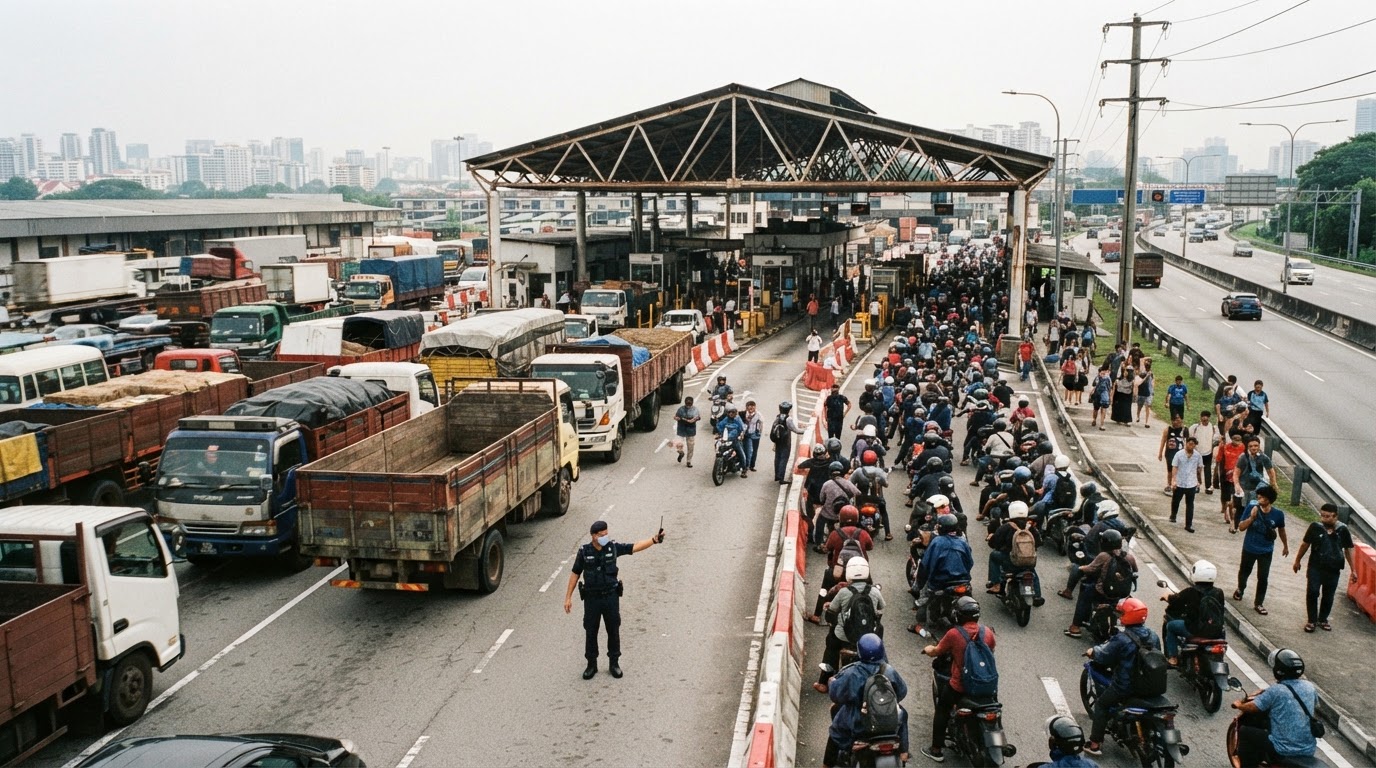
Physical logistics corridors expose their structural fragility not during catastrophic crises, but when ordinary operational friction compounds without a shared administrative buffer. On Nov 5, 2026, vehicular congestion backed up across the Causeway into Johor Bahru, prompting widespread local reports that a power failure had crippled Singapore's Woodlands Checkpoint. The Immigration and Checkpoints Authority moved swiftly to refute that assertion. According to the Singapore agency, the build-up of Singapore-bound traffic occurred while scheduled electrical maintenance works were being carried out, while two vehicle breakdowns on the Malaysian side of the Causeway subsequently caused traffic to tail back across the border.
The factual refutation addresses the technical narrative, yet the underlying operational reality presents a far more stubborn economic problem. By attributing the disruption to simultaneous scheduled maintenance and two disabled vehicles, the authority inadvertently demonstrated the acute structural inelasticity of Southeast Asia's busiest land border. A crossing that processes substantial cross-border commerce and labour cannot absorb routine mechanical failures during planned facility upkeep. When ordinary maintenance on one side of a narrow causeway coincides with normal roadside stalls on the other, the entire transit pipeline seizes.
The Friction of Divided Incentives
Border crossings operate under split administrative incentives that rarely reward joint operational optimization. For Singapore's Immigration and Checkpoints Authority, regulatory screening integrity and secure facility upkeep represent the primary statutory duties. The agency incurs high institutional risk if maintenance is delayed or if procedural controls soften to accommodate surging traffic. Consequently, facility works proceed on internal schedules, narrowing processing margins regardless of bridge conditions. Across the border, Malaysian authorities carry the immediate municipal and economic burden of vehicle queues spilling into Johor Bahru, yet they possess no direct control over Singapore's intake rate.
The Causeway operates as a unified economic conduit trapped between two partitioned administrative regimes, where minor roadside friction triggers widespread corridor paralysis.
Neither jurisdiction bears the direct economic loss created by border paralysis. That liability falls entirely on private enterprise. Industrial manufacturers operating across the Johor-Singapore corridor depend on predictable transit intervals to feed just-in-time assembly lines, perishable deliveries, and shift work. When two vehicular stalls and planned electrical upkeep cascade into hours of stationary traffic, transport companies absorb idle diesel consumption, lost driver hours, and penal demurrage charges. Regional shippers must counter this structural volatility by expanding buffer inventories, effectively raising the cost of production across the corridor.
The Unresolved Operational Constraint
Technological upgrades and public statements cannot compensate for uncoordinated operational protocols. Refuting false accounts of power failures protects Singapore's institutional credibility, but it leaves the systemic bottleneck intact. At present, breakdown recovery on the bridge operates under disjointed regional jurisdiction. If a commercial truck or passenger car stalls on the Malaysian segment, clearance depends entirely on local recovery assets operating independently of Singapore's intake metering.
Decoupling cross-border manufacturing from physical transport delays requires synchronized operational management that spans both ends of the Causeway. Until authorities establish unified real-time incident clearing and coordinated maintenance calendars, cross-border commerce will remain vulnerable to minimal mechanical shocks. The structural barrier facing the corridor is not an absence of physical infrastructure, but the unresolved constraint of two sovereign bureaucracies managing a single interdependent road.
Sources
Newsletter
Pacific Daily
A curated briefing from Thailand, Asia-Pacific and the world.