Classroom Device Bans Confront the Structural Limits of Administrative Discipline
Mexico's federal restriction on handheld screens exposes the growing division between ministerial mandates and daily enforcement across Pacific educational systems
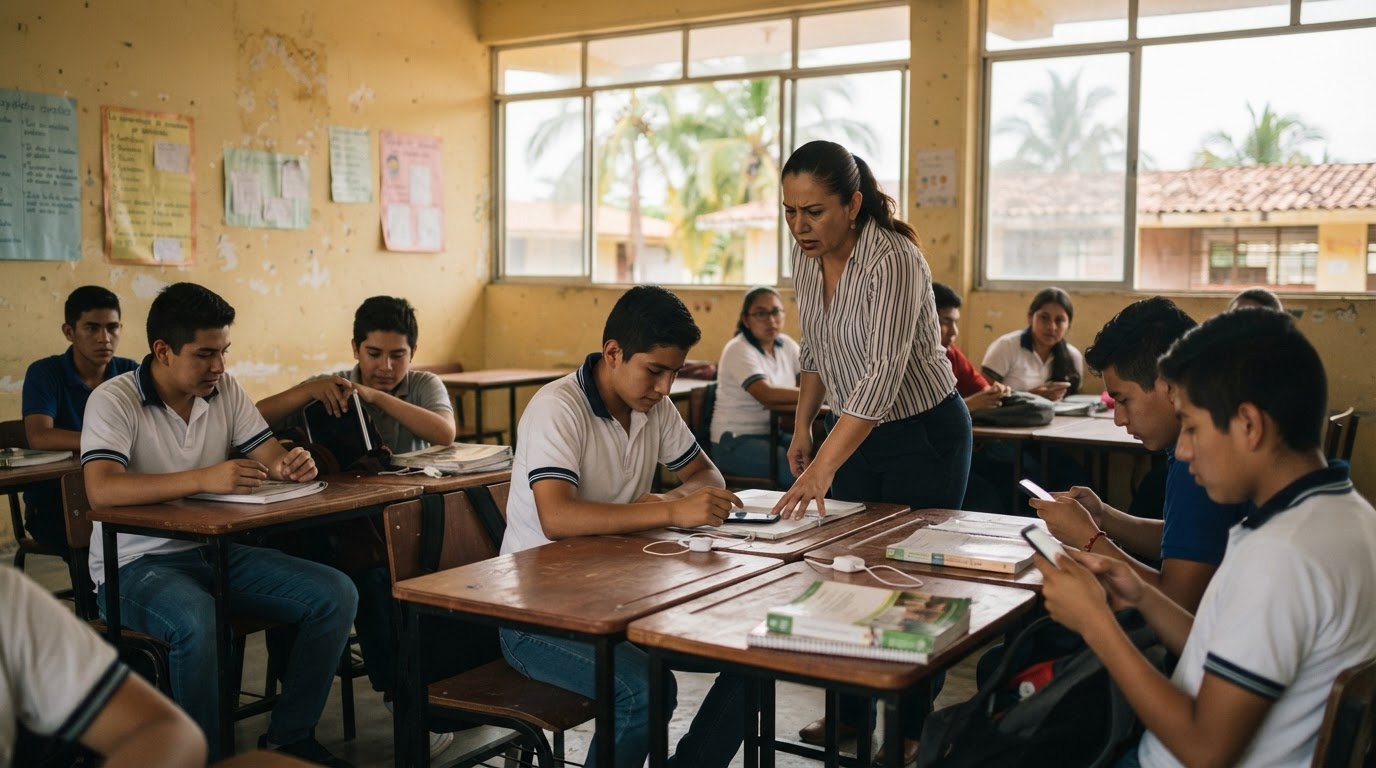
Educational governance has historically oscillated between absorbing personal communication tools as pedagogical assets and excluding them as institutional disruptions. For three decades, modernization programs across emerging economies encouraged device adoption on the assumption that digital access directly enhanced educational equity. Mexico’s Education Ministry, known as SEP, interrupted that trajectory by confirming that the use of cell phones and electronic tablets in public and private schools nationwide faces regulatory restriction starting Tuesday.
The administrative measure operationalizes a Sept. 18 decision by the National Council of Educational Authorities, or Conaedu, to curtail unregulated screen exposure among primary and secondary students. Speaking at a Conaedu gathering on Oct. 26, Education Minister Mario Delgado Carrillo defended the policy through a developmental lens, asserting that unrestricted connectivity fractures the social fabric of early education.
We want to see a return to socializing in the schoolyards, conversations in the hallways and the focus and friendships that flourish in the classroom,
Delgado noted in his presentation. The ministerial rationale treats digital hardware not merely as a localized nuisance, but as a systemic barrier to cognitive focus and unmediated student interaction.
The Divergence Between Policy and Physical Enforcement
Centralized directives frequently underestimate the operational friction inherent in mass implementation. By mandating identical compliance across public and private institutions, the federal framework assumes an administrative uniformity that regional school districts rarely exhibit. Independent academies with surplus staffing can readily construct centralized storage lockers and supervise corridors, whereas under-resourced public institutions must divert teaching personnel into routine security checkpoints and bag inspections.
Pedagogical dissenters contend that absolute exclusions ignore contemporary learning realities. Digital competence cannot develop inside an artificial vacuum where computational devices are prohibited at school thresholds, only to be navigated without structural guidance outside school hours. In public school systems where state-provided textbooks and physical science laboratories remain chronically deficient, personal smartphones have frequently served as informal, improvised research terminals for students seeking reference materials.
Removing handheld hardware without a commensurate increase in public instructional investment risks deepening existing educational deficits. Proponents of statutory bans argue conversely that uninterrupted digital consumption permanently degrades attention spans and exacerbates behavioural fragmentation. While both viewpoints reflect documented institutional realities, ministerial prohibitions shift the unresolved logistics of societal platform dependency directly onto individual classroom teachers.
Unresolved Domestic Dependencies Across the Pacific Rim
Regulatory authorities across the Pacific basin confront identical structural entanglements. Whenever central governments seek to establish offline sanctuaries within compulsory education, they collide with household logistical frameworks that rely on continuous digital contact. Family transport coordination, localized safety notifications, and domestic emergencies ensure that parents actively resist total communication blackouts during school hours.
Administrative decrees cannot independently reverse cultural dependencies established by commercial platforms. Ministries that attempt to engineer social behaviour purely through statutory prohibition encounter diminishing returns when domestic economies demand uninterrupted digital literacy. The federal mandate enacted by SEP clarifies state priorities, yet the institutional divide between enforced classroom isolation and comprehensive consumer connectivity remains fundamentally unresolved.
Sources
Newsletter
Pacific Daily
A curated briefing from Thailand, Asia-Pacific and the world.