Crowded Offshore Starts Expose the Structural Limits of Solo Watchkeeping
The Saint-Malo collision between an IMOCA and a 60ft trimaran demonstrates how dense fleet logistics challenge maritime collision regulations.
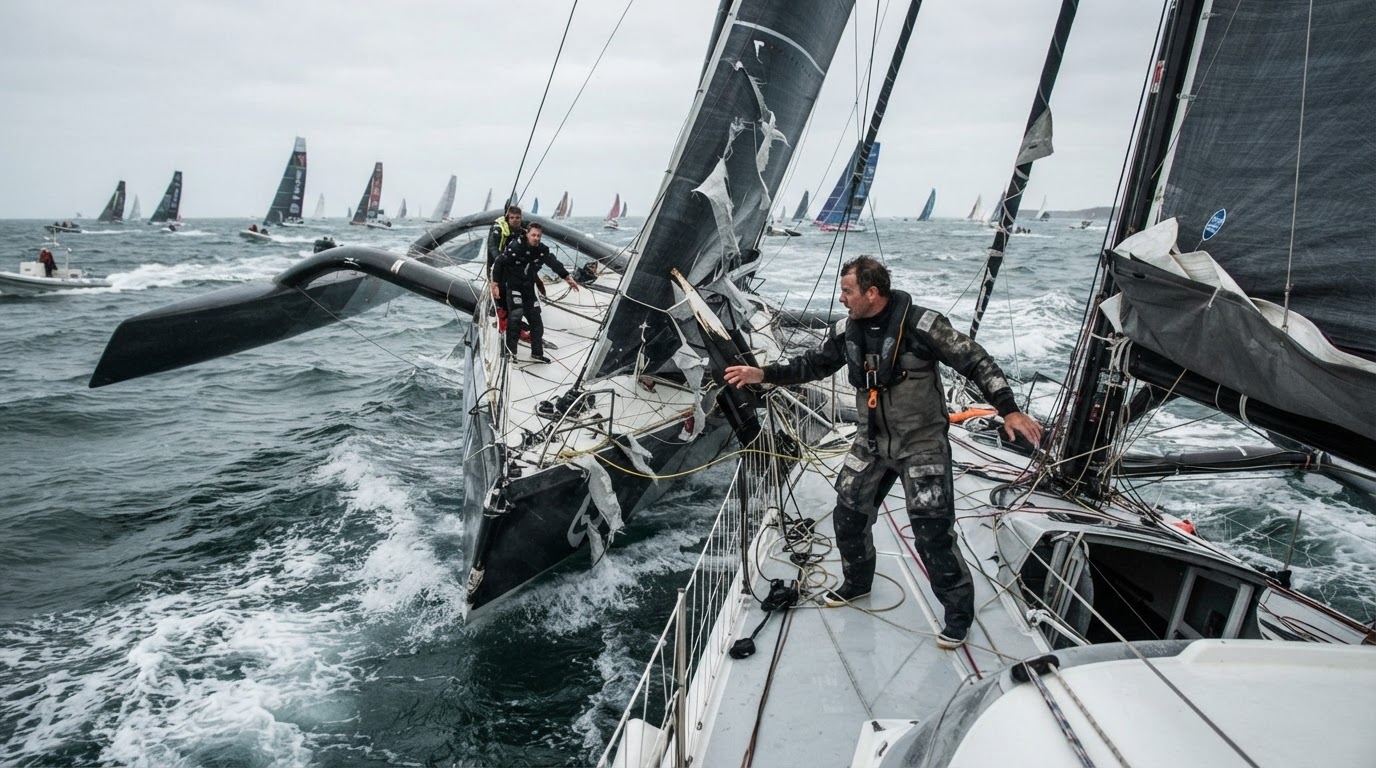
Mass starts in modern ocean racing place an unsustainable burden on single-handed navigational safety. When 115 solo competitors crossed the starting line off Saint-Malo on November 1, 2026, for the 13th Route du Rhum - Destination Guadeloupe, the logistical spectacle once again masked an engineering contradiction. Within two hours of departing northwestern France toward Pointe-a-Pitre, Violette Dorange aboard her monohull IMOCA Initiatives Coeur came together with Romain Pilliard sailing the 60ft trimaran Use It Again. Both skippers escaped unhurt, yet both vessels suffered damage severe enough to force an immediate retreat toward port for repairs.
This early attrition was not an isolated stroke of misfortune. High-performance ocean racing continues to push hull speeds and vessel dimensions into envelopes where human response times cannot compensate for congested sea room. Single-handed rules mandate round-the-clock vigilance, yet putting more than 100 high-speed craft into close-quarters maneuvering along the coast of Brittany challenges the fundamental premise of independent lookout duties.
Congestion Against Maneuverability
International collision regulations establish clear baselines for maintaining an effective watch and keeping safe distances. Under racing conditions, however, technical disparity complicates those standards. Dorange's monohull and Pilliard's multihull operate under entirely distinct polar diagrams, acceleration rates, and visual blind spots created by expansive offshore sail plans. When such boats maneuver in identical coastal corridors off northern France, calculating relative bearings becomes a demanding mechanical exercise.
Organizers understandably celebrate large entry lists as evidence of sporting vitality. Launching 115 vessels simultaneously across a single offshore line generates unmistakable public visibility. The operational reality at sea, however, is that elite racing machinery requires extensive turning radii and clear water. Forcing monohulls and giant trimarans into shared starting sectors creates an artificial traffic density that would alarm commercial vessel traffic services in any busy shipping lane.
Defenders of existing race architecture argue that professional offshore skippers possess exceptional seamanship and that coastal starts test essential tactical competence. Experienced competitors routinely manage tight proximity before dispersing into open ocean tracks. That counterargument assumes human reflexes and visibility remain adequate during high-load maneuvers, even when skippers manage complex sail changes alone.
Operational Reality Beyond the Start Line
The physical damage to Initiatives Coeur and Use It Again underscores how fragile that assumption remains. A 60ft trimaran and an IMOCA possess substantial structural inertia. Even minor contact between carbon composites necessitates ultrasonic inspection and extensive structural repair before any Atlantic crossing can be contemplated. When high-value programs halt before clearing coastal waters, the financial and logistical penalty falls entirely on the racing syndicates.
Coastlines across the Atlantic and Pacific face similar tensions between commercial navigation density and recreational speed. Maritime authorities evaluating high-density coastal transit corridors observe the same structural lesson: reliance on unaided human vigilance in high-speed, congested waters repeatedly fails to eliminate risk. If race directors wish to safeguard fleets through early coastal transit without relying on sheer luck, starting formats will eventually need adjustment. Staggered class releases or broader geographic separations would reduce initial fleet concentration.
Whether organizers choose structural separation or preserve mass departures remains an open institutional question. Until race management addresses the sheer mechanical risk of launching more than a hundred high-speed craft into a tight corridor, early collisions will remain an inherent design flaw rather than an unexpected misfortune. The sea room required by cutting-edge hulls cannot simply be negotiated away by skipper skill.
Sources
Newsletter
Pacific Daily
A curated briefing from Thailand, Asia-Pacific and the world.