Hardware Integration and the Technical Limits of Marine Safety
A joint flotation venture between Henri-Lloyd and Spinlock highlights how elite offshore gear navigates commercial standards across Pacific waters.
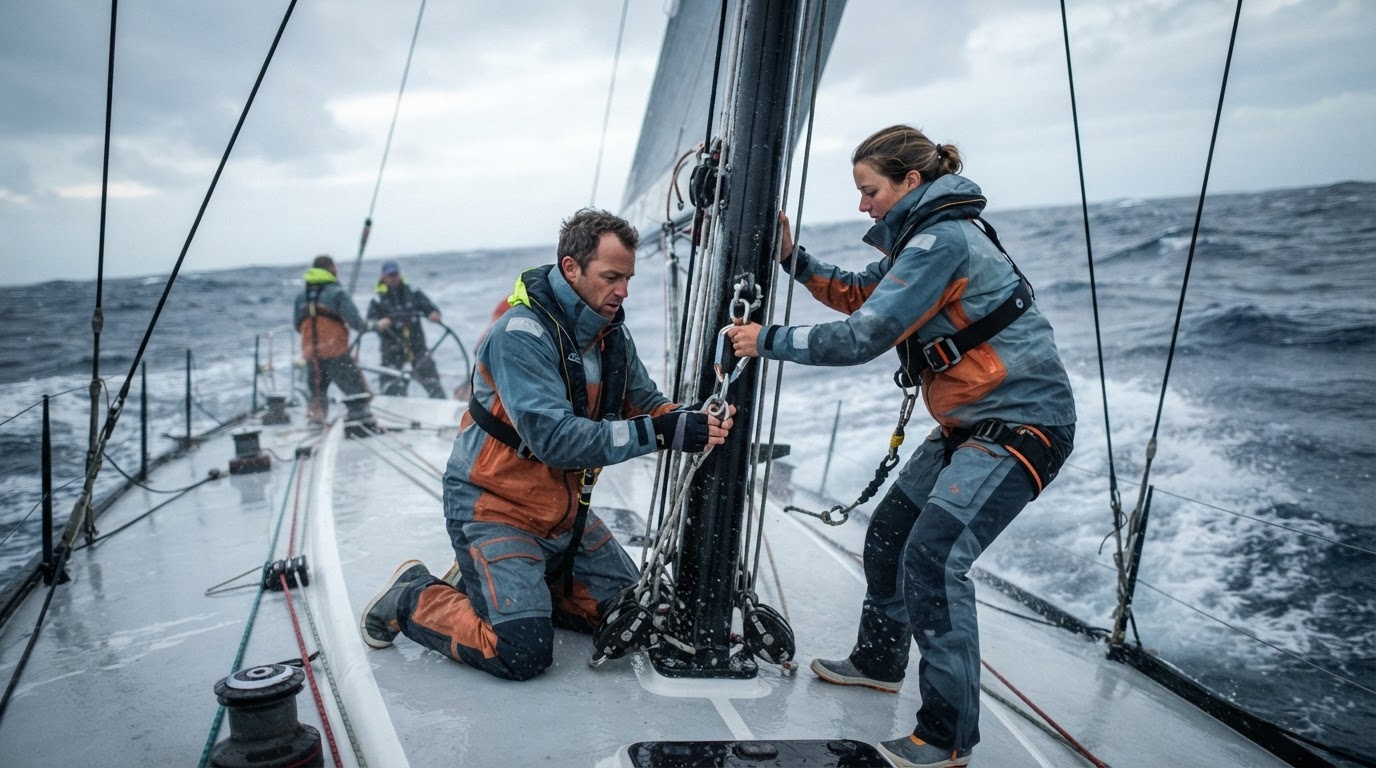
Textile engineering and mechanical buoyancy design have historically occupied separate workshops in commercial marine manufacturing. Fabric cutters understand thermal barrier laminates, taped seams, and salt-resistant outer weaves. Flotation specialists work instead with pressure tolerances, piercing pins, and oral inflation valves. When the two disciplines collide on an offshore deck, the seam between them is usually where equipment fails.
Henri-Lloyd and Spinlock have formalized that division through the launch of their collaborative Lifejacket Range. Reported by Sail World Asia, the product line combines Henri-Lloyd's technical sailing expertise with Spinlock's specialist flotation technology to deliver high-performance protection on the water. The partnership represents an explicit industrial division of labour across the Pacific sailing sector, pairing an established apparel brand directly with a dedicated personal flotation designer.
Commercial marine apparel rarely develops native mechanical hardware from scratch.
Developing certified inflation bladders requires cleanroom assembly, valve tooling, and recurring drop-testing that sit entirely outside the capital profile of a garment mill. Standard personal flotation equipment solves this problem through third-party sourcing, bolting generic harness straps and external bladders over existing ocean jackets. The compromise is familiar to any working crew: thick collar bladders chafe against safety tethers, harness buckles bind across chest pockets, and excess webbing catches on deck hardware during fast line work. Uniting outer garment architecture with dedicated internal bladder mechanics attempts to remove that physical snagging risk before a boat clears the marina breakwater.
Certification Versus Working Deck Reality
Statutory marine codes evaluate a lifejacket by static bench measurements. Surveyors verify chamber volume, rated buoyancy in newtons, and mechanical firing triggers. Those parameters satisfy the inspection sheet, but they say nothing about whether a foredeck hand can actually move across an angled coachroof without snagging a line.
Crew compliance on blue-water passages often hinges on ergonomics rather than nominal buoyancy numbers. If a harness assembly restricts torso rotation or pinches under an oilskin collar, off-watch sailors quietly slip it off during routine deck work. A lifejacket stored inside a cabin locker provides zero protection during a sudden knockdown. Integrating low-profile mechanical architecture into functional sailing outerwear eliminates the standard physical excuses for leaving safety harnesses below deck.
Yet high-performance integration introduces its own operational friction.
Specialized safety gear built for competitive ocean racing presumes a level of mechanical discipline that recreational owners rarely sustain. Dedicated flotation bladders and custom inflation heads demand rigorous servicing schedules, fresh carbon dioxide cylinders, and systematic flushing to clear dried salt crusts from moving triggers. Across Pacific coastal marinas, gear frequently sits through long months of solar exposure and humid bilge storage without scheduled workshop overhauls.
The Problem of Proprietary Spares
Racing syndicates maintain shore managers to inspect hydrostatic triggers before every offshore leg. Recreational cruising crews do not. If an integrated lifejacket system relies on custom geometry or specialist spares that local chandleries do not stock, an owner facing a degraded firing cap will simply defer maintenance until the next major refit.
Safety hardware is only as good as its real-world service life on working vessels. Henri-Lloyd and Spinlock have combined structural garment assembly with specialized flotation mechanics to bridge the gap between human mobility and survival hardware. Whether that engineering actually raises safety standards across Pacific waters depends on whether vessel operators service the mechanical triggers properly or leave them to corrode in damp lockers.
Sources
Newsletter
Pacific Daily
A curated briefing from Thailand, Asia-Pacific and the world.