Beyond Luxury: The Human Limits of Ocean Racing at the 2026 Rolex Sydney Hobart
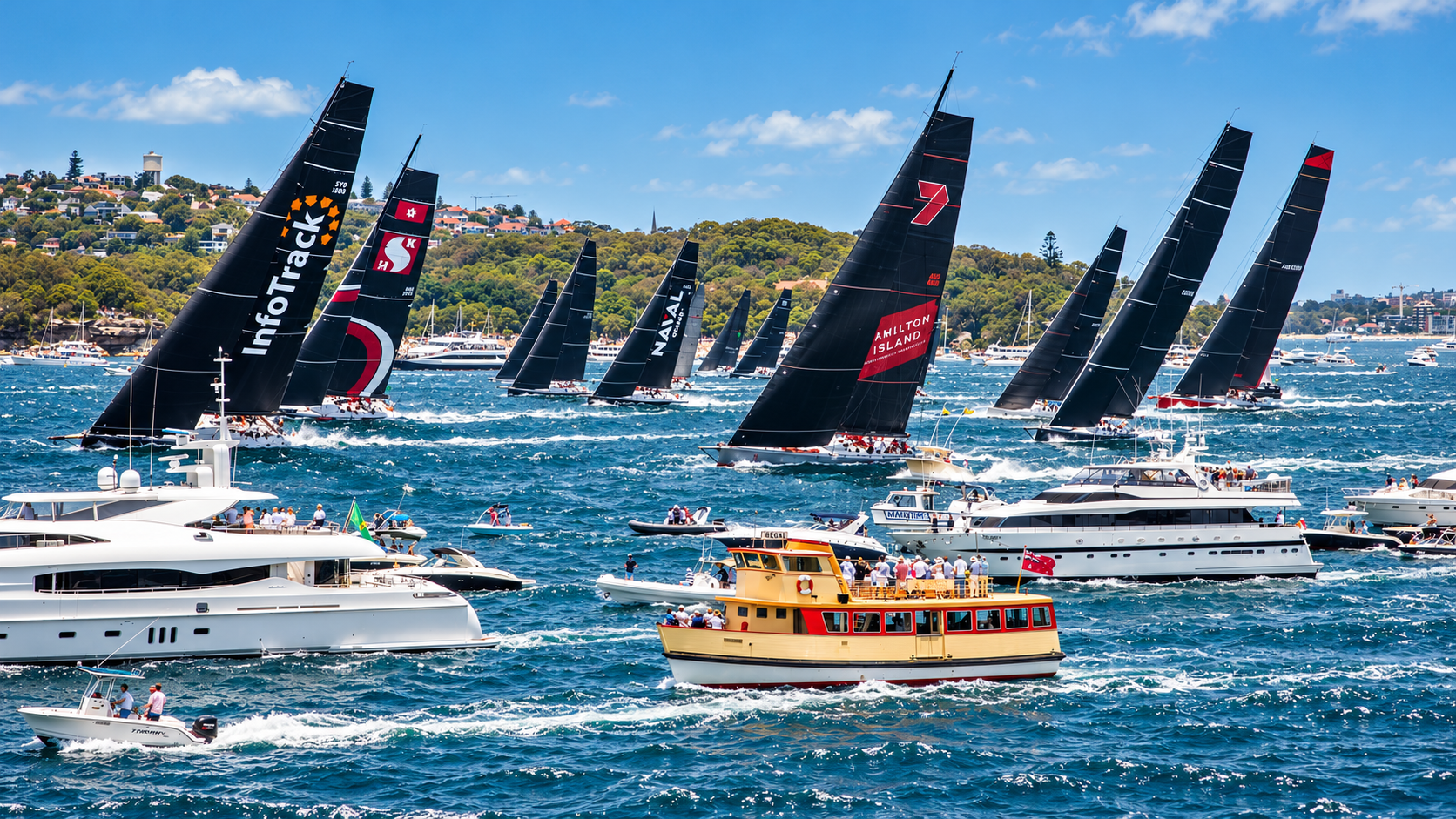
SYDNEY
As the 81st Rolex Sydney Hobart Yacht Race prepares to begin on December 26, the world's most celebrated offshore sailing challenge is approaching another confrontation between human endurance, technological ambition and the unpredictable forces of nature. From record-breaking supermaxis to two-person crews, the 628-nautical-mile journey offers a reminder that, at sea, financial resources and engineering excellence can improve a yacht's capabilities but cannot eliminate the uncertainty of survival and competition.
SYDNEY, AUSTRALIA — October 9, 2026
Every December, Sydney Harbour becomes the starting point for an extraordinary contrast.
Against one of the world's most recognisable urban landscapes, an international fleet of racing yachts assembles for a contest whose defining conditions will unfold far beyond the comfort and spectacle of the city.
On December 26, the Rolex Sydney Hobart Yacht Race will return for its 81st edition, sending competitors south along Australia's eastern coastline, across Bass Strait and towards the Tasmanian capital.
The race covers 628 nautical miles, equivalent to approximately 1,163 kilometres, but distance alone does little to explain its reputation.
Unlike sporting competitions conducted within carefully controlled environments, offshore sailing takes place in conditions that can change faster than crews can respond.
Wind direction, wave patterns, ocean currents and rapidly developing weather systems introduce variables that cannot be neutralised by financial investment or sophisticated equipment.
For competitors, success depends on a combination of engineering, experience, preparation and decisions made under considerable physical and psychological pressure.
The Sydney Hobart is therefore more than a race between sailing vessels.
It is a recurring examination of how far human beings can extend their capabilities without losing respect for the environment in which they compete.
The Ocean Does Not Recognise Reputation
The race begins in the relatively protected waters of Sydney Harbour before competitors enter the Tasman Sea and travel south along the coast of New South Wales.
From there, the fleet approaches Bass Strait, the stretch of water separating mainland Australia from Tasmania.
This passage has become central to the race's identity.
The combination of relatively shallow waters, powerful weather systems and strong currents can produce steep, confused seas that challenge even experienced sailors.
Conditions may change considerably over a short period. A yacht benefiting from favourable winds can encounter difficult seas, sudden wind shifts or prolonged calm before reaching Tasmania.
The course continues along Tasmania's eastern coastline, around Tasman Island, through Storm Bay and into the River Derwent.
Even the final approach to Hobart can become a tactical challenge.
Fading winds, shifting currents and the influence of local geography sometimes slow yachts that have maintained exceptional speeds throughout the earlier stages.
The implication is straightforward: the fastest yacht under one set of conditions may not be the most competitive under another.
Engineering matters enormously, but the ocean retains the ability to expose weaknesses in both equipment and judgment.
Where Technology Meets Its Limits
Modern offshore racing yachts are among the most technically sophisticated vessels in competitive sailing.
Advanced composite construction, lightweight materials, high-performance sail systems and refined hull designs allow them to operate at speeds that would have been extraordinary to earlier generations.
Sophisticated navigation systems provide crews with detailed information about positioning, weather forecasts and potential routes.
Performance-monitoring instruments allow sailors to assess boat speed, wind conditions and the consequences of tactical decisions.
Yet the availability of information does not guarantee that the correct decision will follow.
Weather models describe probable conditions rather than certainties. Small differences between predicted and actual wind patterns can change the outcome of a carefully calculated strategy.
A route designed to maximise speed may expose a crew to demanding sea conditions or create additional pressure on the vessel's equipment.
The technological advantage therefore remains inseparable from human interpretation.
Experienced navigators must understand not only what their instruments report, but also what those readings may fail to capture.
Likewise, skippers must judge when to press an advantage and when reducing sail or changing course represents the wiser decision.
In offshore racing, intelligence is not demonstrated solely by the ability to travel faster.
It is also demonstrated by knowing when speed has become an unacceptable risk.
Two Different Definitions of Victory
One of the most revealing aspects of the Rolex Sydney Hobart is its distinction between Line Honours and Overall victory.
Line Honours recognises the first yacht to finish the course.
This contest traditionally attracts considerable attention because it places the largest and fastest racing yachts in direct competition.
The Overall winner, however, receives the George Adams Tattersall Cup based on corrected time calculated under the IRC rating system.
The distinction creates two different sporting narratives.
A technologically advanced supermaxi may complete the journey faster than every other competitor without winning the most prestigious overall prize.
A smaller yacht, sailed with exceptional efficiency relative to its performance rating, may ultimately secure that honour.
The system does not make every vessel identical, nor does it eliminate the influence of weather and design.
Instead, it recognises that competitive excellence cannot be measured solely by absolute speed.
For spectators accustomed to races in which the first athlete across the line is automatically the winner, this distinction provides an important introduction to the strategic complexity of offshore sailing.
It also challenges an assumption often associated with luxury yachting: that the most expensive or technologically impressive vessel must necessarily be the most successful.
The Lessons of 2025
The 80th Rolex Sydney Hobart Yacht Race provided a particularly compelling demonstration of these competing definitions of success.
Master Lock Comanche secured Line Honours in December 2025, completing the course in two days, five hours, three minutes and 36 seconds.
The 100-foot yacht had already established a remarkable competitive history and retained the race's outright record of one day, nine hours, 15 minutes and 24 seconds, set in 2017.
Yet the Overall victory belonged to a very different vessel.
Min River, a 10.3-metre JPK yacht sailed by Jiang Lin and Alexis Loison, claimed the Tattersall Cup.
Their result made history.
Jiang became the first woman to win the race Overall, while the pair became the first double-handed crew to secure the trophy.
The victory was confirmed following an international jury decision that imposed a time penalty on another competitor, BNC – my::NET / LEON.
That procedural detail matters because the result was not simply a romantic story of a small boat defeating larger rivals.
It was an outcome shaped by sailing performance, racing regulations and the formal adjudication process.
Nevertheless, Min River's achievement demonstrated that elite offshore racing cannot be reduced to a competition between the largest financial investments.
Skill, preparation, tactical discipline and the ability to sustain performance under difficult conditions remain essential.
The 2025 result also offered a powerful illustration of the opportunities available to women and smaller crews within a demanding sporting discipline.
Safety Is Not a Secondary Consideration
Any serious analysis of the Sydney Hobart must acknowledge the dangers associated with offshore racing.
The 2024 edition was marked by the deaths of two sailors, Roy Quaden and Nick Smith, in separate incidents.
Another competitor, Luke Watkins, was rescued after falling overboard.
The Cruising Yacht Club of Australia subsequently commissioned an independent review of the incidents.
Its findings prompted safety recommendations addressing crew preparation, man-overboard procedures, communications and equipment.
Among the measures supported by organisers were requirements concerning qualifying passages involving a substantial proportion of a yacht's race crew, as well as additional provisions relating to personal location technology.
These developments illustrate an important distinction between celebrating the courage of offshore sailors and romanticising the dangers they face.
The ability to withstand difficult conditions is central to the sport, but avoidable risks should never become a measure of sporting authenticity.
Successful offshore racing requires a culture in which preparation, communication and the willingness to withdraw are treated as expressions of competence.
The responsibility of a skipper extends beyond competitive ambition.
It includes protecting the crew, assessing the vessel's capabilities and recognising when circumstances no longer justify continuing.
In this respect, the most consequential decision of a race may not concern how to overtake another yacht.
It may concern whether to remain in the competition at all.
The Contenders Preparing for 2026
Several established competitors are already preparing for the 81st edition.
Among them is Alive, the 66-foot Reichel Pugh racing yacht owned by Tasmanian businessman Phillip Turner.
The vessel previously claimed Overall victories in 2018 and 2023 and is now pursuing a third Tattersall Cup.
Alive's recent activities also demonstrate the increasingly international nature of competitive offshore sailing.
Under skipper Duncan Hine, the yacht competed across Asia during 2025 and the first half of 2026, recording significant performances in events linking Australia, Japan, Hong Kong, Vietnam and Malaysia.
Its return to Sydney Hobart competition provides an opportunity to examine whether experience gained through different sailing environments can contribute to performance in Australian waters.
Another prominent entry is LawConnect, Christian Beck's 100-foot yacht.
The vessel has claimed Line Honours three times, including victories in 2016 under its earlier identity and in 2023 and 2024.
Its return sets up another potential contest among the high-performance yachts seeking to reach Hobart first.
Yet the final composition of the 2026 fleet remains subject to the entry process.
Organisers have scheduled the documentation entry deadline for October 23, with additional requirements extending into November and December.
Any prediction about the eventual winner would therefore be premature.
The final field, the condition of each yacht, crew preparation and the weather encountered during the race will all influence the outcome.
Australia's Race, Asia-Pacific's Sailing Story
Although the Sydney Hobart is firmly embedded in Australian sporting tradition, its influence extends across the wider Asia-Pacific region.
Offshore sailing is supported by a network of yacht clubs, races and maritime communities connecting Australia, New Zealand, Japan, Hong Kong and Southeast Asia.
Competitors frequently move between events, encountering different weather systems, racing formats and professional networks.
Alive's recent Asian campaign provides a particularly relevant example of these connections.
The movement of yachts and crews between regional competitions demonstrates that offshore sailing is not confined to individual national markets.
Knowledge developed in one event can inform preparation for another, while international participation encourages the exchange of sailing techniques and professional experience.
For Asia-Pacific's marine industry, major offshore races also provide opportunities to observe advances in vessel design, navigation and safety.
However, the competitive sailing ecosystem should not be confused with the luxury yacht market as a whole.
An ocean-racing yacht is developed around performance requirements that differ fundamentally from those of a leisure superyacht.
The two sectors may share marine engineering expertise and certain technological innovations, but their commercial purposes and operating environments are distinct.
Recognising those differences allows the Sydney Hobart to be understood on its own terms rather than simply as an extension of luxury tourism.
Beyond the Prestige of a Famous Name
The Rolex Sydney Hobart also illustrates the relationship between sporting heritage and international luxury branding.
Since 2002, Rolex has supported the race through its partnership with the Cruising Yacht Club of Australia.
The association brings together two forms of prestige: a longstanding sporting tradition and a global luxury brand recognised for its relationship with precision and performance.
Such partnerships can strengthen the financial and international visibility of sporting events.
Nevertheless, the cultural value of the Sydney Hobart rests primarily on the competition itself.
The race began in 1945, decades before its present title sponsorship, and its reputation was established through generations of sailors who confronted the challenges of the course.
Its history belongs to the crews, yacht clubs, navigators and maritime communities that have sustained the event.
Commercial partnerships may expand its reach, but they cannot replace the sporting qualities that make it meaningful.
Indeed, the lasting appeal of the race lies partly in the fact that commercial power cannot guarantee a favourable outcome.
No sponsor, investor or yacht designer can determine the weather that competitors will encounter in Bass Strait.
That uncertainty gives the competition an authenticity that cannot be manufactured through branding alone.
What 2026 Will Ultimately Test
As the 2026 fleet prepares to leave Sydney Harbour on Boxing Day, attention will naturally focus on the fastest yachts, the leading contenders and the possibility of another remarkable performance.
But the central question is broader than who will reach Hobart first.
The race will test the ability of crews to make complex decisions under fatigue, maintain effective communication and adapt their strategies to uncertain conditions.
It will test whether advanced equipment performs as intended under sustained pressure.
It will also test the judgment required to balance competitive ambition against responsibility for human safety.
These are not secondary aspects of offshore racing.
They are fundamental to its character.
For the crews competing in the 81st Rolex Sydney Hobart Yacht Race, the ocean will provide neither certainty nor an obligation to reward ambition.
Technology can offer speed. Experience can improve judgment. Preparation can reduce exposure to danger.
None can entirely remove uncertainty.
And that is why the Sydney Hobart remains one of the most revealing contests in international sailing.
Beyond its prestige, celebrated yachts and dramatic finish-line moments, it asks a question that is increasingly relevant in a world shaped by technological confidence.
How far can human ingenuity take us when nature remains beyond our control?
On December 26, another fleet will leave Sydney in search of an answer.
---
2026 Rolex Sydney Hobart Yacht Race — Event Information
Event: 81st Rolex Sydney Hobart Yacht Race
Organiser: Cruising Yacht Club of Australia (CYCA)
Start date: Saturday, December 26, 2026
Start time: 1:00 p.m. Australian Eastern Daylight Time (AEDT)
Starting location: Sydney Harbour, New South Wales, Australia
Finish: Hobart, Tasmania, Australia
Race distance: 628 nautical miles (approximately 1,163 kilometres)
Race format: Offshore monohull yacht racing, with fully crewed and double-handed entries
Major awards: John H. Illingworth Challenge Cup (Line Honours) and George Adams Tattersall Cup (Overall winner)
Official website: https://www.rolexsydneyhobart.com/
Race information: https://www.rolexsydneyhobart.com/about-the-race/
2026 competitor information: https://www.rolexsydneyhobart.com/competitor-hub/race-entry/
Google Maps — Sydney Harbour: https://www.google.com/maps/search/?api=1&query=Sydney+Harbour+Australia
Google Maps — Constitution Dock, Hobart: https://shorturl.at/PoF3g
Newsletter
Pacific Daily
A curated briefing from Thailand, Asia-Pacific and the world.