West Kowloon Staging and the Institutional Price of Branded Culture
Free admission to corporate drama masks the financial arithmetic linking civic arts venues with commercial prestige.
SINGAPORE
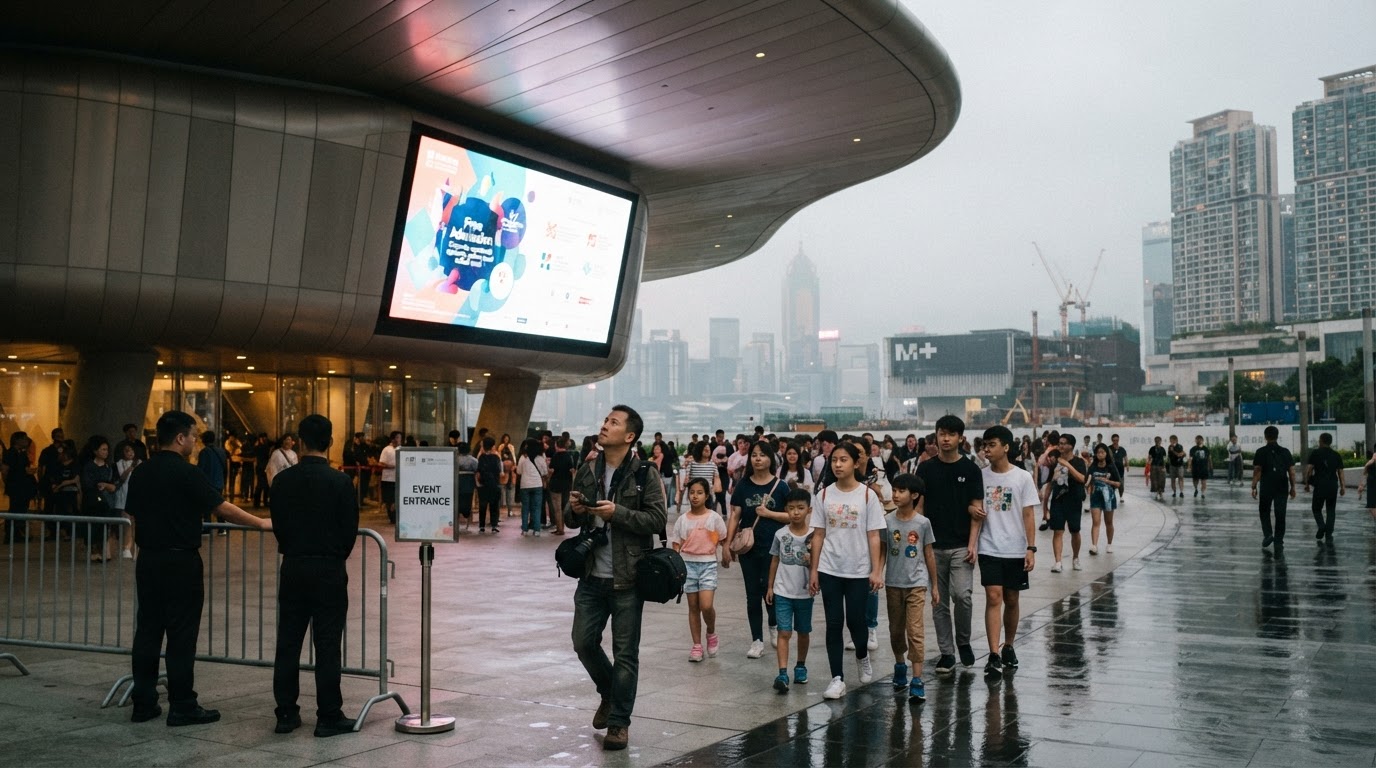
Public cultural infrastructure requires continuous operating liquidity, while European luxury houses require elite artistic pedigree to protect their gross margins. At Freespace in Hong Kong's West Kowloon Cultural District, the French maison Hermès has financed a surrealist theatrical production and exhibition running until Nov. 8. The public enters without paying box office fees, reserving seats through an online portal at zero cost.
Corporate arts patronage is rarely an exercise in detached civic charity. When a commercial equestrian heritage house commissions an original play written by Pauline Bayle and directed by Joe Hufton, the real transaction operates through institutional positioning rather than box office turnover. Hospitality accounting recognizes this logic immediately. Premium venues frequently deploy loss leaders, accepting negative gross margins on initial entertainment offerings to capture long-term consumer spend across retail channels. Hermès adopts a parallel approach in Hong Kong. By underwriting free public access to a bespoke production, the brand bypasses the crass mechanics of retail merchandising while commandeering civic architecture to substantiate its corporate mythology. Freespace gains footfall and high production values. The luxury group secures public cultural validation without submitting its staged spectacle to ordinary market appraisal.
The Architecture of Free Admission
Spectators consume an artistic narrative divorced from immediate point-of-sale pressure, and that emotional distance is precisely what fortifies the commercial premium. Underwriting a full theatrical performance directed by Hufton with text by Bayle signals high literary ambition. That investment positions the company far above ordinary commercial apparel makers. Yet public institutions face persistent financial obligations to maintain physical halls and sustain audience counts. Civic facilities supply the physical staging, technical staff, and public credibility that private capital cannot independently manufacture. When an overseas luxury tenant fills this budgetary void, public programming risks transforming into a delivery mechanism for external brand equity.
Advocates of corporate sponsorship insist that free admission broadens public access by welcoming spectators who would otherwise be priced out of bespoke theatrical productions. That observation is accurate as far as it goes. Waiving ticket charges eliminates economic friction, allowing residents to experience sophisticated stagecraft supported by capital reserves that municipal agencies cannot assemble. However, this accessibility argument ignores the deeper distortion of artistic priorities. Public arts precincts were created to cultivate autonomous regional expression, not to serve as subsidised exhibition halls for foreign commercial syndicates. Once corporate capital dictates production slates, independent creators must compete for scarce institutional dates against deep-pocketed corporate balance sheets.
The Lingering Institutional Deficit
Civic districts build sprawling architectural spaces to anchor global cultural status, but maintaining operational solvency without commercial partners remains a severe structural hurdle.
Public facilities incur high overhead expenses for staging, lighting, and administration. Private luxury houses possess the liquid reserves to offset these operational burdens, trading theatrical funding for civic endorsement. This financial interdependence produces a compromised civic realm where genuine public enrichment and corporate marketing merge. What appears on the surface as openhanded cultural hospitality represents an expenditure on prestige, repaid through the gradual erosion of curatorial independence.
As the theatrical performances and adjacent exhibition approach their Nov. 8 conclusion, the fundamental dilemma is not whether Bayle and Hufton delivered a technically capable production. The unresolved tension sits in the balance of power between public civic infrastructure and multinational luxury capital. Civic halls need private funds to keep their venues populated, just as heritage luxury brands need institutional prestige to justify their retail pricing. Neither side has established an alternative model that preserves public autonomy without corporate underwriting.
Sources
Newsletter
Pacific Daily
A curated briefing from Thailand, Asia-Pacific and the world.