Warehouse Acoustics and the Suburban Turn of Bangkok Club Culture
As Together Festival shifts underground subgenres into cavernous exhibition halls, the commercial staging of dance music in Thailand faces structural friction.
BANGKOK
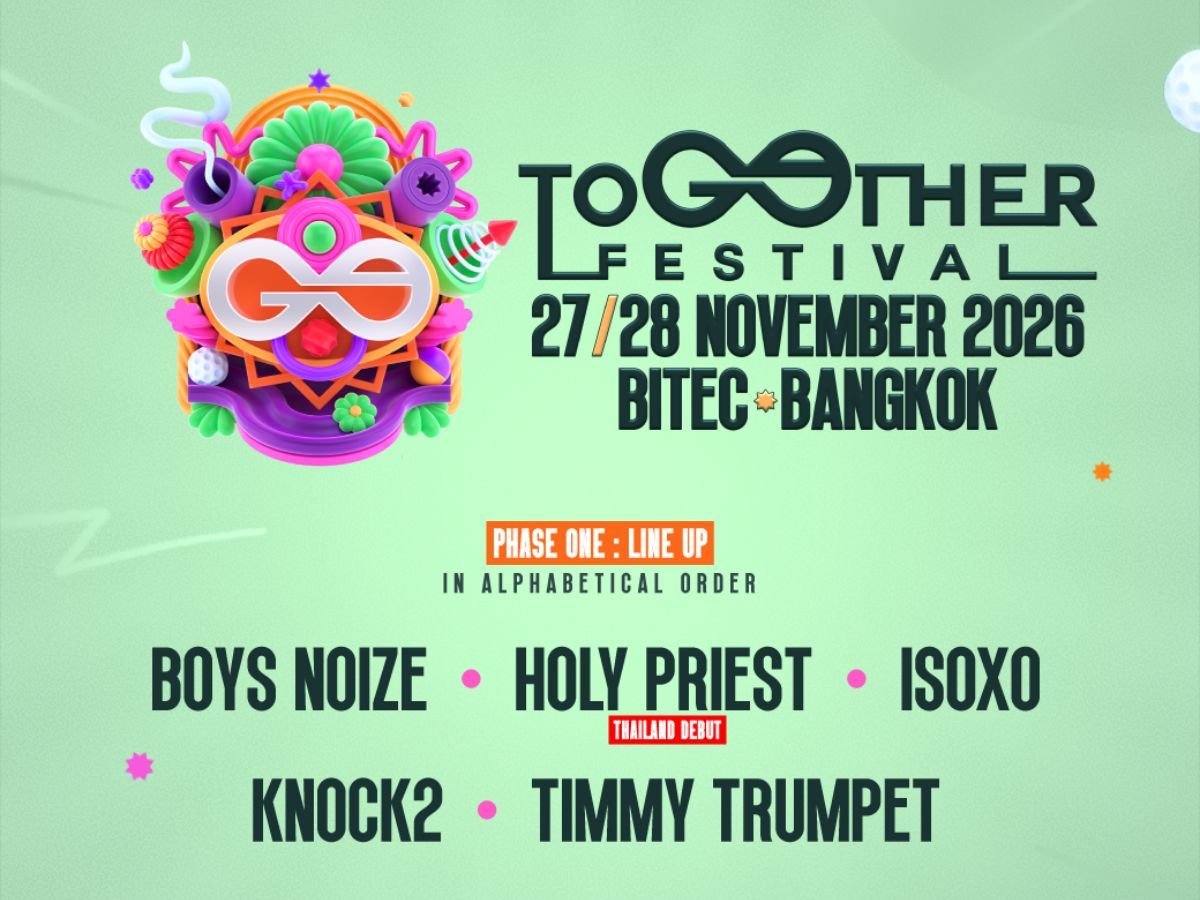
Cavernous convention halls built for trade expos along Bang Na-Trat Road were never designed to hold the punishing resonance of sub-bass. Industrial concrete floors, soaring steel girders and endless perimeter drywall at BITEC Bangkok generally serve corporate logistics, consumer trade delegations and regional enterprise gatherings. On November 27 to 28, 2026, however, five international headline acts take over that exact footprint for Together Festival 2026. The bill gathers Berlin-based producer Boys Noize alongside Holy Priest, ISOxo, KNOCK2 and Australian DJ Timmy Trumpet, spanning hard techno, trap, electro and EDM.
Nightlife in the Thai capital long evolved through dense urban pockets where small rooms dictated the musical tempo. Intimate spaces naturally accommodated subtle track selections and immediate peer interactions. When large-scale entertainment promoters redirect hundreds of thousands of watts into suburban exhibition centres, the fundamental relationship between audience, subculture and architectural space undergoes an awkward recalibration. Sound design ceases to be an organic accompaniment to urban density; instead, it becomes an engineered mass exercise housed inside an edge-city hangar.
Shifting Cadences
Commercial scale forces strange sonic alliances. The initial roster for Together Festival 2026 gathers aesthetics that historically occupied opposite poles of dance culture. Boys Noize brings an underground electro legacy and his collaborative pedigree through DOG BLOOD with Skrillex, while Holy Priest arrives under a mask to make a Thailand debut anchored in relentless hard techno. Alongside them, the brassy festival routines of Timmy Trumpet meet the contemporary American trap-and-bass hybridity championed by ISOxo and KNOCK2.
Such eclectic programming reveals how regional event operators construct commercial viability. Rather than catering to a singular, cohesive subculture, festival programmers assemble disconnected global niches onto one bill to guarantee massive turnout. The approach reflects broader shifts across metropolitan Asia, where younger ticket buyers consume club music through algorithmic playlists rather than localized subcultural affiliations. Hard techno and arena EDM share equal space on corporate timetables because both deliver sensory overload tailored for cavernous venues.
Skeptics may counter that moving club genres into vast convention complexes democratizes access. Large venues provide superior transportation links, formal crowd management and air conditioning that smaller urban venues cannot match. Exposure to idiosyncratic producers like Boys Noize inside an arena setting can also introduce younger listeners to alternative electronic sounds that might otherwise remain confined to distant underground scenes in Europe.
Spatial Disconnect
Yet that institutional hospitality comes at an artistic cost. Music born in unpolished basements or specialized clubs loses its contextual tension when transferred into an exhibition compound designed to host machinery expos and consumer fairs. Subcultural identity thins out when every performance must fill identical rectangular floor plates under industrial sodium fixtures.
The economics of these gatherings also favour international names over local scenes. Major commercial resources flow toward flying in five overseas headliners, cementing Bangkok as an import hub for global talent rather than an exporter of regional sound. Audiences pay steep admission fees to experience foreign acts within a sanitized, highly regulated corporate perimeter, far removed from the city's self-organized cultural initiatives.
That tension sits unresolved at the venue gates. When BITEC Bangkok powers down its sound systems late in November 2026, the exhibition halls will promptly revert to standard trade functions. The bass lines will dissipate into suburban concrete, leaving behind an open question about whether Thailand's metropolitan youth culture is genuinely establishing a permanent creative home or merely renting temporary floor space inside commercial logistics parks.
Sources
Newsletter
Pacific Daily
A curated briefing from Thailand, Asia-Pacific and the world.