The Solitary Departure from Saint-Malo and the Illusions of Offshore Speed
Boris Herrmann embarks on the Route du Rhum toward Guadeloupe, exposing how elite oceanic passage strips travel down to bare endurance
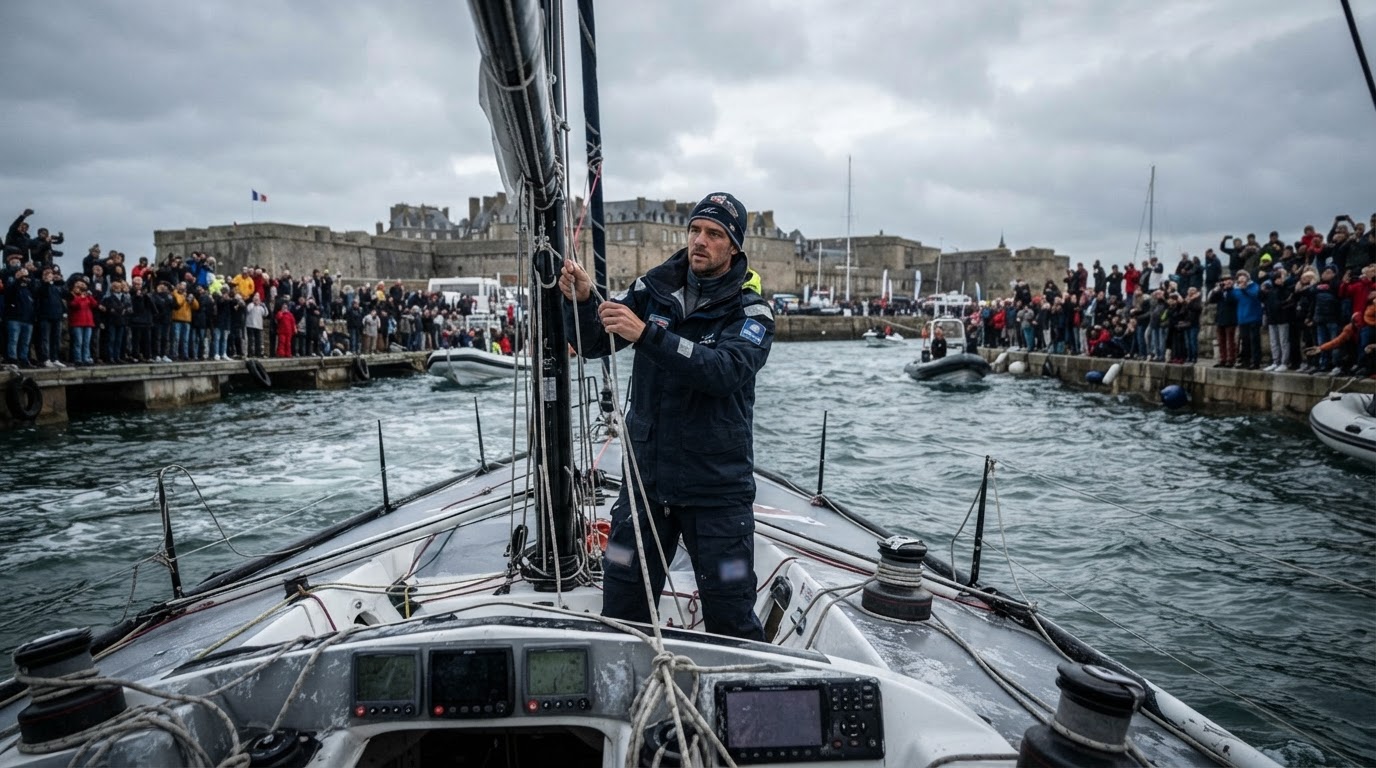
The granite perimeter of Saint-Malo offers an orderly threshold when offshore hulls meet open saltwater under clear skies and gentle breezes. On the surface, the start of an oceanic passage appears as an exercise in measured composure, where composite structures glide outward along coastal waters without visible friction. Stone ramparts recede into a pale horizon as spectators watch from the shorelines. Open water seems entirely benign. Shoreline landmarks slip quietly into the wake.
Yet every departure of this scale demands an immediate physical recalibration from those aboard. When Team Malizia skipper Boris Herrmann secured a clean start in the 13th Route du Rhum - Destination Guadeloupe under sunny skies and light winds, the mild conditions presented an inevitable contrast with the coming crossing. Projections estimate that the IMOCA fleet will require around 10-12 days to reach Pointe-à-Pitre. That timeframe indicates a notable compression of distance, but analytical observation suggests speed across open water rarely corresponds to ease. Solo competitive routing strips passage of ordinary shelter, turning long transit into an unrelenting physical vigil.
The Geography of Solitude
Modern long-distance travel typically functions by insulating passengers from external geography. Commercial air corridors and maritime cruise tracks carry travelers in climate-controlled suspension, detached from ocean temperature, deep currents and atmospheric turbulence. Most travelers experience distance as an abstraction measured in boarding passes and scheduled hours. The solo mariner experiences precisely the opposite reality. Reaching Pointe-à-Pitre requires immediate accommodation of wave geometry, mechanical fatigue and fluctuating wind fields.
Advances in high-performance monohull engineering have steadily shortened crossing projections between distant ports. Observers often view these racing machines primarily as technical displays, separate from the broader history of maritime exposure. That technical sophistication, however, arguably intensifies human strain rather than diminishing it. Confined inside carbon fiber hulls navigating heavy chop, solo sailors operate in near-continuous noise, sleeping in brief cycles while assessing telemetry. The craft does not eliminate oceanic volatility; it merely forces human reaction times into narrower operational margins.
The craft does not eliminate oceanic volatility; it merely forces human reaction times into narrower operational margins.
This gap between structural mastery and elemental vulnerability applies across long-distance maritime corridors. Across distant island archipelagos and high-volume littoral channels, offshore navigation still requires continuous vigilance from anyone attempting open-water transit. While mainland terminals treat mobility as an automated convenience, open water imposes uncompromising physical demands. Safety continues to rest on structural integrity and sustained operational attention. Equipment may evolve, but the marine environment yields nothing to convenience.
Arrival on Oceanic Terms
Reaching an island anchorage after an extended passage fundamentally alters the nature of arrival. For the IMOCA fleet tracking toward Pointe-à-Pitre, landfall is not simply a scheduled finish line. It represents eventual release from hull vibration and the unbroken attention required to manage a solo racing boat under sail. The land asks the mariner to step away from heightened vigilance and adapt to stillness.
When the passage from Saint-Malo concludes, the official record will document elapsed times, tactical choices and technical damage across the fleet. Those figures will quantify competitive performance, but they reflect only the surface of the undertaking. Inferences drawn from solo navigation suggest that modern routing systems never fully command ocean weather. The water Herrmann now traverses answers to its own dynamics, indifferent to the preparation of Team Malizia or the timetable calculated for Guadeloupe. A vessel departs Saint-Malo under clear light and planned navigation, yet it completes its transit only by accommodating the terms set by the sea.
Sources
Newsletter
Pacific Daily
A curated briefing from Thailand, Asia-Pacific and the world.