The Paved Promenade and the Private Fairway
Puerto Vallarta's seasonal launch juxtaposes public civic traditions with closed corporate tourism circuits
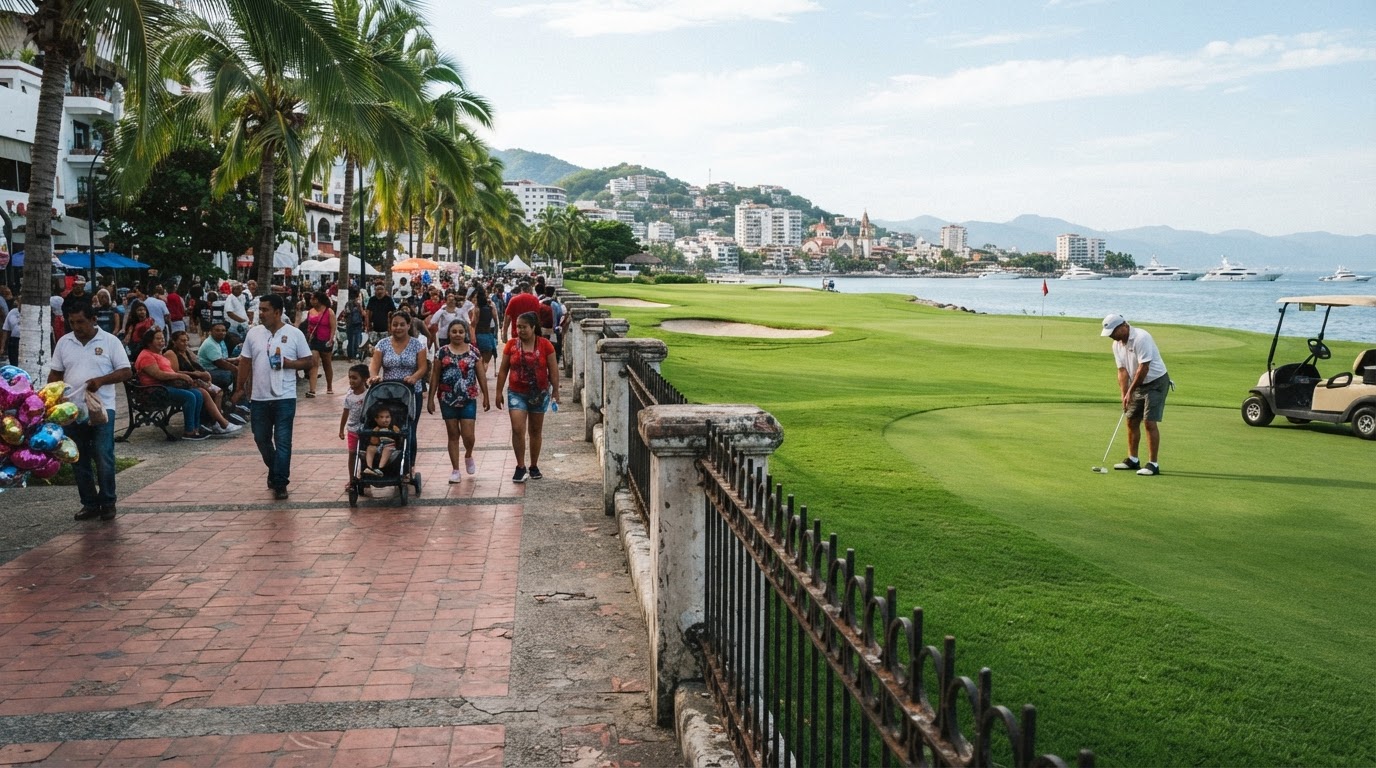
Fresh municipal improvements along Avenida México on the Malecón mark the onset of Puerto Vallarta's high season, preparing the waterfront for visitors arriving from the north. Stalls for weekly tianguis open to sell regional crafts, while civic plazas near Los Arcos and the Plaza de Armas ready themselves for public gatherings. Overhead, municipal preparations culminate in the installation of the monumental Catrina for Día de Muertos, an observance dedicated to departed souls. On the surface, the seaside strip remains a communal gathering ground, anchoring local pedestrian routines alongside the formal opening of the winter visitor calendar.
Beneath this civic pageantry, however, lies an unmistakable economic evolution. The winter cycle no longer depends solely on traditional seaside promenade strolls or neighbourhood markets. Planning priorities across the resort corridor reflect an increasing tilt toward high-profile global commercial circuits. Alongside community observances, the regional calendar features the HEAT Latin Music Awards and a Professional Golf Association tournament staged at VidantaWorld, one of only two PGA Tour events held annually in Mexico.
Two Conceptions of Coastal Space
This dual itinerary reveals an underlying spatial friction between public gathering and corporate spectacle. Along the Malecón, cultural observance is inherently civic, accessible to any resident or traveler walking the bay. The tianguis operate through direct, local exchange in shared spaces that families navigate throughout the year. Even the monumental Catrina, built to command attention across the waterfront, functions within an open civic square where collective memory remains physically accessible to the public.
Across the corridor at VidantaWorld, the Professional Golf Association tournament introduces a divergent logic of coastal land use. Enclosed fairways and ticketed gates insulate international athletic competition from the surrounding urban fabric. Such corporate sporting fixtures, coupled with televised ceremonies like the HEAT Latin Music Awards, create self-contained economic circuits that generate visibility for global sponsors while concentrating consumer spending within private commercial properties. While municipal resources maintain public thoroughfares like Avenida México, the highest-yield commercial assets remain separated behind resort gates.
Development strategists often defend this division by pointing to regional exposure and economic spillover. In this view, staging an elite PGA tournament or broadcasting international music awards generates broadcast reach that local cultural traditions cannot match. Such spectacles, the argument suggests, support baseline occupancy for hotels, sustain broader restaurant trade, and indirectly channel purchasing power toward street vendors and artisan tianguis.
The Enclosure of Coastal Leisure
Yet that economic rationale leaves open questions about the allocation of public resources. When infrastructure priorities emphasise shoreline facelifts on tourist avenues over long-standing civic needs elsewhere, public investment serves external visitation first and permanent residency second. Cultural traditions like Día de Muertos risk being evaluated by commercial planners primarily as visual assets, decorative bookends to broadcasted galas and televised sports.
These spatial patterns resonate well beyond western Mexico, mirroring challenges faced across tourism corridors throughout the Pacific Rim. From Southeast Asian island resorts to coastal enclaves in East Asia, municipal authorities frequently attempt to balance public heritage against private luxury enclaves that enclose coastal territory. When civic traditions share calendar space with international entertainment franchises, the open commons risks functioning merely as an ambient prelude to private consumption.
As seasonal crowds move along Avenida México, the freshly paved promenade will accommodate thousands of daily pedestrians beneath the gaze of the monumental Catrina. The central unresolved tension is whether coastal municipalities can sustain their civic commons as living social spaces, or whether public life will gradually be treated as background scenery for exclusive international circuits.
Sources
Newsletter
Pacific Daily
A curated briefing from Thailand, Asia-Pacific and the world.