The Filtered Corridor and the Pavement Below
Haze along Orchard Road exposes the economic divide between air-conditioned interiors and the labourers required to remain outside
SINGAPORE
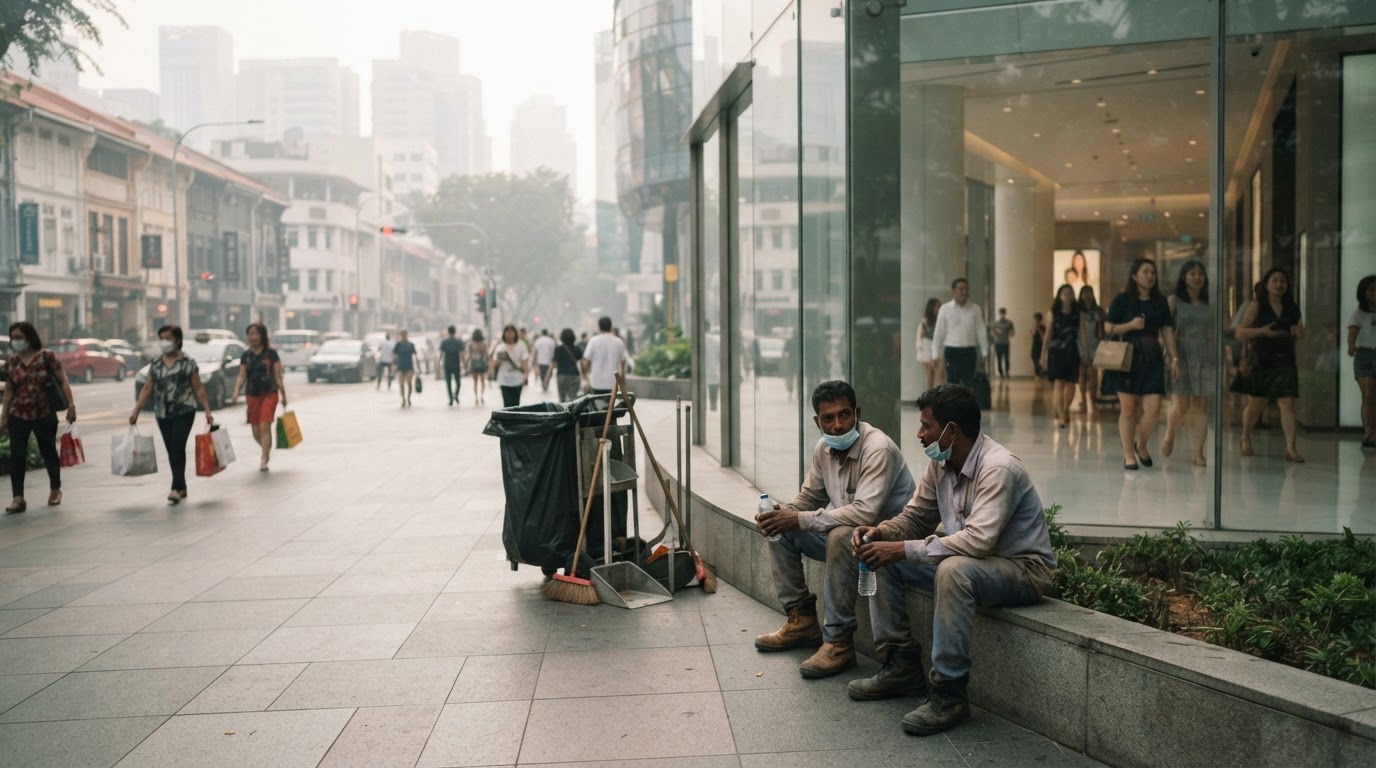
Orchard Road on Oct 12, 2026, presented a study in layered atmosphere. Behind vast panes of commercial plate glass, climate-controlled retail halls offered refrigerated air, gentle lighting, and uninterrupted sanctuary. Outside, a dense regional haze hung over the tarmac, dulling the clean architectural angles and blurring the skyline. The retail avenue functions on an assumption of frictionless ease, welcoming consumers into temperature-managed interiors while relying constantly on the labour taking place beneath the grey sky.
Cities constructed around high standards of urban management project an image of complete environmental control. Trees stand meticulously aligned along pedestrian routes, public transport runs with measured regularity, and commercial towers maintain internal climates separated entirely from tropical humidity. Yet the haze introduces a seasonal vulnerability that municipal engineering cannot entirely seal away. When atmospheric particulate blankets the island, the outdoor space shifts from an engineered amenity into an occupational hazard.
Protecting the outdoor workforce from that dirty air proves easier said than done. Olivia Jensen of NUS’ Institute for the Public Understanding of Risk identified the fundamental friction: financial pressures make reducing haze exposure difficult for Singapore's outdoor workers. The urban machinery requires bodies on the ground to move cargo, direct transport, sweep walkways, and maintain sites. For these workers, retreating behind insulated glass doors is not merely an operational inconvenience. It is an economic impossibility.
The Cost of Seeking Shelter
When clean air becomes tied to enclosed architecture, shelter itself acquires an economic threshold. Office employees, consumers, and tourists experience severe air pollution as a visual background, an inconvenience negotiated between underground transit links and connected retail basements. For outdoor labourers, however, every hour spent outside represents an exposure mandated by wage structures and immediate project timelines.
Halting physical operations carries immediate financial penalties. Contractors face project delays, delivery deadlines falter, and low-wage daily earners risk lost income whenever outdoor hours are curtailed. Economic necessity thus enforces continuous presence on the pavement, regardless of the particulate density reported by monitoring stations.
Similar pressures appear across regional centres facing environmental extremes. In India, informal workers struggle when intense heatwaves make outdoor physical effort dangerous, prompting trials with protective insurance schemes because taking shelter means sacrificing daily wages. Policy gaps in Vietnam have likewise left outdoor workers exposed during prolonged heatwaves, illustrating how the dilemma extends across developing and industrialised economies alike. The common factor is not meteorological unpredictability, but the financial structure that punishes stillness.
Exposure as an Economic Mandate
Administrative recommendations often suggest that employers reschedule demanding tasks, introduce rotational shifts, or provide protective equipment. Such measures assume that work schedules possess infinite flexibility. In practice, logistical supply chains run on fixed arrival windows, and urban maintenance operates on unforgiving cycles.
Financial pressures make reducing haze exposure difficult for Singapore's outdoor workers, says Olivia Jensen of NUS’ Institute for the Public Understanding of Risk.
That dynamic creates a quiet civic contradiction. The contemporary metropolis asks its outdoor workforce to maintain the polished exterior that attracts international commerce, yet leaves those same workers vulnerable when the regional climate turns sour. The physical boundary between the street and the shopping atrium becomes a socio-economic frontier. Step inside, and air filtration eliminates the haze; stay on the pavement, and the body must absorb the smoke.
Orchard Road will repeatedly see its commercial corridors illuminated against grey skies. Shoppers will browse insulated galleries, glancing momentarily through plate glass at the obscured avenue. Down on the street, the work will proceed, driven by the persistent reality that clean air remains an architectural privilege.
Sources
Newsletter
Pacific Daily
A curated briefing from Thailand, Asia-Pacific and the world.