The Ecological Vulnerability of Early Human Memory
Wildfire damage to prehistoric rock art in Sulawesi exposes the structural limits of territorial conservation against transboundary environmental shocks.
SINGAPORE
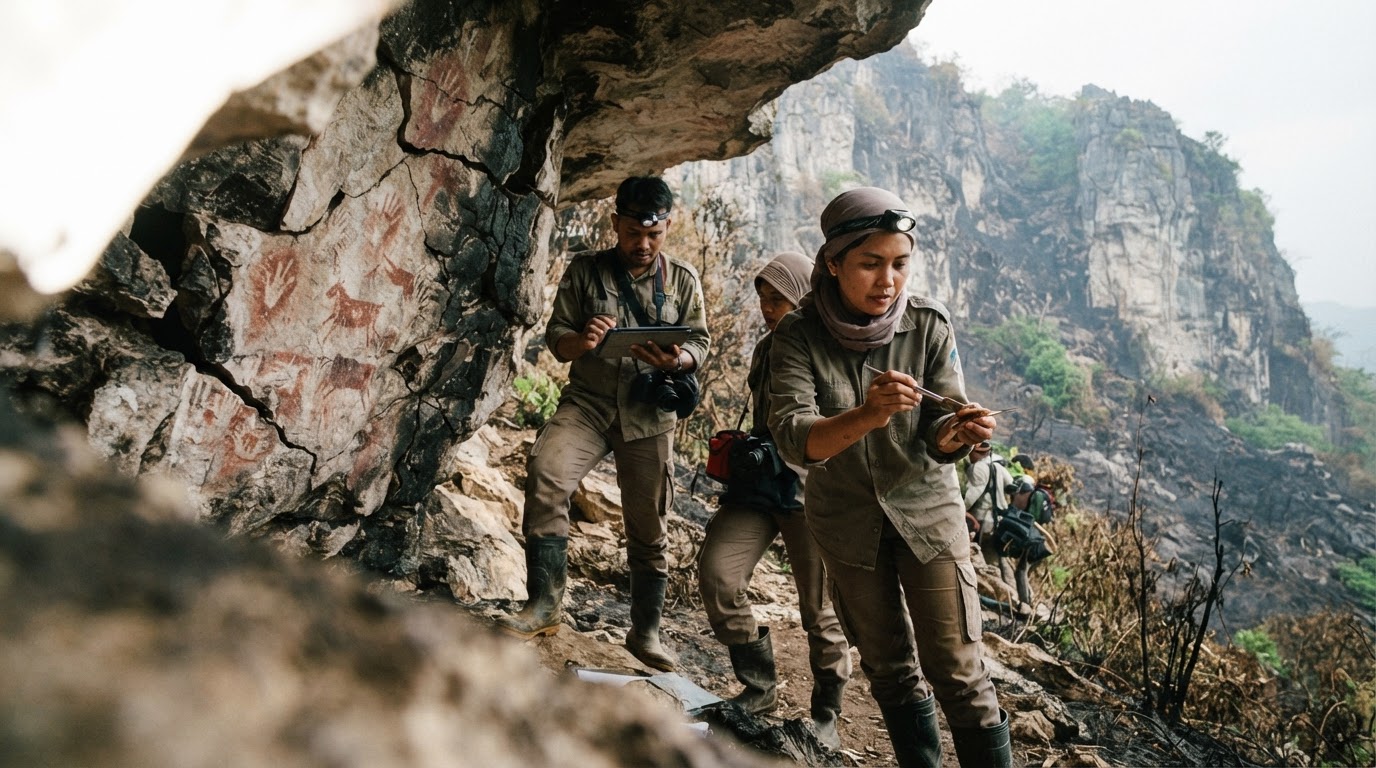
In South Sulawesi's Maros-Pangkep, an artwork depicting human-like figures interacting with a pig was dated by researchers from Australia's Griffith University to be at least 51,200 years old. That scientific finding, confirmed alongside surrounding panels and hand stencils dated to more than 67,000 years old, situated the Indonesian archipelago at the very origin of earliest figurative visual culture. For decades, conventional conservation practice treated limestone caves as durable geographic vaults, protected from external weather by heavy karst formations. That operational assumption collapsed in Oct 2026. Researchers reported that heat and particulate smoke from Indonesia's worst wildfires in more than a decade are accelerating the deterioration of these ancient surfaces, demonstrating that static spatial boundaries offer no defense against widespread atmospheric degradation.
Regional heritage governance has historically relied on physical exclusion to safeguard cultural assets. Administrative bodies, including Indonesia's National Research and Innovation Agency, routinely map cave openings, post perimeter guards, and restrict human foot traffic, proceeding on the calculation that direct human vandalism represents the primary danger to mineral pigments. Such methods prevented localized quarrying and direct defacement around Maros-Pangkep. They offer negligible utility, however, when regional forest fires saturate entire provincial air basins with thermal updrafts and dense carbon soot. While prehistoric art sites span Sulawesi, Sumatra, and Borneo, administrative protections remain strictly localized, leaving fragile cavern systems vulnerable to external shocks that park wardens possess neither the equipment nor the jurisdiction to control.
Karst Microclimates and Atmospheric Strain
Karst geology functions as a porous environmental conduit rather than a sealed repository. Ambient air, temperature differentials, and airborne ash penetrate natural fissures, disrupting the delicate moisture balance necessary to keep ancient mineral binders attached to stone. Observers skeptical of state intervention contend that these depictions have survived more than 51,200 years of environmental fluctuations, enduring past drought cycles without disintegrating. That appraisal, however, infers durability under natural conditions while underestimating the cumulative strain of modern anthropogenic burning. Sustained smoke exposure drives chemical salt crystallization and rapid exfoliation, stripping painted limestone far more rapidly than baseline weather cycles.
Atmospheric disruption across archipelagic landscapes converts localized cave preservation into an unmanageable crisis of fire suppression and forestry regulation.
Such atmospheric contamination shifts heritage protection from an academic curatorial issue into an unresolved problem of state resource governance. Indonesia has grappled with intense seasonal fire cycles before, notably during the severe El Nino conditions recorded in 2015. Yet fire management strategies and prehistoric preservation operate under entirely separate administrative silos. When emergency fire suppression fails across outer island timber concessions, the resulting airborne pollutants irrevocably erode cultural materials that cannot be restored once lost.
Institutional Disconnect and Regulatory Gaps
Institutional fragmentation, rather than technical ignorance, explains why these subterranean sites remain exposed. Advanced laboratory dating developed with Australia's Griffith University proved the antiquity of Maros-Pangkep, elevating the site within world archaeological history. Yet analytical sophistication has not yielded defensive capability. Heritage authorities monitor spalling limestone, but statutory authority over agricultural burning and commercial concession clearing sits within industrial and forestry ministries that evaluate fire damage exclusively in burned acreage rather than damaged Pleistocene art.
Preserving subterranean panels cannot succeed through chemical sealants if surrounding districts burn uncontrolled. The painted limestone of Sulawesi remains tied to the air of the archipelago, bounded by the unresolved tension between land-clearing practices and heritage preservation.
Sources
Newsletter
Pacific Daily
A curated briefing from Thailand, Asia-Pacific and the world.