Index Downgrades Price Out Indonesian Equities Before Capital Can Adapt
Prabowo Subianto frames MSCI's standalone market warning as external coercion, but benchmark mandates reallocate capital on cold balance sheet rules.
SINGAPORE
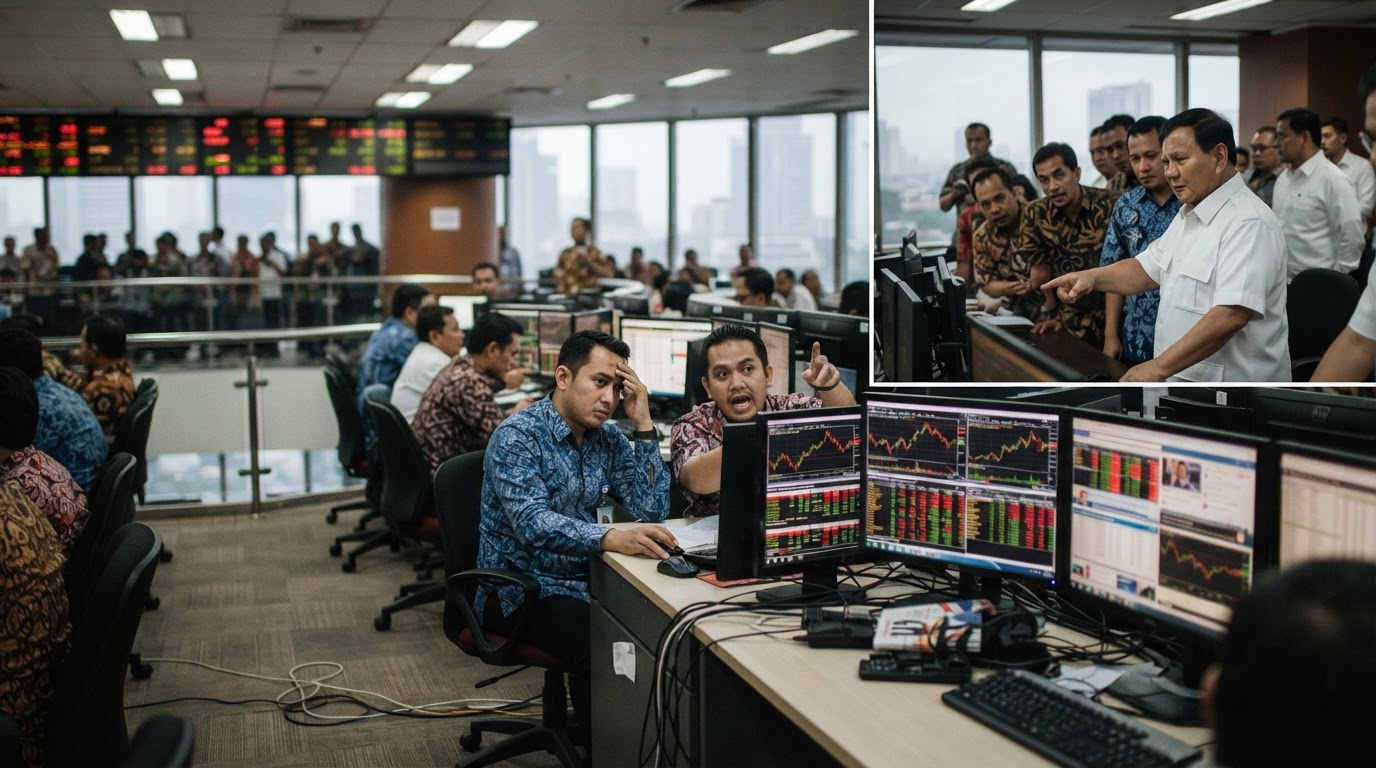
Capital flight ignores political posturing. Global index provider MSCI warned last week that it was considering demoting Indonesia's equities to standalone market status, triggering a record-breaking market rout across domestic exchanges. Indonesian President Prabowo Subianto met the drop with defiance before his Cabinet on Wednesday, insisting the sovereign state would not be frightened by institutional pressure. The clash exposes an unyielding balance-sheet reality: sovereign leadership can dismiss institutional criticism, but it cannot compel foreign portfolio capital to remain in an asset class its mandates prohibit.
Benchmark providers govern portfolio allocations through rigid mechanical thresholds rather than diplomatic protocols. When index managers signal that an emerging market risks demotion to standalone status, passive funds and benchmark-tracking institutions face immediate legal instructions to trim holdings. Foreign capital reallocates long before any formal downgrade concludes. Listed equities bear the immediate cost through compressed pricing, leaving domestic companies stranded without the cross-border equity demand that underpins expansion and debt refinancing.
Mandate Mechanics Dictate Who Gets Priced Out
President Prabowo Subianto framed the warning as external interference during his address to the Cabinet. His administration argued that sovereign policy must not bend to corporate demands from overseas rating entities.
The MSCI... intended to intimidate us,
Trading desks do not trade on sovereign sentiment. Fund custodians must abide by investment mandates that penalize unclassified or standalone assets. If Indonesia drops out of standard emerging market indices, index-tracking exchange-traded funds and cross-border pension pools are legally barred from maintaining their positions. Listed private enterprises face the sharpest discount. Deprived of foreign capital, domestic firms find themselves priced out of competitive international equity financing, forced instead to rely on higher-yielding local borrowing or depleted onshore liquidity.
Surrounding Asian equity destinations absorb what Jakarta stands to surrender. Asset allocators facing benchmark constraints do not leave cash idle; they redirect passive flows to peer bourses across the Asia-Pacific that satisfy operational governance metrics. Regional bourses gain direct equity inflows at Jakarta's expense. Corporate borrowers in Indonesia must then confront higher capital expenses, while regional competitors enjoy lower debt-servicing hurdles supported by redirected foreign money.
The Lingering Asset Valuation Squeeze
Standalone status exacts a tangible toll on asset valuations across the domestic real economy. Companies seeking public capital or commercial real estate balance sheets dependent on sustained liquidity will see multiple compressions. Domestic retail accounts and state institutions are left to absorb the discounted paper left behind as institutional foreign capital departs for major markets such as the United States.
Local balance sheets cannot substitute for the sheer scale of global index liquidity. When index providers flag liquidity, currency convertibility, or operational concerns, capital simply moves along the path of least resistance. The immediate casualties are domestic corporate balance sheets that need affordable capital to service debt and finance construction.
Sovereign defiance cannot bridge the spread between institutional requirements and political resistance. Strong rhetoric inside the Cabinet room may play well to domestic audiences, but international capital allocators answer exclusively to compliance mandates. Jakarta now faces an unresolved structural constraint: address the benchmark provider's market accessibility criteria directly, or watch institutional capital permanently discount domestic equities.
Sources
Newsletter
Pacific Daily
A curated briefing from Thailand, Asia-Pacific and the world.